Ditapis dengan

America at the crossroads: Democracy, power, and the neoconservative legacy
Francis Fukuyama’s criticism of the Iraq war put him at odds with neoconservative friends both within and outside the Bush administration. Here he explains how, in its decision to invade Iraq, the Bush administration failed in its stewardship of American foreign policy. First, the administration wrongly made preventive war the central tenet of its foreign policy. In addition, it badly misjudg…
- Edisi
- -
- ISBN/ISSN
- 978-0-300-11399-0
- Deskripsi Fisik
- xiv, 226 pages : index ; 21 cm
- Judul Seri
- -
- No. Panggil
- 327.73 Fuk a

America's secret war: Inside the hidden worldwide struggle between America an…
"In America's Secret War, George Friedman identifies the United States' most dangerous enemies, delves into presidential strategies of the last quarter century, and reveals the real reasons behind the attack of 9/11- and the Bush administration's motivation for the war in Iraq. It describes in detail America's covert and overt efforts in the global war against terrorism: not only are U.S. armie…
- Edisi
- 1st ed.
- ISBN/ISSN
- 0-385-51245-7
- Deskripsi Fisik
- xii, 354 pages : maps : index ; 25 cm.
- Judul Seri
- -
- No. Panggil
- 327.73 Fri a

A tangled web: The making of foreign policy in the Nixon Presidency
Richard Nixon's accomplishments in foreign affairs have long been cited as enduring successes: during his Administration the United States reestablished ties with China, initiated detente with the U.S.S.R., and ended American participation in the Vietnam War. A Tangled Web challenges these views and stands on its own as the first fully authoritative account of the Nixon-Kissinger record in its …
- Edisi
- First Edition
- ISBN/ISSN
- 0-8090-9151-8
- Deskripsi Fisik
- xix, 647 pages : Illustrations : bibl: hlm 608-620 : index ; 24 cm.
- Judul Seri
- -
- No. Panggil
- 327.73 Bun t

The grand chessboard: American primacy and its geostrategic imperatives
The heart of The Grand Chessboard is Brzezinski's analysis of the four critical regions of Eurasia and of the stakes for America in each arena - Europe, Russia, Central Asia, and East Asia. The crucial fault lines may seem familiar, but the implosion of the Soviet Union has created new rivalries and new relationships, and Brzezinski maps out the strategic ramifications of the new geopolitical r…
- Edisi
- -
- ISBN/ISSN
- 0-465-02726-1
- Deskripsi Fisik
- xiv, 223 pages : maps : index ; 25 cm.
- Judul Seri
- -
- No. Panggil
- 327.73 Brz t
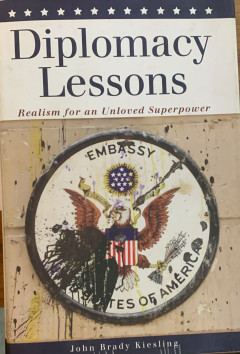
Diplomacy lessons: Realism for an unloved superpower
In Diplomacy Lessons, Kiesling reminds readers that U.S. power does not rest on military might alone and that anger at America has real consequences for U.S. national interests. The security and prosperity of the American people depend on efficient cooperation with foreigners on a range of issues, not only terrorism and nuclear nonproliferation but also trade policy, environmental protection, a…
- Edisi
- Ed. 1
- ISBN/ISSN
- 978-1-59797-017-4
- Deskripsi Fisik
- ix, 317 pages : index ; 23 cm
- Judul Seri
- -
- No. Panggil
- 327.73 Bra d

How America got it right: The U.S. march to military and political supremacy
As the world's dominant political force and military power, he says, we are the only nation that will actually go into the world and strike down evil. And we must not shirk that responsibility - especially because we cannot rely on our so-called allies to defend our freedoms. Alexander tells the dramatic and sometimes surprising story of how, from the American Revolution to the War on Terror, A…
- Edisi
- -
- ISBN/ISSN
- 1-4000-5288-2
- Deskripsi Fisik
- viii, 309 pages : bibl: hlm 293-296 : index ; 25 cm
- Judul Seri
- -
- No. Panggil
- 327.73 Ale h

The Canadian way: Shaping Canada's foreign policy, 1968-1984
The Canadian Way - which reflects the experiences and perspectives of both authors - provides a fascinating insider's view of an important period in the development of Canada's foreign policy.
- Edisi
- -
- ISBN/ISSN
- 0-7710-4099-7
- Deskripsi Fisik
- xi, 361 pages : index ; 25 cm
- Judul Seri
- -
- No. Panggil
- 327.71009045 Hea c

Nigeria and its immediate neighbours: Constraints and prospects of sub-region…
This book focuses on the security implications for Nigeria of its relationships with its five immediate neighbours namely, Cameroun, Benin, Niger, Chad and Equatorial Guinea in the 1990s.
- Edisi
- First Published
- ISBN/ISSN
- 978-2049-10-7
- Deskripsi Fisik
- xiv, 288 pages : bibl: hlm 264-276 : index ; 25 cm
- Judul Seri
- -
- No. Panggil
- 327.669 Ate n
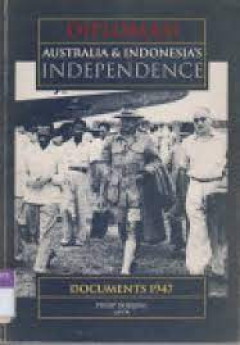
Diplomasi : Australia & Indonesia's independence
This is the first of three volumes of documents on Australian policy toward Indonesia if the years 1947-49.498 cablegrams, dispatches and other documents tell the story of Australian diplomacy in 1947, revealing for the first time the full extent and depth of Australia's support for the embattled Indonesian Republic.
- Edisi
- first volume
- ISBN/ISSN
- 0644332492
- Deskripsi Fisik
- xxii, 545 pages : illustrations : index ; 25 cm
- Judul Seri
- -
- No. Panggil
- 327.59894 Dor d

The Sijori cross-border region: Transnational politics, economics, and culture
Twenty-five years ago, the governments of Singapore, Malaysia, and Indonesia agreed to jointly promote the city-state, the state of Johor in Malaysia, and the Riau Islands in Indonesia. Facilitated by common cultural references, a more distant shared history, and complementary attributes, interactions between the three territories developed quickly. Logistics networks have proliferated and prod…
- Edisi
- -
- ISBN/ISSN
- 978-981-4695-58-9
- Deskripsi Fisik
- xxvii, 481 pages : illustrations : index ; 25 cm
- Judul Seri
- -
- No. Panggil
- 327.5980595 Hut s
 Karya Umum
 Filsafat
 Agama
 Ilmu-ilmu Sosial
 Bahasa
 Ilmu-ilmu Murni
 Ilmu-ilmu Terapan
 Kesenian, Hiburan, dan Olahraga
 Kesusastraan
 Geografi dan Sejarah