Ditapis dengan
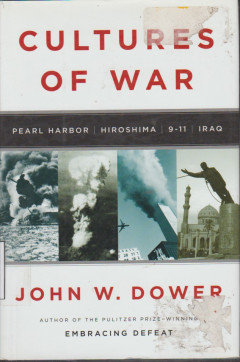
Cultures of war: Pearl Harbor / Hiroshima / 9-11 / Iraq
Cultures of War explores how nations justify, experience, and remember war through four pivotal events: the attack on Pearl Harbor, the bombing of Hiroshima, the September 11 attacks, and the 2003 invasion of Iraq. John W. Dower examines recurring patterns in U.S. strategic thinking, political rhetoric, and cultural responses to conflict. Through comparative historical analysis, Dower reveals h…
- Edisi
- -
- ISBN/ISSN
- 978-0-393-06150-5
- Deskripsi Fisik
- xxxvii, 396 pages : illustration ; 24,5 cm
- Judul Seri
- -
- No. Panggil
- 355.00973 DOW c

War and decision: Inside the pentagon at the dawn of the war on terrorism
This book is a firsthand account of Douglas J. Feith, U.S. Under Secretary of Defense for Policy during President George W. Bush's early term after the September 11, 2001, attacks. In War and Decision, Feith details the Pentagon's decision-making process, the internal dynamics of the U.S. government, and the strategies that shaped the global war on terrorism. The book provides in-depth insights…
- Edisi
- -
- ISBN/ISSN
- 978-0-06-089973-8
- Deskripsi Fisik
- xiv, 674 pages : illustration ; 23,5 cm
- Judul Seri
- -
- No. Panggil
- 355.0217 FEI w

America at the crossroads: Democracy, power, and the neoconservative legacy
Francis Fukuyama’s criticism of the Iraq war put him at odds with neoconservative friends both within and outside the Bush administration. Here he explains how, in its decision to invade Iraq, the Bush administration failed in its stewardship of American foreign policy. First, the administration wrongly made preventive war the central tenet of its foreign policy. In addition, it badly misjudg…
- Edisi
- -
- ISBN/ISSN
- 978-0-300-11399-0
- Deskripsi Fisik
- xiv, 226 pages : index ; 21 cm
- Judul Seri
- -
- No. Panggil
- 327.73 Fuk a

How America got it right: The U.S. march to military and political supremacy
As the world's dominant political force and military power, he says, we are the only nation that will actually go into the world and strike down evil. And we must not shirk that responsibility - especially because we cannot rely on our so-called allies to defend our freedoms. Alexander tells the dramatic and sometimes surprising story of how, from the American Revolution to the War on Terror, A…
- Edisi
- -
- ISBN/ISSN
- 1-4000-5288-2
- Deskripsi Fisik
- viii, 309 pages : bibl: hlm 293-296 : index ; 25 cm
- Judul Seri
- -
- No. Panggil
- 327.73 Ale h
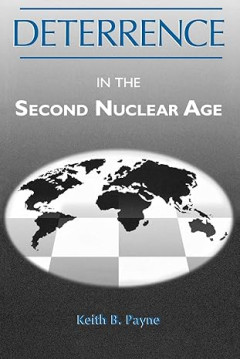
Deterrence in the second nuclear age
Keith Payne begins by asking, "Did we really learn how to deter predictably and reliably during the Cold War?" He answers cautiously in the negative, pointing out that we know only that our policies toward the Soviet Union did not fail. What we can be more certain of, in Payne's view, is that such policies will almost assuredly fail in the Second Nuclear Age―a period in which direct nuclear t…
- Edisi
- -
- ISBN/ISSN
- 0-8131-0895-0
- Deskripsi Fisik
- xiv, 168 pages : index ; 23 cm
- Judul Seri
- -
- No. Panggil
- 327.17 Pay d

Against all enemies: Inside America's war on terror
On the day of the meeting [September 4, 2001], Clarke sent Rice an impassioned personal note. He criticized U.S. counterterrorism efforts past and present. The 'real question' before the principals, he wrote, was 'are we serious about dealing with the al-Qida threat?...Is al-Qida a big deal?...Decision makers should imagine themselves on a future day when the CSG has not succeeded in stopping a…
- Edisi
- -
- ISBN/ISSN
- 0-7432-6024-4
- Deskripsi Fisik
- xiii, 304 pages : index ; 24 cm
- Judul Seri
- -
- No. Panggil
- 303.625 Cla a

Technological change and the future of warfare
In light of the spectacular performance of American high-technology weapons in the 1991 Persian Gulf War, as well as the phenomenal pace of innovation in the modern computer industry, many defense analysts have posited that we are on the threshold of a revolution in military affairs (RMA). The issue has more than semantic importance. Many RMA proponents have begun to argue for major changes in …
- Edisi
- -
- ISBN/ISSN
- 0815764391
- Deskripsi Fisik
- x, 208 pages : illustrations (black and white) ; 23 cm
- Judul Seri
- -
- No. Panggil
- 355.033573 Oha t

The pentagon's new map: War and peace in the twenty-first century
Contents: 1. New rule sets 2. The rise of the "lesser includeds" 3. Disconnectedness defines danger 4. The core and the gap 5. The new ordering principle etc.
- Edisi
- -
- ISBN/ISSN
- 0-399-15175-3
- Deskripsi Fisik
- 435 pages ; 23 cm
- Judul Seri
- -
- No. Panggil
- 355.033 Bar p

Preventive defense: A new security strategy for America
The thoughts we express in this book are informed by our service in the pentagon during the first term of the Clinton administration and with the reflection of a year of distance from the fray.
- Edisi
- -
- ISBN/ISSN
- 0-8157-1308-8
- Deskripsi Fisik
- 243 pages : index ; 25 cm
- Judul Seri
- -
- No. Panggil
- 355.03373 Car p
 Karya Umum
  Filsafat
  Agama
Agama  Ilmu-ilmu Sosial
  Bahasa
  Ilmu-ilmu Murni
  Ilmu-ilmu Terapan
  Kesenian, Hiburan, dan Olahraga
  Kesusastraan
  Geografi dan Sejarah