Ditapis dengan

Soft Power: The means to sucess in world politics
Joseph Nye coined the term "soft power" in the late 1980s. It is now used frequently - and often incorrectly - by political leaders, editorial writers, and academics around the world. So what is soft power? Soft power lies in the ability to attract and persuade. Whereas hard power - the ability to coerce - grows out of a country's military or economic might, soft power arises from the attractiv…
- Edisi
- -
- ISBN/ISSN
- 1586483064
- Deskripsi Fisik
- xvi, 191 pages : illustrations ; 22 cm
- Judul Seri
- -
- No. Panggil
- 327.73 Nye s

The bubble of American supremacy: The costs of Bush' war in Iraq
The author provided a workable, and severely critical, analysis of the Bush administration's overreaching, militaristic foreign policy. Soros believes that this administration's plans abroad come from the same sort of "bubble" psychology that afflicted our markets in the late 1990s. They have used military supremacy to create a deluded worldview, that might makes right and that "you're either w…
- Edisi
- -
- ISBN/ISSN
- 1-58648-292-0
- Deskripsi Fisik
- xiii, 207 pages : index ; 21 cm.
- Judul Seri
- -
- No. Panggil
- 327. 730090511 Sor b

The opportunity: America's moment to alter history's course
America's great military, economic, and political power discourages traditional challenges; no ideological fault line divides the world into warring blocs. India, China, Japan, Russia, and Europe all seek a prolonged period of stability that would support economic growth.The opportunity thus exists for unprecedented cooperation among the major powers. This is good, because they share vulnerabil…
- Edisi
- ed. 1
- ISBN/ISSN
- 978-58648-453-8
- Deskripsi Fisik
- xiv, 254 pages : ilustrations : index ; 19 cm
- Judul Seri
- -
- No. Panggil
- 327.73 Haa o

America at the crossroads: Democracy, power, and the neoconservative legacy
Francis Fukuyama’s criticism of the Iraq war put him at odds with neoconservative friends both within and outside the Bush administration. Here he explains how, in its decision to invade Iraq, the Bush administration failed in its stewardship of American foreign policy. First, the administration wrongly made preventive war the central tenet of its foreign policy. In addition, it badly misjudg…
- Edisi
- -
- ISBN/ISSN
- 978-0-300-11399-0
- Deskripsi Fisik
- xiv, 226 pages : index ; 21 cm
- Judul Seri
- -
- No. Panggil
- 327.73 Fuk a

America's secret war: Inside the hidden worldwide struggle between America an…
"In America's Secret War, George Friedman identifies the United States' most dangerous enemies, delves into presidential strategies of the last quarter century, and reveals the real reasons behind the attack of 9/11- and the Bush administration's motivation for the war in Iraq. It describes in detail America's covert and overt efforts in the global war against terrorism: not only are U.S. armie…
- Edisi
- 1st ed.
- ISBN/ISSN
- 0-385-51245-7
- Deskripsi Fisik
- xii, 354 pages : maps : index ; 25 cm.
- Judul Seri
- -
- No. Panggil
- 327.73 Fri a
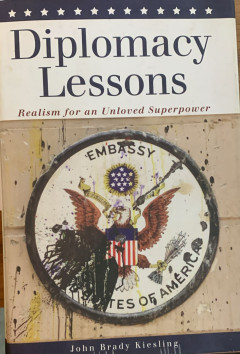
Diplomacy lessons: Realism for an unloved superpower
In Diplomacy Lessons, Kiesling reminds readers that U.S. power does not rest on military might alone and that anger at America has real consequences for U.S. national interests. The security and prosperity of the American people depend on efficient cooperation with foreigners on a range of issues, not only terrorism and nuclear nonproliferation but also trade policy, environmental protection, a…
- Edisi
- Ed. 1
- ISBN/ISSN
- 978-1-59797-017-4
- Deskripsi Fisik
- ix, 317 pages : index ; 23 cm
- Judul Seri
- -
- No. Panggil
- 327.73 Bra d

Soft power : The means to success in world politics
Joseph Nye coined the term "soft power" to describe a nation's ability to attract and persuade. Whereas hard power-the ability to coerce- grows out of a country's military or economic might, soft power arises from the attractiveness of its culture, political ideals, and policies. Hard power remains crucial in a world of states trying to guard their independence and of non-state groups willin…
- Edisi
- -
- ISBN/ISSN
- 1586483064
- Deskripsi Fisik
- 191 pages : 23 cm.
- Judul Seri
- -
- No. Panggil
- 327. 73 Nye s

Rogue nation: American unilateralism and the failure of good intentions
The term "rogue nation," formerly reserved for outlaw countries, is increasingly applied to the United States-not only by enemies but by people and nations who have been steadfast friends. The litany is familiar to anyone who has ever read an op-ed page. In the six months before 9/11, the United States walked away from a treaty to control the world traffic in small arms, the Kyoto accord, a tre…
- Edisi
- -
- ISBN/ISSN
- 0465062792
- Deskripsi Fisik
- 327 pages : illustration ; 27 cm
- Judul Seri
- -
- No. Panggil
- 327. 73 Pre r

The paradox of American power: Why the worlds only superpower can't go it alone
Not since Rome has any nation had so much economic, cultural, and military power, but that power does not allow us to solve global problems like terrorism, environmental degradation, and the proliferation of weapons of mass destruction without involving other nations. The author focuses on the rise of these and other new challenges and explains clearly why America must adopt a more cooperative …
- Edisi
- -
- ISBN/ISSN
- 0195150880
- Deskripsi Fisik
- 222 pages : 25 cm.
- Judul Seri
- -
- No. Panggil
- 327. 73 Nye p
 Karya Umum
  Filsafat
  Agama
Agama  Ilmu-ilmu Sosial
  Bahasa
  Ilmu-ilmu Murni
  Ilmu-ilmu Terapan
  Kesenian, Hiburan, dan Olahraga
  Kesusastraan
  Geografi dan Sejarah