Ditapis dengan

Humanity, terrorism, terrorist war : Palestine, 9/11, Iraq, 7/7...
Contents: 1. Our question 2. A division of labour, philosophy's part 3. Negotiation, international law 4. UN resolution 5. Human rights 6. Just war theory 7. The politics of reality, etc.
- Edisi
- -
- ISBN/ISSN
- 0-8264-9116-2
- Deskripsi Fisik
- vi, 206 pages : index ; 19 cm
- Judul Seri
- -
- No. Panggil
- 303.625 Hon h
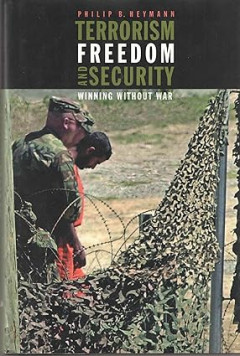
Terrorism, freedom, and security : Winning without war
In Terrorism, Freedom, and Security, Philip Heymann continues the discussion of responses to terrorism that he began in his widely read Terrorism and America. He argues that diplomacy, intelligence, and international law should play a larger role than military action in our counterterrorism policy; instead of waging war against terrorism, the United States needs a broader range of policies. Hey…
- Edisi
- -
- ISBN/ISSN
- 0-262-08327-2
- Deskripsi Fisik
- xiii, 210 pages : index ; 23 cm
- Judul Seri
- -
- No. Panggil
- 303.625 Hey t
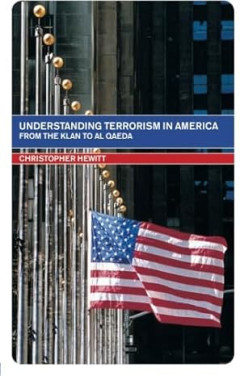
Understanding terrorism in America from the klan to Al Qaeda
Christopher Hewitt's comprehensive book surveys the characteristics and causes of terrorism and governmental responses to it. He also examines the organizational structure of terrorist networks, how they are financed and their ideological agendas. Groups covered include: Islamic fundamentalists, white and black racists, black nationalists, revolutionary communists, neo-Nazis, militant Jewish gr…
- Edisi
- Cet. 1
- ISBN/ISSN
- 0-415-27766-3
- Deskripsi Fisik
- xvii, 154 pages : illustrations (black and white) : bibl: hlm 138-147 : index ; 21 cm
- Judul Seri
- -
- No. Panggil
- 303.625 Hew u

Terror and consent: The wars for the twenty-first century
Almost every widely held idea we have about the war on terror is wrong, Philip Bobbitt argues, and must be rethought. It is not about religion, nationalism or a'clash of civilizations'. Instead, we face the death of the nation-state and the birth of frontierless, globally networked 'states of terror' that seek to undermine an entire culture of political consent. This dramatic and highly acclaim…
- Edisi
- -
- ISBN/ISSN
- 9780141017662
- Deskripsi Fisik
- x, 672 pages : bibl: hlm 647-661 : index ; 19 cm
- Judul Seri
- -
- No. Panggil
- 303.625 Bob t
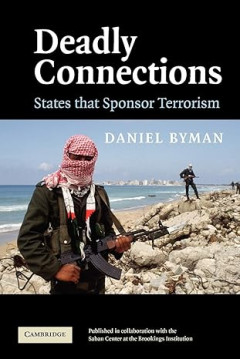
Deadly connections: States that sponsor terrorism
Thousands of people have died at the hands of terrorist groups who rely on state support for their activities. Iran and Syria are well known as sponsors of terrorism, while other countries, some with strong connections to the West, have enabled terrorist activity by turning a blind eye. Daniel Byman's hard-hitting and articulate book analyzes this phenomenon. Focusing primarily on sponsors from…
- Edisi
- -
- ISBN/ISSN
- 0-521-83973-4
- Deskripsi Fisik
- xi, 369 pages : illustrations (black and white) : bibl: hlm 335-357 : index ; 23 cm
- Judul Seri
- -
- No. Panggil
- 303.625 Bym d
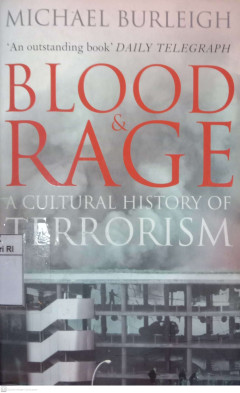
Blood and rage: A cultural history of terrorism
Michael Burleigh lays bare the workings of the terrorist mind and explores the nature of terrorism, from its origins in the West to today's global threat of jihadist violence. This searing analysis focuses on the distorted morality that drives terrorists to organize and operate, revealing who they are and the wider support encouraging them
- Edisi
- -
- ISBN/ISSN
- 978-0-00-724225-2
- Deskripsi Fisik
- xvi, 581 pages : illustration : bibl: hlm 537-549 : index ; 20 cm
- Judul Seri
- -
- No. Panggil
- 303.625 Bur b

The new face of terrorism: Threats from weapons of mass destruction
This revised edition is a comprehensive account of the technological and political possibilities and dangers presented by weapons of mass destruction in the wake of September 11th, 2001. The technical and organizational sophistication of the attacks on September 11th heralds a new era in the age-old war against terrorism. After these attacks, attention became focused on the activities and capac…
- Edisi
- -
- ISBN/ISSN
- 1-86064-825-8
- Deskripsi Fisik
- xii, 312 pages : bibl: hlm 309-312 ; 21 cm
- Judul Seri
- -
- No. Panggil
- 303.625 Gur n
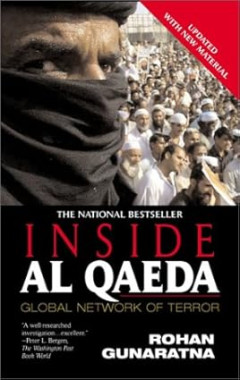
Inside Al Qaeda: Global network of terror
"Inside Al Qaeda examines the leadership, ideology, structure, strategies, and tactics of the most violent politico-religious organization the world has ever seen. Although founded in 1988, Al Qaeda merged with, and still works with, several other extremist groups. Hence Al Qaeda rank and file draw on nearly three decades of terrorist expertise. Moreover, it inherited a full-fledged training an…
- Edisi
- -
- ISBN/ISSN
- 0-425-19114-1
- Deskripsi Fisik
- xlix, 362 Pages : index ; 21 cm
- Judul Seri
- -
- No. Panggil
- 303.625 Gun i

Inside Al Qaeda global network of terror
The book sheds light on Al Qaeda's financial infrastructure and how the organization trains combat soldiers and vanguard fighters for multiple guerrilla, terrorist and semiconventional campaigns in the Middle East, Asia, Africa, the Caucasus and the Balkans. In addition, Rohan Gunaratna investigates the clandestine Al Qaeda operational network in the West.
- Edisi
- First Edition
- ISBN/ISSN
- 81-7436-243-6
- Deskripsi Fisik
- xiii, 271 pages : index ; 21 cm
- Judul Seri
- -
- No. Panggil
- 303.625 Gun i

The Al-Qaeda connection : The Taliban and terror in Pakistan's tribal areas
The face of Terror has changed dramatically. Today major terrorist attacks are marked by their meticulous preparation and deadly execution as the Mumbai attacks of 26/11 have clearly established. The most important planning centre for these operations is the tribal region located on the border between Pakistan and Afghanistan. Following the U.S. action in Afghanistan in December 2001 many Al Qa…
- Edisi
- -
- ISBN/ISSN
- 978-0-670-08292-6
- Deskripsi Fisik
- 308 pages : index ; 22 cm
- Judul Seri
- -
- No. Panggil
- 303.625 Gul a
 Karya Umum
  Filsafat
  Agama
Agama  Ilmu-ilmu Sosial
  Bahasa
  Ilmu-ilmu Murni
  Ilmu-ilmu Terapan
  Kesenian, Hiburan, dan Olahraga
  Kesusastraan
  Geografi dan Sejarah