Ditapis dengan
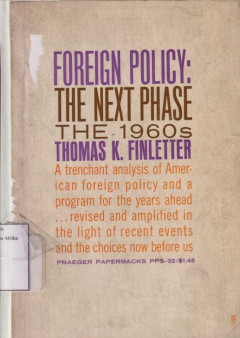
Foreign policy: The Next phase — the 1960s
This book examines the challenges and strategic choices facing United States foreign policy as the nation entered the 1960s. Finletter discusses the political, military, and economic factors shaping America’s role in the postwar world, emphasizing the need for new approaches to emerging Cold War realities. The work analyzes key issues including nuclear strategy, international alliances, and t…
- Edisi
- -
- ISBN/ISSN
- -
- Deskripsi Fisik
- 235 pages ; 20 cm
- Judul Seri
- -
- No. Panggil
- 327.73 FIN f

Revolutionary diplomacy: Chinese foreign policy and the united front doctrine
This study analyzes the development of China’s foreign policy through the framework of the United Front doctrine, a strategy that combines ideological, political, and diplomatic tools to advance national and revolutionary interests. Armstrong examines China’s international behavior from the early years of the Communist movement through the post-1949 period, highlighting the interplay betwee…
- Edisi
- -
- ISBN/ISSN
- 0-520-04273-5
- Deskripsi Fisik
- 251 pages ; 21,5 cm
- Judul Seri
- -
- No. Panggil
- 327.51 ARM r
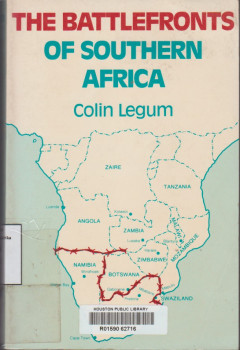
The Battlefronts of Southern Africa
he Battlefronts of Southern Africa by Colin Legum provides a detailed examination of the political and military struggles that shaped Southern Africa during the late twentieth century. Drawing on material previously published in Africa Contemporary Record, the book analyzes regional conflicts, South Africa’s foreign policy under apartheid, and the liberation movements that arose in neighborin…
- Edisi
- -
- ISBN/ISSN
- 0-8419-1135-5
- Deskripsi Fisik
- xxix, 451 pages : illustration ; 23 cm
- Judul Seri
- -
- No. Panggil
- 327.68 LEG b

The United states and world war II
This book provides a comprehensive analysis of the United States' involvement in World War II, exploring political, military, economic, and social dimensions of the conflict. Robert James Maddox examines America's path to war, the strategic decisions that shaped military operations, domestic mobilization, wartime diplomacy, and the broader international consequences of U.S. participation. Desig…
- Edisi
- -
- ISBN/ISSN
- 0-8133-0437-7
- Deskripsi Fisik
- ix, pages : illustration ; 23 cm
- Judul Seri
- -
- No. Panggil
- 940.53 MAD u

Madagascar in the whirlwind of international relations: At The heart of the I…
This book by Serge Zafimahova offers a critical and insightful analysis of Madagascar’s international and regional political dynamics within the Indian Ocean. Drawing on the author’s extensive experience as a former international affairs correspondent and presidential adviser, the work examines the interaction between global politics and Madagascar’s domestic policy. It highlights issues …
- Edisi
- -
- ISBN/ISSN
- 2-913015-01-8
- Deskripsi Fisik
- 210 pages ; 23,5 cm
- Judul Seri
- -
- No. Panggil
- 327.669 ZAF m
India's foreign policy
The book analyzes India’s foreign policy amid shifting regional and global dynamics. It examines India’s fluctuating relationship with Pakistan, the stalemate in Afghanistan, ethnic conflict in Sri Lanka, and the cautious improvement in relations with China. It discusses new developments in South-East Asia, confusion in Gulf and West Asian politics including the Iran–Iraq war, and Indi…
- Edisi
- -
- ISBN/ISSN
- 0-7069-3310-9
- Deskripsi Fisik
- xiii, 523 pages ; 21,5 cm
- Judul Seri
- -
- No. Panggil
- 327.54 DUT i
Disarmament: India's initiatives
Disarmament: India’s Initiatives is a government-published document by the External Publicity Division of India’s Ministry of External Affairs, outlining India’s long-standing commitment and concrete actions on global disarmament. The publication presents India’s historical proposals, including its call for a nuclear-weapon-free world, the 1988 Action Plan for phased disarmament, and ef…
- Edisi
- -
- ISBN/ISSN
- -
- Deskripsi Fisik
- 135 pages; 24,5 cm
- Judul Seri
- -
- No. Panggil
- 954 EXT d
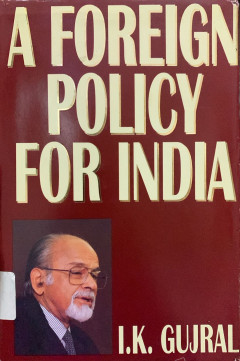
A Foreign policy for India
IK Gujral's "A Foreign Policy for India" outlines the vision and principles behind India's international diplomacy, as articulated by a senior statesman with deep experience in foreign relations. In the book, Gujral outlines his ideas on how India should conduct its foreign policy—emphasizing moral leadership, regional cooperation, and a commitment to peaceful coexistence with its neighbors. …
- Edisi
- -
- ISBN/ISSN
- -
- Deskripsi Fisik
- 337 pages : illustrations ; 24 cm
- Judul Seri
- -
- No. Panggil
- 954 GUJ f

The Center of the universe: The Geopolitics of Iran
In this original and provocative book, Graham E. Fuller examines Iran and the character of its relations with each of its regional neighbors in the Middle East, Central Asia, the Soviet Union, and around the Indian Ocean. Fuller's geopolitical analysis takes into account the impact of historical events, regional demographic makeup, the nature of past conflicts, and the psychological attitud…
- Edisi
- -
- ISBN/ISSN
- 0-8133-1158-6
- Deskripsi Fisik
- xv, 301 pages ; 24 cm
- Judul Seri
- -
- No. Panggil
- 327.55 FUL c
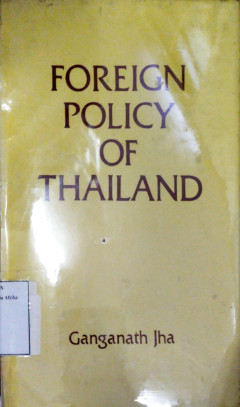
Foreign policy of Thailand
oreign Policy of Thailand provides a comprehensive examination of Thailand’s external relations from historical, political, and strategic perspectives. Ganganath Jha analyzes the evolution of Thai foreign policy within the shifting dynamics of Southeast Asia and the broader international system. The book explores Thailand’s efforts to maintain sovereignty, navigate great-power rivalries, an…
- Edisi
- -
- ISBN/ISSN
- -
- Deskripsi Fisik
- xii, 195 pages ; 22 cm
- Judul Seri
- -
- No. Panggil
- 327.593 JHA f
 Karya Umum
 Filsafat
 Agama
 Ilmu-ilmu Sosial
 Bahasa
 Ilmu-ilmu Murni
 Ilmu-ilmu Terapan
 Kesenian, Hiburan, dan Olahraga
 Kesusastraan
 Geografi dan Sejarah