Ditapis dengan

The military transition: Democratic reform of the armed forces
This meticulously researched volume explains how the relationship between the armed forces and politicians can change from authoritarian regimes to democratic ones. The author is not only a first-rate social scientist but, as one of the longest-serving defense ministers in a major European state, someone who was responsible for formulating and implementing defense reform. Serra's lucid argument…
- Edisi
- -
- ISBN/ISSN
- 978-0-521-13344-9
- Deskripsi Fisik
- vi, 263 pages ; 23 cm
- Judul Seri
- -
- No. Panggil
- 355.686 Ser m

Asia-Pacific strategic relations: Seeking convergent security
This comprehensive book is an overview of security issues in the Asia-Pacific and an argument for a strategy that promises to achieve greater regional stability. It finds that current approaches by policy-makers increase the likelihood of conflict. Instead, it proposes that a strategy of 'convergent security' be adopted to build an enduring regional security framework. A concise survey of key p…
- Edisi
- -
- ISBN/ISSN
- 0-521-00368-7
- Deskripsi Fisik
- xv, 303 pages ; 24 cm
- Judul Seri
- -
- No. Panggil
- 355.43 Tow a

Al-Qaeda membongkar intelijen Amerika : perang konspirasi tingkat tinggi
Muhammad Khalil Al-Hakaymah mencoba menerangkan kepada dunia tentang kehebatan intelijen Amerika ini. Penulis menelanjangi dinas intelijen Amerika dengan sangat runtut dan detail
- Edisi
- cet 1
- ISBN/ISSN
- 978-979-602-8171-01-4
- Deskripsi Fisik
- 356 halaman ; 23 cm
- Judul Seri
- -
- No. Panggil
- 355.07 Hak a

Green economy and good governance for sustainable development: Opportunities,…
Much of the debate on green growth and environmental governance tends to be general in nature, and is often conceptual or limited to single disciplines - such as green growth being dominated by economists and governance by political scientists. This book examines such terms within the context of wide-interest topics including education, oceans and cities, and mixes conceptual discussion with em…
- Edisi
- -
- ISBN/ISSN
- 978-9280812169
- Deskripsi Fisik
- xv, 350 pages ; 23,5 cm.
- Judul Seri
- -
- No. Panggil
- 338.9 Oli g
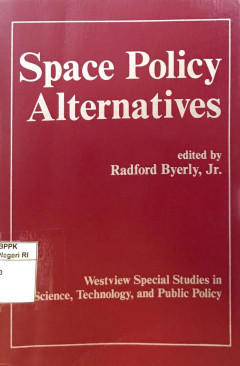
Space policy alternatives
A collection of essays on American space policy issues. After examining existing space programmes and the context in which they exist, the contributors suggest alternatives such as NASA's Earth Observing System and manned and unmanned programmes.
- Edisi
- -
- ISBN/ISSN
- 0-8133-8618-7
- Deskripsi Fisik
- x, 285 pages ; 22,5 cm.
- Judul Seri
- -
- No. Panggil
- 520.6 Bye s
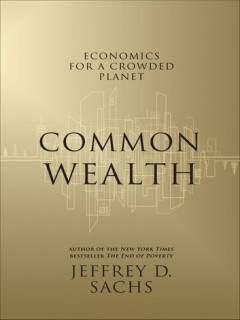
Common wealth: Economics for a crowded planet
In Common Wealth, Jeffrey D. Sachs-one of the world's most respected economists and the author of The New York Times bestseller The End of Poverty- offers an urgent assessment of the environmental degradation, rapid population growth, and extreme poverty that threaten global peace and prosperity. Through crystalline examination of hard facts, Sachs predicts the cascade of crises that awaits thi…
- Edisi
- -
- ISBN/ISSN
- 978-1-59420-127-1
- Deskripsi Fisik
- xiii, 386 pages : illustration (black and white) ; 24 cm.
- Judul Seri
- -
- No. Panggil
- 338.9 Sac c

The commanding heights: The battle of the government and the marketplace that…
The "commanding heights," according to Pulitzer Prize-winner Daniel Yergin and international business advisor Joseph Stanislaw, are those dominant enterprises and industries that form the high economic ground in nations around the globe. In their analysis of the new world economy, The Commanding The Battle Between Government and the Marketplace That Is Remaking the Modern World, they examine "t…
- Edisi
- -
- ISBN/ISSN
- 0-684-82975-4
- Deskripsi Fisik
- 457 pages : illustration (black and white) ; 24 cm.
- Judul Seri
- -
- No. Panggil
- 338.9 Yer c

APEC: Where do we go from here?
This report summarized the presentations and discussions the current main agenda items of APEC: (a) achieving free and open trade in the region; (b) trade and investment; (c) development cooperation; and (d) APEC institutionalization
- Edisi
- 1st Ed.
- ISBN/ISSN
- 979-8026-29-2
- Deskripsi Fisik
- vi, 46 pages ; 21 cm.
- Judul Seri
- -
- No. Panggil
- 338.9 Mal a

Capital controls: Country experiences with their use and liberalization
This paper examines country experiences with the use and liberalization of capital controls to develop a deeper understanding of the role of capital controls in coping with volatile capital flows, as well as the issues surrounding their liberalization. Detailed analyses of country cases aim to shed light on the motivations to limit capital flows; the role the controls may have played in coping …
- Edisi
- -
- ISBN/ISSN
- 0251-6365 ; 1-55775-874-3
- Deskripsi Fisik
- ix, 123 pages : illustrations ; 28 cm
- Judul Seri
- -
- No. Panggil
- 332.4566 Ari c

Solutions for the world's biggest problems: Costs and benefits
Solutions for the World's Biggest Problems offers a rigorous overview of twenty-three of the world's biggest problems relating to the environment, governance, economics, and health and population. Leading economists provide a short survey of the state-of-the-art analysis and sketch out some promising policy solutions for which they provide cost-benefit ratios.
- Edisi
- First Published
- ISBN/ISSN
- 9780521715973
- Deskripsi Fisik
- xvii, 442 pages : illustration ; 24 cm
- Judul Seri
- -
- No. Panggil
- 338.9 Lom s
 Karya Umum
  Filsafat
  Agama
Agama  Ilmu-ilmu Sosial
  Bahasa
  Ilmu-ilmu Murni
  Ilmu-ilmu Terapan
  Kesenian, Hiburan, dan Olahraga
  Kesusastraan
  Geografi dan Sejarah