Ditapis dengan

Genesis of power: General Sudirman and the Indonesian military in politics (1…
In an epilogue to his historical account, Dr Salim observes that while the legitimacy of the military's participation in politics has remained unquestioned, new circumstances following General Sudirman's death have constantly forced it to redefine the precise nature of that participation.
- Edisi
- -
- ISBN/ISSN
- 981-3035-90-0
- Deskripsi Fisik
- xx, 185 pages : illustrations ; 22 cm
- Judul Seri
- -
- No. Panggil
- 320.9598 SAI g
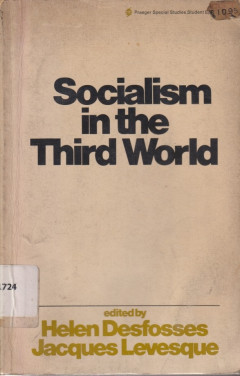
Socialism in the third world
This edited volume explores the development and adaptation of socialist ideas in the Third World during the post-colonial era. Through a series of essays and lectures, contributors examine how newly independent nations incorporated socialist principles into their political and economic systems. The book analyzes case studies across Asia, Africa, and Latin America, highlighting the challenges of…
- Edisi
- -
- ISBN/ISSN
- 0-275-55560-7
- Deskripsi Fisik
- xvi, 318 pages ; 23 cm
- Judul Seri
- -
- No. Panggil
- 335.009 DES s

Taking sides: Clashing views on controversial issues in world politics
Taking Sides: Clashing Views on Controversial Issues in World Politics presents a series of opposing essays that explore major debates in international relations. Edited by John T. Rourke, the book brings together contrasting perspectives on global political issues, enabling readers to critically evaluate arguments and develop a deeper understanding of key controversies shaping world affairs. D…
- Edisi
- -
- ISBN/ISSN
- 0-87967-737-6
- Deskripsi Fisik
- xii, 324 pages ; 23,5 cm
- Judul Seri
- -
- No. Panggil
- 327 ROU t

Revolutionary diplomacy: Chinese foreign policy and the united front doctrine
This study analyzes the development of China’s foreign policy through the framework of the United Front doctrine, a strategy that combines ideological, political, and diplomatic tools to advance national and revolutionary interests. Armstrong examines China’s international behavior from the early years of the Communist movement through the post-1949 period, highlighting the interplay betwee…
- Edisi
- -
- ISBN/ISSN
- 0-520-04273-5
- Deskripsi Fisik
- 251 pages ; 21,5 cm
- Judul Seri
- -
- No. Panggil
- 327.51 ARM r
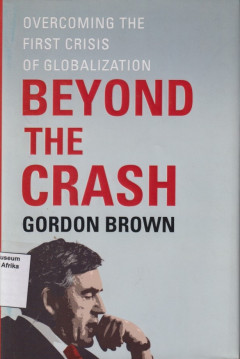
Beyond the crash: Overcoming the first crisis of globalization
In this book, Gordon Brown offers an inside perspective on the global financial crisis of 2008–2009 and outlines strategies for overcoming what he calls the first crisis of globalization. Drawing on his experience as the United Kingdom’s prime minister and former chancellor of the exchequer, Brown analyzes the structural weaknesses of the international financial system, the failures of glob…
- Edisi
- -
- ISBN/ISSN
- 978-1-4516-2405-2
- Deskripsi Fisik
- xx, 314 pages ; 23,5 cm
- Judul Seri
- -
- No. Panggil
- 330.90511 BRO b
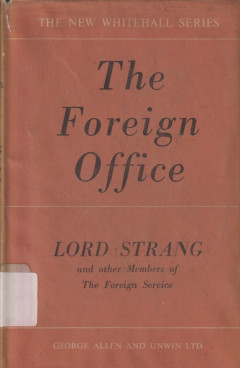
The Foreign office
This book, written by Lord Strang, former Permanent Under-Secretary of State for Foreign Affairs, provides an authoritative overview of the structure, functions, and evolution of the British Foreign Office. It explains the organization of the diplomatic service, its operational methods, and its role in shaping British foreign policy. The work offers historical insights into the development of m…
- Edisi
- -
- ISBN/ISSN
- -
- Deskripsi Fisik
- 226 pages ; 22 cm
- Judul Seri
- -
- No. Panggil
- 327.101 STR f

Diplomacy in peace and war: Recollections and reflections
This memoir by T. N. Kaul offers personal reflections on his long diplomatic career and provides insights into India’s foreign policy during critical moments of the twentieth century. The book recounts Kaul’s experiences in major postings and international negotiations, while also examining the broader dynamics of peace, war, and global diplomacy. Combining autobiographical narrative with p…
- Edisi
- -
- ISBN/ISSN
- 0-7069-0749-3
- Deskripsi Fisik
- x, 251 pages : illustration ; 21 cm
- Judul Seri
- -
- No. Panggil
- 327.54 KAU d

Global paradox: The Bigger the world economy, the more powerful its smallest …
Global Paradox explores one of John Naisbitt’s central ideas: as the global economy becomes increasingly interconnected and expansive, power paradoxically shifts toward smaller, more agile players—small nations, small companies, and even individuals. Naisbitt analyzes global economic trends, technological change, and the rise of the information society, arguing that decentralization and reg…
- Edisi
- -
- ISBN/ISSN
- 0-688-12791-6
- Deskripsi Fisik
- 304 pages ; 24 cm
- Judul Seri
- -
- No. Panggil
- 330.900112 NAI g

Macropolitics: International relations in a global society
Macropolitics: International Relations in a Global Society provides an in-depth examination of the political dynamics shaping interactions among states within an increasingly interconnected world. Richard W. Sterling analyzes major theoretical perspectives, global political structures, and the evolving roles of power, institutions, and interdependence. The book offers a comprehensive overview o…
- Edisi
- -
- ISBN/ISSN
- 0-394-48521-1
- Deskripsi Fisik
- xx, 648 pages ; 24 cm
- Judul Seri
- -
- No. Panggil
- 327 STE m

The Lexus and the olive tree
The Lexus and the Olive Tree explores the rise of globalization as the defining international system of the post–Cold War era. Thomas L. Friedman examines how technological innovation, free markets, and global integration shape political, economic, and cultural dynamics across nations. Through vivid reporting and analytical insights, Friedman contrasts the forces of modernization (“the Lexu…
- Edisi
- -
- ISBN/ISSN
- 0-374-19203-0
- Deskripsi Fisik
- xix, 394 pages : illustration ; 23,5 cm
- Judul Seri
- -
- No. Panggil
- 337 FRI l
 Karya Umum
  Filsafat
  Agama
Agama  Ilmu-ilmu Sosial
  Bahasa
  Ilmu-ilmu Murni
  Ilmu-ilmu Terapan
  Kesenian, Hiburan, dan Olahraga
  Kesusastraan
  Geografi dan Sejarah