Ditapis dengan

The United States and Asia: Regional dynamics and twenty-first-century relations
Offers a cogent overview of the historical context and enduring patterns of U.S. relations with Asia ... Robert G. Sutter provides a balanced analysis of post-Cold War dynamics in Asia, which involve interrelated questions of security, economics, national identity, and regional institution building. He demonstrates how these critical concerns manifest a complex mix of realist, liberal, and cons…
- Edisi
- -
- ISBN/ISSN
- 9781442226333
- Deskripsi Fisik
- x, 327 pages ; 23 cm
- Judul Seri
- -
- No. Panggil
- 327.7305 Sut u
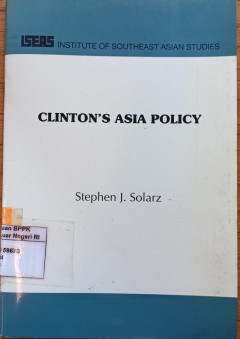
Clinton's Asia policy
A related adjustment in American policy toward China has been the extent to which the United States has re-initiated a high-level dialogue with the PRC President Bush, perhaps because he did not want to be seen as being too soft on China in the wake of the Tiananmen incident, suspended a high-level dialogue with Beijing. Under President Clinton, to some extent perhaps because the Administration…
- Edisi
- -
- ISBN/ISSN
- 981-3016-88-4
- Deskripsi Fisik
- viii, 22 pages ; 25 cm
- Judul Seri
- -
- No. Panggil
- 327.16959673 Sol c
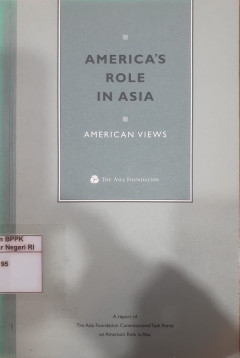
America's role in Asia: American views
In the post-Cold War world, U.S.-Asian relations remain central to U.S. policy. Fault lines in the Taiwan Straits and on the Korean peninsula require the daily vigilance of U.S. and Asian policymakers. Asia's continued recovery from the 1997 financial crisis depends in part upon the health of the American economy. And as domestic political change accelerates across Asia, relations must be recal…
- Edisi
- ed. 1
- ISBN/ISSN
- 1-892325-02-0
- Deskripsi Fisik
- xi, 62 pages : iIlustrations ; 23 cm
- Judul Seri
- -
- No. Panggil
- 330.97395 Fou a

U.S Policy in the Asia-Pacific region: Meeting the challeges of the post cold…
The contens of this book: 1. opening Addres - Lee Kuan Yew 2. U.S Policy in the Asia-Pacific region: meeting the challeges of the post cold-war era - George Bush 3, Discussion 4. CLosing Remarks - K.S Sandhu
- Edisi
- -
- ISBN/ISSN
- 981-3016-24-8
- Deskripsi Fisik
- 18 pages ; 24 cm
- Judul Seri
- -
- No. Panggil
- 355.02 Bus u

Japan, the United States, and prospects for the Asia-Pasific century: Three s…
This book provides a framework for considering the ramifications of Japan's expanding role and influence in the Asia-Pacific region. It documents Japan's emergence as the regional "core economy"; reviews the factors that may influence Tokyo's future political and military role; poses alternative scenarios for the evolving Asia-Pacific economic, political and security order; analyses the factors…
- Edisi
- -
- ISBN/ISSN
- 981-3016-22-1
- Deskripsi Fisik
- xiv, 155 pages : ilustrasi ; 23 cm
- Judul Seri
- -
- No. Panggil
- 327.52 Cro j

Toward disengagement in Asia: A strategy for American foreign policy
This book gets to the marrow of the matter in East Asia. It is free of the distortions, misrepresentations, and irrelevancies which have so marred the debate on Vietnam and so filled most of the current literature on crises in Asia. In the author seeks to find out how the Asians can take over the primary responsibility for security while the United States decreases its involvement. Thus, he add…
- Edisi
- -
- ISBN/ISSN
- -
- Deskripsi Fisik
- vi, 186 pages : illustrations : index ; 20 cm
- Judul Seri
- -
- No. Panggil
- 327.59073 Gor t
 Karya Umum
  Filsafat
  Agama
Agama  Ilmu-ilmu Sosial
  Bahasa
  Ilmu-ilmu Murni
  Ilmu-ilmu Terapan
  Kesenian, Hiburan, dan Olahraga
  Kesusastraan
  Geografi dan Sejarah