Ditapis dengan

G-24 discussion paper series: The Indonesian bank crisis and restructuring: L…
Drawing on the Indonesian experience in 1997, this paper demonstrates the complexity of managing banking crises deals. It aims at deriving conclusions from this experience for other developing countries facing similar problems. The paper also refers to comparative experiences of other countries, in particular Malaysia and Thailand, examines the IMF programme and reveals its shortcomings. Th…
- Edisi
- No. 23
- ISBN/ISSN
- -
- Deskripsi Fisik
- ix, 35 pages : illustrations (black and white) ; 30 cm
- Judul Seri
- -
- No. Panggil
- 382 Pan g

G-24 discussion paper series: Interests and options of developing and least-d…
This paper discusses the trade-strategy options of low-income countries, the areas of greatest interest to developing countries, as well as those that are to pose the greatest difficulties, the question of how developing countries can enhance the effectiveness of their participation in the new Round of Multilateral Trade Negotiations, and also makes some suggestions on how to change WTO governa…
- Edisi
- No. 2
- ISBN/ISSN
- -
- Deskripsi Fisik
- ix, 26 pages ; 30 cm
- Judul Seri
- -
- No. Panggil
- 382 Oye g

Assuring development gains and poverty reduction from trade: The labour mobil…
This publication attempts to provide a comprehensive picture of the impact on trade, development and poverty reduction brought about by global labour movement and integration. It attempts to answer the question as to how temporary labour mobility can be better managed so as to contribute to improving peoples livelihood as welfare prospects while at the same time moving closer to achieving of in…
- Edisi
- -
- ISBN/ISSN
- 978-92-1-112741-6
- Deskripsi Fisik
- v, 123 pages : illustrations (black and white) ; 21 cm
- Judul Seri
- -
- No. Panggil
- 381 Pur a
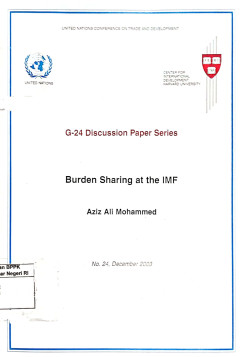
G-24 discussion paper series: Burden sharing at the IMF
The paper reviews aspects of the financial governance of the IMF, focusing on the equity implications of the manner of distributing the cost of running the Fund’s regular (nonconcessionary) lending operations as well as the modalities of funding its concessionary lending and debt relief operations. It is concluded that while the Fund charges borrowers roughly what it pays its creditor members…
- Edisi
- No. 24
- ISBN/ISSN
- -
- Deskripsi Fisik
- ix, 11 pages : illustrations (black and white) ; 30 cm
- Judul Seri
- -
- No. Panggil
- 382 Moh g
 Karya Umum
  Filsafat
  Agama
Agama  Ilmu-ilmu Sosial
  Bahasa
  Ilmu-ilmu Murni
  Ilmu-ilmu Terapan
  Kesenian, Hiburan, dan Olahraga
  Kesusastraan
  Geografi dan Sejarah