Ditapis dengan
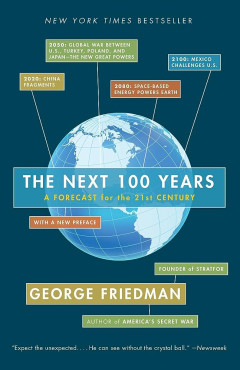
The next 100 years: A forecast for the 21st century
In his thought-provoking new book, George Friedman, founder of STRATFOR-the preeminent private intelligence and forecasting firm-focuses on what he knows best, the future. Positing that civilization is at the dawn of a new era, he offers a lucid, highly readable forecast of the changes we can expect around the world during the twenty-first century, all based on his own through analysis and rese…
- Edisi
- Cetakan Pertama
- ISBN/ISSN
- 0-393-03075-x
- Deskripsi Fisik
- xxi, 253 pages : illustration : index ; 22 cm
- Judul Seri
- -
- No. Panggil
- 303.49 Fri n

A Brief history of the future: A Brave and controversial look at the twenty-f…
A Brief History of the Future by Jacques Attali presents an ambitious and provocative analysis of humanity’s likely trajectory throughout the twenty-first century. Drawing from economics, geopolitics, technology, philosophy, and cultural studies, Attali outlines major global transformations—including shifts in political power, economic restructuring, technological breakthroughs, and evolvin…
- Edisi
- -
- ISBN/ISSN
- 978-1-55970-879-1
- Deskripsi Fisik
- xvii, 291 pages ; 21 cm
- Judul Seri
- -
- No. Panggil
- 303.49 LEG a
Preparing for the twenty-first century
This book is a wide-ranging and intelligent survey of global trends —from population growth and global warming to the revolutions in biotechnology and robotics— and how they are likely to influence, if not dictate, the shape of society in coming years. The book is divided into three parts. The first is largely descriptive and examines general world trends. A chapter each is devoted to the p…
- Edisi
- -
- ISBN/ISSN
- 0-00-215705-5
- Deskripsi Fisik
- xvi, 428 pages : index ; 23 cm
- Judul Seri
- -
- No. Panggil
- 303.490905 Ken p
Preparing for the twenty-first century
Human history has always been shaped by the growth and migration of populations, by the opportunities and constraints provided by the environment, and by the rise of new technologies. Today, these forces are enmeshed in a state of unprecedented turbulence. World population has more than doubled in the past forty years to reach its current level of 5.5 billion, and it will exceed 8 billion and p…
- Edisi
- First Edition
- ISBN/ISSN
- 0-394-58443-0
- Deskripsi Fisik
- xvi, 428 pages : bibl: hlm 389-405 : index ; 20 cm
- Judul Seri
- -
- No. Panggil
- 303.490905 Ken p

The great divide: Unequal societies and what we can about them
This book is mostly about the economics of inequality. In various essays in this volume, Stiglitz describing the nexus between politics and economics: the vicious circle by which more economic inequality gets translated into political inequality, especially in America's political system, which gives such unbridled power to money.
- Edisi
- First Edition
- ISBN/ISSN
- 978-0-393-24857-9
- Deskripsi Fisik
- xxvi, 428 pages ; 24 cm
- Judul Seri
- -
- No. Panggil
- 305.50973 Sti g

War made easy: How presidents and pundits keep spinning us to death
In War Made Easy, Norman Solomon cuts through the dense web of spin to probe and scrutinize the key "perception management" techniques that have played huge roles in the promotion of American wars in recent decades. In addition to documenting a long series of deliberate misdeeds at the highest levels of power, it lays out important guidelines to help us distinguish elements in a propaganda camp…
- Edisi
- -
- ISBN/ISSN
- 0-471-79001-X
- Deskripsi Fisik
- v, 314 pages : index ; 24 cm
- Judul Seri
- -
- No. Panggil
- 070.44935502 Sol w

What next? : Surviving the twenty-first century
What Next? tackles the big questions about our global condition and our collective future with a verve and authority no other current commentator or political figure, on either side of the Atlantic or the Channel, could match. Energy, food, water, international crime, weapons proliferation, drug trafficking, climate change, epidemic disease, migration - the challenges facing our world are thems…
- Edisi
- -
- ISBN/ISSN
- 9780713998566
- Deskripsi Fisik
- xii, 490 pages : illustrations. ; 24 cm
- Judul Seri
- -
- No. Panggil
- 909.83 Pat w

The ISIS apocalypse: The history, strategy, and doomsday vision of the islami…
The ISIS Apocalypse by William McCants explores how religious fervor, strategic calculation, and doomsday prophesy shaped the Islamic State's past and foreshadow its dark future.
- Edisi
- -
- ISBN/ISSN
- 9781250080905
- Deskripsi Fisik
- xi, 242 pages : 25 cm
- Judul Seri
- -
- No. Panggil
- 363.3250956 Mcc i

Preventive defense: A new security strategy for America
The thoughts we express in this book are informed by our service in the pentagon during the first term of the Clinton administration and with the reflection of a year of distance from the fray.
- Edisi
- -
- ISBN/ISSN
- 0-8157-1308-8
- Deskripsi Fisik
- 243 pages : index ; 25 cm
- Judul Seri
- -
- No. Panggil
- 355.03373 Car p

What kind of country?: Australia and the twenty first century
I had wanted to write a book about Australia in the twenty first century so as to write about the Australia I liked, or perhaps wanted. I hoped, too, that Australia would be more successful in the next century than it had managed to be in this one. The twentieth century had been America's, not just in the sense that the United States became a dominanta power during it but because the style of t…
- Edisi
- -
- ISBN/ISSN
- 0-14-010681-2
- Deskripsi Fisik
- xii, 178 pages ; 20 cm
- Judul Seri
- -
- No. Panggil
- 994.063 Gra w
 Karya Umum
  Filsafat
  Agama
Agama  Ilmu-ilmu Sosial
  Bahasa
  Ilmu-ilmu Murni
  Ilmu-ilmu Terapan
  Kesenian, Hiburan, dan Olahraga
  Kesusastraan
  Geografi dan Sejarah