Ditapis dengan

Captive : My time as a prisoner of the taliban
An American reporter's chilling account of being kidnapped and imprisoned by the Taliban, in the no-man's-land between Afghanistan and Pakistan Jere Van Dyk was on the wrong side of the border. He and three Afghan guides had crossed into the tribal areas of Pakistan, where no Westerner had ventured for years, hoping to reach the home of a local chieftain by nightfall. But then a dozen armed men…
- Edisi
- 1
- ISBN/ISSN
- 978-0-8050-8827-4
- Deskripsi Fisik
- xiii, 269 pages : 25 cm
- Judul Seri
- -
- No. Panggil
- 958.1 DYK c

An End to al-qaeda: Destroying bin Laden’s Jihad and restoring America’s …
An End to al-Qaeda presents intelligence expert Malcolm Nance’s strategic analysis of the global jihadist movement led by Osama bin Laden and the methods required to defeat it. Drawing from decades of counterterrorism experience, Nance explains the origins, ideology, and operational structure of al-Qaeda, revealing how the group exploits global conflicts and political narratives. He argues th…
- Edisi
- -
- ISBN/ISSN
- 978-0-312-59249-3
- Deskripsi Fisik
- viii, 296 pages ; 25 cm
- Judul Seri
- -
- No. Panggil
- 363.325 NAN e

Battle for our minds: Western elites and the terror threat
This book examines how Western political elites, media outlets, and academics have unwittingly undermined counterterrorism efforts. Michael Widlanski examines terrorist groups' communication strategies, the manipulation of public opinion through the media, and the failure of intelligence analysis to understand ideological threats. Using psychological and geopolitical approaches, this book highl…
- Edisi
- -
- ISBN/ISSN
- 978-1-4516-5903-0
- Deskripsi Fisik
- v, 394 pages ; 24 cm
- Judul Seri
- -
- No. Panggil
- 363.3250973 WID b
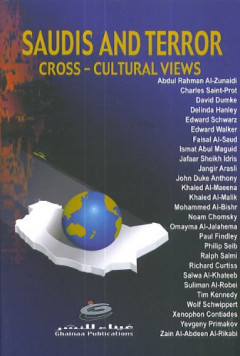
Saudis and terror cross-cultural views
Saudis and Terror: Cross-Cultural Views is a multi-perspective anthology written by scholars, intellectuals, and media analysts from Saudi Arabia, Europe, the U.S., Russia, and other parts of the Arab world. The book examines terrorism from many different angles — its definition, causes, ideology, history, and political dimensions. It challenges prevailing narratives and stereotypes by highli…
- Edisi
- -
- ISBN/ISSN
- 9960-9454-6-4
- Deskripsi Fisik
- 372 pages ; 21 cm
- Judul Seri
- -
- No. Panggil
- 363.3209 SAU s
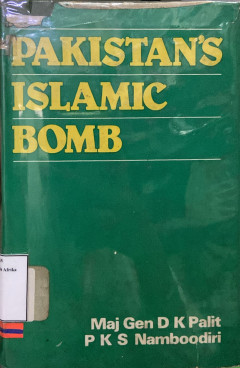
Pakistan's islamic bomb
Pakistan's Islamic Bomb deeply analyzes Pakistan's efforts to develop nuclear capabilities in the 1970s, particularly after its defeat in the 1971 war and the loss of Bangladesh. Palit and Namboodiri outline the geopolitical background, strategic competition with India, and the internal political dynamics that led to the development of this nuclear program. With a strong analytical approach, th…
- Edisi
- -
- ISBN/ISSN
- 0-7069-0911-9
- Deskripsi Fisik
- xii, 150 pages; 22 cm
- Judul Seri
- -
- No. Panggil
- 2X9.6 PAL p

On the trail of terror : The inside story of the Lockerbie investigation
The investigation into the bombing of Pan Am flight 103 which blew up over Lockerbie in 1988, with the loss of 270 lives. It shows how the bombing was planned at a secret meeting at the head quarters of the Libyan intelligence agency.
- Edisi
- -
- ISBN/ISSN
- 0-224-03030-2
- Deskripsi Fisik
- 230 pages ; 24 cm
- Judul Seri
- -
- No. Panggil
- 363.12 Lep o

Different societies, shared futures: Australia, Indonesia and the region
This book examines the wide range of factors and approaches that are involved in meeting the bilateral and regional challenges, including government links, public images and mutual perceptions, regional organizations, the role of Islam, the aid relationship, security and counterterrorism, economic and business relations, and the student market. The articles by the authors in this book reflect a…
- Edisi
- Indonesian Update Series
- ISBN/ISSN
- 981-230-386-3
- Deskripsi Fisik
- xxii, 204 pages : illustration : index ;23 cm
- Judul Seri
- -
- No. Panggil
- 327.9598944 Mon d

The 9/11 commission report: Final report of the national commission on terror…
The official Government edition of the Final Report of the National Commission on Terrorist Attacks Upon the United States provides a full and complete account of the circumstances surrounding the September 11th, 2001, terrorist attacks, including preparedness for and the immediate response to the attacks. It also includes recommendations designed to guard against future attacks.
- Edisi
- -
- ISBN/ISSN
- 0-7607-6806-4
- Deskripsi Fisik
- xviii, 664 pages : illustrations (black and white) : index ; 23 cm
- Judul Seri
- -
- No. Panggil
- 303.625 Com c

Worlds in collision: Terror and the future of global order
Longer pieces then started appearing, and more recently books. What almost all of this analysis and imagining revealed was a sense not only that one historical era had ended, but that some- thing of truly epic significance had occurred which would affect the human international political consciousness with the same impact as the dropping of the atomic bombs, the First World War or the Thirty Ye…
- Edisi
- Cet. 1
- ISBN/ISSN
- 0-333-99805-7
- Deskripsi Fisik
- x, 376 pages : index ; 21 cm
- Judul Seri
- -
- No. Panggil
- 303.625 Boo w

America's other War: Terrorizing Colombia
Colombia is the worst humanitarian catastrophe in the hemisphere. The sources are deeply rooted in Colombia's own history, and in policies of the hegemonic power that are no less deeply rooted in its own history and institutions. This study provides a uniquely perceptive analysis of the tragic interaction, and its far-reaching implications for understanding the past and the evolving global or…
- Edisi
- -
- ISBN/ISSN
- 1842775472
- Deskripsi Fisik
- 147 pages : index ; 23 cm
- Judul Seri
- -
- No. Panggil
- 327.730861 Sto a
 Karya Umum
  Filsafat
  Agama
Agama  Ilmu-ilmu Sosial
  Bahasa
  Ilmu-ilmu Murni
  Ilmu-ilmu Terapan
  Kesenian, Hiburan, dan Olahraga
  Kesusastraan
  Geografi dan Sejarah