Ditapis dengan
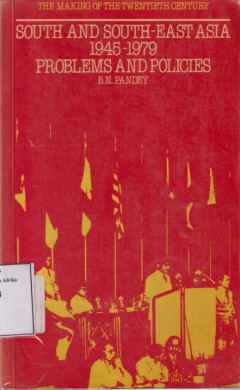
South and South-East Asia 1945-1979: Problems and policies
This book examines the political, social, and economic developments in South and South-East Asia from the end of the Second World War to the late 1970s. It analyzes major regional problems, state-building processes, decolonization, and policy responses within the context of the Cold War. The work provides a comprehensive overview of post-war transformations and challenges faced by Asian nations…
- Edisi
- -
- ISBN/ISSN
- 0-333-04978-0
- Deskripsi Fisik
- viii, 236 pages ; 21,5 cm
- Judul Seri
- -
- No. Panggil
- 959.05 PAN s
Imperialism and revolution in South Asia
This volume brings together a collection of essays that analyze the historical background, dynamics, and consequences of imperialism and revolutionary movements in South Asia. The contributors explore the political and economic structures shaped by colonial domination, the rise of revolutionary consciousness, and the impact of capitalism on social development in the region. Through case studies…
- Edisi
- -
- ISBN/ISSN
- 0-85345-273-3
- Deskripsi Fisik
- viii, 470 pages ; 21 cm
- Judul Seri
- -
- No. Panggil
- 320.95405 GOU i

The Pathans: 550 B.C.–A.D. 1957
This historical study by Olaf Caroe provides a comprehensive account of the Pathans (Pashtuns) from their earliest recorded origins in 550 B.C. to the mid-twentieth century. The book traces the political, cultural, and social development of the Pathan people, examining their tribal structure, migrations, and interactions with major empires, including the Persians, Mughals, and British. Caroe hi…
- Edisi
- -
- ISBN/ISSN
- 0-19-577221-0
- Deskripsi Fisik
- xxiv, 533 pages : illustrations ; 22,5 cm
- Judul Seri
- -
- No. Panggil
- 954.912 CAR p
Tradition and politics in South Asia
This volume examines the complex interactions between political structures, traditional institutions, and cultural practices in South Asia. Edited by R. J. Moore, the book brings together scholarly essays that explore how historical traditions have shaped political behavior, governance, and social change across countries such as India, Pakistan, Bangladesh, and Sri Lanka. The work provides insi…
- Edisi
- -
- ISBN/ISSN
- 0-7069-0608-X
- Deskripsi Fisik
- xxii, 266 pages ; 21 cm
- Judul Seri
- -
- No. Panggil
- 320.954 MOO t
Governments and politics of South Asia
“This book provides a comprehensive analysis of governmental structures and political dynamics in South Asia. It examines the historical development, constitutional frameworks, political institutions, leadership patterns, and contemporary political challenges in countries of the region. Through contributions from multiple scholars, the book offers comparative insights into democratic practice…
- Edisi
- -
- ISBN/ISSN
- -
- Deskripsi Fisik
- xviii, 604 pages ; 22,5 cm
- Judul Seri
- -
- No. Panggil
- 320.954 JOH g

South Asia: Post-nehrurvian dynamics of diplomacy
This book examines the shifts in South Asian diplomacy in the post-Nehruvian era, focusing on how regional politics, security concerns, and changes in India's foreign policy have shaped inter-state relations in South Asia. Edited by K.M. Sajad Ibrahim, the volume brings together analyses from scholars on themes such as regional cooperation, conflict dynamics, strategic interests, and the evolvi…
- Edisi
- -
- ISBN/ISSN
- 978-81-7708-355-2
- Deskripsi Fisik
- xxi, 239 pages : illustrations ; 22,5 cm
- Judul Seri
- -
- No. Panggil
- 327.54 IBR s

India, Pakistan, Nepal and Bangladesh: India as a factor in the intra-regiona…
This book examines the political dynamics and intra-regional interactions among India, Pakistan, Nepal, and Bangladesh in South Asia. P. K. Mishra analyzes India’s central role in shaping regional relations, focusing on historical, political, and strategic factors that influence cooperation and conflict. The study highlights bilateral issues, regional power asymmetry, and the evolution of Sou…
- Edisi
- -
- ISBN/ISSN
- -
- Deskripsi Fisik
- viii, 286 pages : illustration ; 22 cm
- Judul Seri
- -
- No. Panggil
- 327.54 MIS i
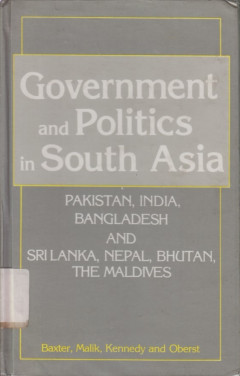
Government and politics in South Asia
Government and Politics in South Asia provides a comprehensive examination of the political systems, institutions, and governing structures of countries in South Asia, including India, Pakistan, Bangladesh, Sri Lanka, and Nepal. Written by leading scholars, the book analyzes historical developments, constitutional frameworks, political parties, military influence, regional tensions, and pattern…
- Edisi
- -
- ISBN/ISSN
- -
- Deskripsi Fisik
- xv, 415 pages : illustrations ; 22,5 cm
- Judul Seri
- -
- No. Panggil
- 320.954 BAX g

South Asia: A Short history of the subcontinent
South Asia: A Short History of the Subcontinent provides a concise yet comprehensive overview of the historical development of the Indian subcontinent. Covering major regions including India, Pakistan, Bangladesh, Sri Lanka, and Nepal, the book traces political, cultural, and social transformations from ancient civilizations to the twentieth century. Meyer highlights the interaction of diverse …
- Edisi
- -
- ISBN/ISSN
- 0-8226-0034-X
- Deskripsi Fisik
- vi, 265 pages : illustrations ; 20,5 cm
- Judul Seri
- -
- No. Panggil
- 954 MEY s
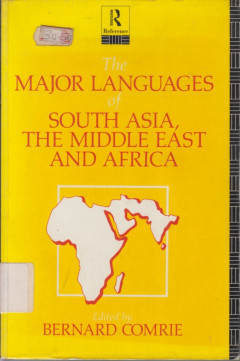
The Major Languages of South Asia, the Middle East and Africa
This volume provides an authoritative survey of the major languages spoken across South Asia, the Middle East, and Africa. Edited by Bernard Comrie, the book contains contributions from leading linguists and offers detailed descriptions of the phonological, grammatical, and lexical features of each language or language group. The work also discusses historical developments, linguistic typology,…
- Edisi
- -
- ISBN/ISSN
- 0–415–05772–8
- Deskripsi Fisik
- xi, 315 pages : illustrations ; 23,5 cm
- Judul Seri
- -
- No. Panggil
- 409 COM m
 Karya Umum
  Filsafat
  Agama
Agama  Ilmu-ilmu Sosial
  Bahasa
  Ilmu-ilmu Murni
  Ilmu-ilmu Terapan
  Kesenian, Hiburan, dan Olahraga
  Kesusastraan
  Geografi dan Sejarah