Ditapis dengan

Turning points in history book 3: Mogration land and minerals inn the making …
The book examines how migration, land distribution, and the mining industry played pivotal roles in shaping the history and development of South Africa. Through a focus on historical events and policy decisions, it explores the socio-political impact of these factors on South African society.
- Edisi
- -
- ISBN/ISSN
- 1-919855-31-9
- Deskripsi Fisik
- 80 pages : illustrations ; 24 cm
- Judul Seri
- -
- No. Panggil
- 968 NAS t
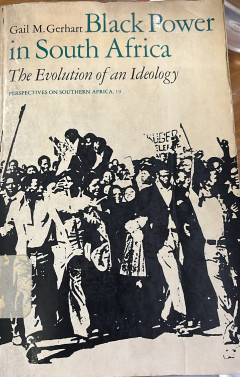
Black power in South Africa: The evolution of an ideology
This book examines the rise and development of the Black Power movement in South Africa as an ideological response to apartheid and racial domination. Written by Gail M. Gerhart, the work traces the historical roots, philosophical foundations, and political impact of Black Consciousness and related movements from the 1960s onward. Through detailed analysis, the author explores how Black Power s…
- Edisi
- -
- ISBN/ISSN
- 0-520-03933-5
- Deskripsi Fisik
- xi, 364 pages ; 22 cm
- Judul Seri
- -
- No. Panggil
- 968.06 GER b

Gott segne Afrika : Texte und Predigten des Friedensnobelpreisträgers
This book is a collection of texts, sermons, and reflections by Desmond Tutu, Nobel Peace Prize laureate and leading moral voice in the struggle against apartheid in South Africa. Written during a period of intense political repression, the work combines theological insight with sharp social critique, emphasizing justice, reconciliation, and human dignity. Tutu addresses the moral responsibilit…
- Edisi
- -
- ISBN/ISSN
- 3-499-15626-1
- Deskripsi Fisik
- 155 pages : Illustrations ; 19 cm
- Judul Seri
- -
- No. Panggil
- 968.065 TUT g
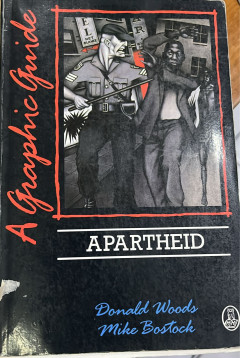
Apartheid : A Graphic guide
This book presents a concise and accessible introduction to apartheid in South Africa through a graphic narrative format. Written by Donald Woods and illustrated by Mike Bostock, it explains the origins, ideology, and implementation of apartheid policies, as well as their social, political, and human consequences. Using visual storytelling, the book highlights racial segregation, state violence…
- Edisi
- -
- ISBN/ISSN
- 0-8050-0609-5
- Deskripsi Fisik
- 148 pages : illustrations ; 21 cm
- Judul Seri
- -
- No. Panggil
- 968.065 WOO a

Fight against apartheid : India’s pioneering role in the world campaign aga…
This book examines India’s pioneering role in the global struggle against apartheid and racial discrimination in South Africa. Written by T. G. Ramamurthi, the work highlights India’s diplomatic, political, and moral leadership in mobilizing international opposition to apartheid through the United Nations and other global forums. The book documents historical developments, policy initiative…
- Edisi
- -
- ISBN/ISSN
- -
- Deskripsi Fisik
- 191 pages ; 22 cm
- Judul Seri
- -
- No. Panggil
- 325.26 RAM f

The Opening of the apartheid mind: Options for the New South Africa
Revealing the complex political forces involved in disman- thing apartheid, Adam and Moodley argue that although the African National Congress will join the government it may be forced to govern without real constitutional, eco- nomie, or military power. They view a political settlement as a necessary but insufficient condition for reversing the social disintegration and economie decline that i…
- Edisi
- -
- ISBN/ISSN
- 0-520-08199-4
- Deskripsi Fisik
- 256 pages : illustration ; 24 cm
- Judul Seri
- -
- No. Panggil
- 968.064 ADA o
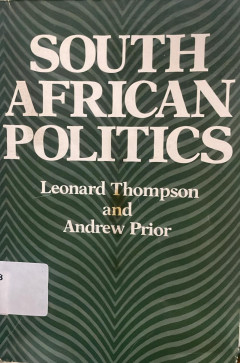
South African Politics
This book provides a comprehensive analysis of the political system and historical development of South Africa. It examines the evolution of political institutions, ideologies, and power relations from the colonial period through the era of apartheid and its aftermath. The authors explore the roles of race, ethnicity, nationalism, and economic structures in shaping South African politics, as we…
- Edisi
- -
- ISBN/ISSN
- 0-300-02767-2
- Deskripsi Fisik
- 255 pages ; 21 cm
- Judul Seri
- -
- No. Panggil
- 320.968 THO s

Apartheid and the homelands in South Africa
Apartheid and the Homelands in South Africa: A New Zealander’s View presents an external and independent perspective on the apartheid system and the creation of “homelands” (Bantustans) in South Africa. Written from the viewpoint of a New Zealand observer, the book analyzes how apartheid policies shaped racial segregation, political control, and socio-economic inequality. It examines the …
- Edisi
- -
- ISBN/ISSN
- -
- Deskripsi Fisik
- 39 pages : illustrations : 21 cm
- Judul Seri
- -
- No. Panggil
- 968.9704 LAN a
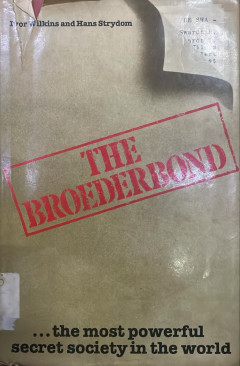
The Broederbond
The most controversial nation in the world, the nation of gold and diamonds, of apartheid and Soweto, does not exist in complete isolation. South Africa, whether we like it or not, is inextricably linked to the economies of the Western world and its fate will affect us all. It is a nation divided not only between black and white but between white and white. To understand South Africa the world …
- Edisi
- 1
- ISBN/ISSN
- 0 70920734 4
- Deskripsi Fisik
- 458 pages ; 24 cm
- Judul Seri
- -
- No. Panggil
- 320.968 WIL b

Economy and society in pre-industrial South Africa
Over the past forty years there has been a revolution in South African historiography, yet no broadly interpretative essay on South African history has appeared. The essays in this volume aim to provide such a reinterpretation for the nineteenth century before the discovery of minerals transformed the nature of South African societies, and help to shed light on earlier phases of South Africa's …
- Edisi
- -
- ISBN/ISSN
- 0-582-64656-1
- Deskripsi Fisik
- 385 pages ; 22 cm
- Judul Seri
- -
- No. Panggil
- 330.68 MAR e
 Karya Umum
  Filsafat
  Agama
Agama  Ilmu-ilmu Sosial
  Bahasa
  Ilmu-ilmu Murni
  Ilmu-ilmu Terapan
  Kesenian, Hiburan, dan Olahraga
  Kesusastraan
  Geografi dan Sejarah