Ditapis dengan
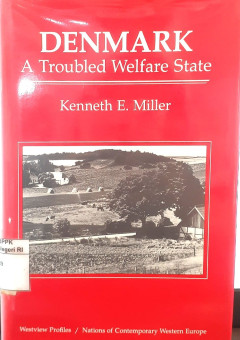
Denmark : A trouble welfare state
Denmark in the 1990s promises to be a stark contrast to the postwar years. In this critical introduction, Professor Kenneth Miller examines Danish social, governmental and public policy, focusing on the changes that have transformed it in the past 40 years. He presents a story of stability and change, of a welfare state in times of challenge and difficulty, and of a small country – despite in…
- Edisi
- -
- ISBN/ISSN
- 0-81330834-8
- Deskripsi Fisik
- xiii, 224 pages ; 24 cm
- Judul Seri
- -
- No. Panggil
- 361.6509 MIL d

Tanzania's human revolution
This book analyzes the social, political, and economic changes in post-independence Tanzania, particularly through the human development policies initiated during the era of President Julius Nyerere. James N. Karioki evaluates the implementation of Ujamaa socialism, collective village development, and their impact on the country's social structure. In addition to discussing theory and policy, t…
- Edisi
- -
- ISBN/ISSN
- 0-271-00206-9
- Deskripsi Fisik
- 225 pages ; 23,5 cm
- Judul Seri
- -
- No. Panggil
- 309.1678 KAR t

Why nations fail: The origins of power, prosperity, and poverty
Daron Acemoglu and James Robinson conclusively show that it is man-made political and economic institutions that underlie economic success (or lack of it). Korea, to take just one of their fascinating examples, is a remarkably homogeneous nation, yet the people of North Korea are among the poorest on earth while their brothers and sisters in South Korea are among the richest. The south forged a…
- Edisi
- First Edition
- ISBN/ISSN
- 978-0-307-71922-5
- Deskripsi Fisik
- 529 pages : illustration : bibl: hlm 465-482 : index ; 25 cm
- Judul Seri
- -
- No. Panggil
- 330 Ace w

Postwar Vietnam: Dynamics of a transforming society
Moving beyond the standard emphasis on the Vietnam War and Vietnamese politics and economy, this volume provides a historically grounded examination of the dynamics of contemporary society and state-society relations. Within that framework, the contributors explore the dynamics of economic reforms, socioeconomic inequality, environmental changes, gender and ethnic relations, migration, media, a…
- Edisi
- -
- ISBN/ISSN
- 0-8476-9865-3
- Deskripsi Fisik
- vii, 336 pages : illustrations (black and white) : index ; 23 cm
- Judul Seri
- -
- No. Panggil
- 306.09597 Luo p

Economic development, social order, and world politics
Based on methodological individualism and a public-choice approach to social theory, this book provides an analysis of the interdependence of economic development, social order and interstate conflict.
- Edisi
- -
- ISBN/ISSN
- 155587620X
- Deskripsi Fisik
- xi, 203 pages ; 23,5 cm.
- Judul Seri
- -
- No. Panggil
- 338.9 Wee e

What next? : Surviving the twenty-first century
What Next? tackles the big questions about our global condition and our collective future with a verve and authority no other current commentator or political figure, on either side of the Atlantic or the Channel, could match. Energy, food, water, international crime, weapons proliferation, drug trafficking, climate change, epidemic disease, migration - the challenges facing our world are thems…
- Edisi
- -
- ISBN/ISSN
- 9780713998566
- Deskripsi Fisik
- xii, 490 pages : illustrations. ; 24 cm
- Judul Seri
- -
- No. Panggil
- 909.83 Pat w

National government: Agenda for a new India
The contents of this book: 1. Why a National Goverment? 2. The Changing Political Systems 3. The Need for Economic Restructuring 4. Social Restructuring and Holistic Perspective
- Edisi
- -
- ISBN/ISSN
- 81-85273-66-9
- Deskripsi Fisik
- xiii, 163 pages ; 23 cm
- Judul Seri
- -
- No. Panggil
- 320.954 Sat n

Social policy for development
Strong social policy is essential for sustainable growth. This book is an extremely useful overview of social policy issue for policy makers and anyone who wants to understand the true roots of successful sustainable development. Contents: 1. Social policy for development : Local, national and global dimensions 2. Poverty, inequality and development: The challenge for social policy 3. Soci…
- Edisi
- -
- ISBN/ISSN
- 0-7619-6715-X
- Deskripsi Fisik
- XV, 288 pages ; 24 cm
- Judul Seri
- -
- No. Panggil
- 361.1 Hal s

Fighting for New Zealand: New Zealand in the 21st century
Here Mike Moore examines the implications of the post industrial economy, the emerging information age, and how New Zealand can best prosper within the global economy. He warns of the serious economic consequences of ignoring our social, intellectual and infrastructural deficits and makes a case for New Zealand's endangered middle class, advancing the significant proposition that New Zealand mo…
- Edisi
- First Edition
- ISBN/ISSN
- 0-473-01769-5
- Deskripsi Fisik
- viii, 197 pages ; 20 cm
- Judul Seri
- -
- No. Panggil
- 993.1 Moo f
 Karya Umum
  Filsafat
  Agama
Agama  Ilmu-ilmu Sosial
  Bahasa
  Ilmu-ilmu Murni
  Ilmu-ilmu Terapan
  Kesenian, Hiburan, dan Olahraga
  Kesusastraan
  Geografi dan Sejarah