Ditapis dengan

Leveraging track two diplomacy in the workshop on managing potential conflict…
The Workshop on Managing Potential Conflict in the South China Sea provides an informal platform for dialogue and confidence-building among regional stakeholders. However, declining participation, political posturing, and limited non-governmental involvement have reduced its relevance. Transitioning the Workshop into a fully Track Two diplomacy platform can revitalize its role by establishing a…
- Edisi
- -
- ISBN/ISSN
- -
- Deskripsi Fisik
- -
- Judul Seri
- -
- No. Panggil
- Sesdilu 78-2025

Optimizing the role of Indonesia representatives in the ASEAN Committee in Th…
This paper examines the optimization of Indonesia's representatives' role in the ASEAN Committee in Third Countries and International Organizations (ACTCs) as a strategy to strengthen Indonesia's leadership and influence within ASEAN following its 2023 chairmanship. As a founding member, Indonesia leverages ASEAN to enhance political-security, economic, and socio-cultural cooperation, fostering…
- Edisi
- -
- ISBN/ISSN
- -
- Deskripsi Fisik
- -
- Judul Seri
- -
- No. Panggil
- Sesdilu 76-2024

Strengthening Indonesia's foreign policy: A strategic vision for MoFA's repre…
Indonesia’s expanding international engagement at the regional level requires stronger Ministry of Foreign Affairs (MoFA) representation outside Jakarta. The growing involvement of local governments in migrant worker protection, investment, tourism, and international cooperation has created a need for closer coordination between national and regional stakeholders. Establishing MoFA regional r…
- Edisi
- -
- ISBN/ISSN
- -
- Deskripsi Fisik
- -
- Judul Seri
- -
- No. Panggil
- Sesdilu 78-2025

Indonesia’s strategic leadership: Operationalizing the AOIP to reinforce As…
This paper examines the role of Indonesia's leadership strategy in operationalizing the ASEAN Outlook on the Indo-Pacific (AOIP) to strengthen ASEAN Centrality and enhance ASEAN-European Union synergy in the Indo-Pacific region. ASEAN faces an implementation gap regarding the AOIP, while the European Union confronts credibility challenges in its Indo-Pacific engagement. Indonesia's experience w…
- Edisi
- -
- ISBN/ISSN
- -
- Deskripsi Fisik
- -
- Judul Seri
- -
- No. Panggil
- Sesdilu 79-2025

International politics in East Asia since world war II
This book provides a comprehensive overview of the major political developments and international relations in East Asia following World War II. Donald F. Lach and Edmund S. Wehrle analyze key regional dynamics, including the rise of new nation-states, ideological conflicts, Cold War tensions, and shifting power structures. Through historical context and political analysis, the authors explore …
- Edisi
- -
- ISBN/ISSN
- -
- Deskripsi Fisik
- x, 388 pages : illustration ; 23 cm
- Judul Seri
- -
- No. Panggil
- 327.51 LAC i
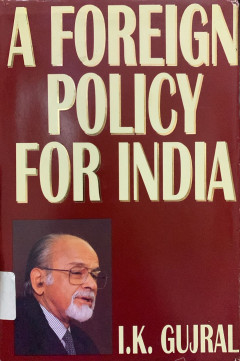
A Foreign policy for India
IK Gujral's "A Foreign Policy for India" outlines the vision and principles behind India's international diplomacy, as articulated by a senior statesman with deep experience in foreign relations. In the book, Gujral outlines his ideas on how India should conduct its foreign policy—emphasizing moral leadership, regional cooperation, and a commitment to peaceful coexistence with its neighbors. …
- Edisi
- -
- ISBN/ISSN
- -
- Deskripsi Fisik
- 337 pages : illustrations ; 24 cm
- Judul Seri
- -
- No. Panggil
- 954 GUJ f
 Karya Umum
  Filsafat
  Agama
Agama  Ilmu-ilmu Sosial
  Bahasa
  Ilmu-ilmu Murni
  Ilmu-ilmu Terapan
  Kesenian, Hiburan, dan Olahraga
  Kesusastraan
  Geografi dan Sejarah