Ditapis dengan

Soft Power: The means to sucess in world politics
Joseph Nye coined the term "soft power" in the late 1980s. It is now used frequently - and often incorrectly - by political leaders, editorial writers, and academics around the world. So what is soft power? Soft power lies in the ability to attract and persuade. Whereas hard power - the ability to coerce - grows out of a country's military or economic might, soft power arises from the attractiv…
- Edisi
- -
- ISBN/ISSN
- 1586483064
- Deskripsi Fisik
- xvi, 191 pages : illustrations ; 22 cm
- Judul Seri
- -
- No. Panggil
- 327.73 Nye s
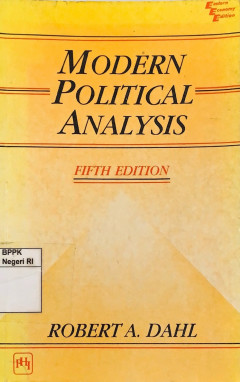
Modern political analysis
This classic introduction provides an analysis and description of democracy, political behavior, political evaluation, policy-making, and comparative political systems. Power and influence, pivotal features of the book, are depicted through concrete illustrations of people in power from the relatively powerless to the most powerful. Thus, the reader is invited to enter imaginatively into the ex…
- Edisi
- Fifth Edition
- ISBN/ISSN
- 81-203-0698-8
- Deskripsi Fisik
- xii, 157 pages : illustration, index ; 22 cm
- Judul Seri
- -
- No. Panggil
- 320 Dah m
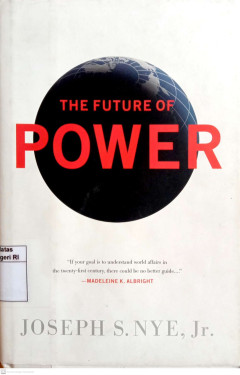
The future of power
In The Future of Power, Joseph S. Nye, Jr., a longtime analyst of power and a hands-on practitioner in government, delivers a new power narrative that considers the shifts, innovations, bold technologies, and new relationships that will define the twenty-first century. He shows how power resources are adapting to the digital age and how smart power strategies must include more than a country's …
- Edisi
- Ed.1
- ISBN/ISSN
- 978-1-58648-891-8
- Deskripsi Fisik
- xviii, 300 pages : Index ; 24 cm
- Judul Seri
- -
- No. Panggil
- 303.3 Nye f

Knowledge and power: The life of the mind and the conduct of government
We as a nation, have often tended to see problems as opportunities. In the face of conflicting demands, proliferating information, and rapid technological change, many of us would agree that imagination and integrity in the use of knowledge are essential if we are to make hard choices and move ahead.
- Edisi
- -
- ISBN/ISSN
- -
- Deskripsi Fisik
- 43 pages; 22 cm
- Judul Seri
- Occasional papers of the Council of Scholars ; no. 6
- No. Panggil
- 303.3 Bil k

Soft power : The means to success in world politics
Joseph Nye coined the term "soft power" to describe a nation's ability to attract and persuade. Whereas hard power-the ability to coerce- grows out of a country's military or economic might, soft power arises from the attractiveness of its culture, political ideals, and policies. Hard power remains crucial in a world of states trying to guard their independence and of non-state groups willin…
- Edisi
- -
- ISBN/ISSN
- 1586483064
- Deskripsi Fisik
- 191 pages : 23 cm.
- Judul Seri
- -
- No. Panggil
- 327. 73 Nye s

The paradox of American power: Why the worlds only superpower can't go it alone
Not since Rome has any nation had so much economic, cultural, and military power, but that power does not allow us to solve global problems like terrorism, environmental degradation, and the proliferation of weapons of mass destruction without involving other nations. The author focuses on the rise of these and other new challenges and explains clearly why America must adopt a more cooperative …
- Edisi
- -
- ISBN/ISSN
- 0195150880
- Deskripsi Fisik
- 222 pages : 25 cm.
- Judul Seri
- -
- No. Panggil
- 327. 73 Nye p

The ruler's imperative: Strategies for political survival in Asia and Africa
This book on political leadership in underdeveloped Africa and Asia as- sumes that a ruler's first desire is to retain his position at the apex of government while others press to displace him. THE RULER'S IMPERATIVE asks: Once positioned at the apex, what must a ruler do to remain in power and pursue more effectively the nation- building goals he sets for himself and his polity? How can he act…
- Edisi
- -
- ISBN/ISSN
- -
- Deskripsi Fisik
- ix, 275 pages : index ; 24 cm
- Judul Seri
- -
- No. Panggil
- 320.59960 Wri r
 Karya Umum
  Filsafat
  Agama
Agama  Ilmu-ilmu Sosial
  Bahasa
  Ilmu-ilmu Murni
  Ilmu-ilmu Terapan
  Kesenian, Hiburan, dan Olahraga
  Kesusastraan
  Geografi dan Sejarah