Ditapis dengan

Our Zimbabwe: An element of political economy
Our Zimbabwe: An Element of Political Economy offers an analytical overview of Zimbabwe’s economic and political structures in the years following independence. Arthur Jim Patsanza examines the nation’s development challenges, economic policies, and the relationship between political decision-making and economic outcomes. The book discusses issues such as state planning, resource distributi…
- Edisi
- -
- ISBN/ISSN
- 0-7974-0832-0
- Deskripsi Fisik
- 246 pages ; 21,5 cm
- Judul Seri
- -
- No. Panggil
- 338.9689 PAT o
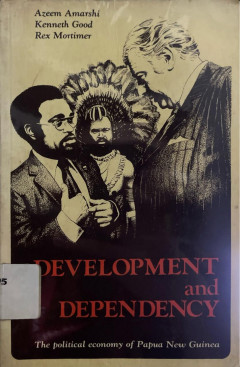
Development and Dependency
Development and Dependency examines the contrasting theories of economic development and dependency that have shaped global development discourse. The book analyzes how historical, political, and economic structures contribute to persistent inequalities between industrialized and developing nations. It explores concepts such as modernization, exploitation, peripheral economies, and the influenc…
- Edisi
- 1
- ISBN/ISSN
- 0 19 550582 4
- Deskripsi Fisik
- xviii, 261 pages : illustrations ; 21,5 cm
- Judul Seri
- -
- No. Panggil
- 330.9 AMA z

Iraq: The Eternal fire 1972 Iraqi oil nationalizaation in perspective
Iraq: The Eternal Fire – 1972 Iraqi Oil Nationalization in Perspective examines one of the most significant turning points in Iraq’s modern economic and political history: the nationalization of its oil industry in 1972. The book analyzes the circumstances that led to the decision, including international pressures, domestic political shifts, and Iraq’s growing assertion of sovereignty ov…
- Edisi
- 11
- ISBN/ISSN
- 0 86199 004 8
- Deskripsi Fisik
- 255 pages; 22,5 cm
- Judul Seri
- -
- No. Panggil
- 338.2 HUS i

Regional dynamics : Security, political and economic issues in the Asia-Pasif…
This collection of papers is only a subset of a much larger body of papers, the result of a collaboration among about 50 scholars from the Asia Pacific region, which have been commissioned under the so-called "Quadrilateral Project." That project was jointly sponsored by the Institute of East Asian Studies, University of California, Berkeley; the University of Tokyo, the Centre for Strategic an…
- Edisi
- -
- ISBN/ISSN
- 979-8026-10-1
- Deskripsi Fisik
- vi, 418 pages ; 21 cm
- Judul Seri
- -
- No. Panggil
- 330.95 Sca r
Secrets, lies and democracy
Another illusion-shattering piece from the man "The New York Times" called "arguably the most important intellectual alive". In 1970, about 90 per cent of international capital was used for trade and long-term investment - more or less productive things - and 10 per cent for speculation. By 1990, these figures had reversed. Haiti, a starving island, is exporting food to the US - about 35 times …
- Edisi
- First Published
- ISBN/ISSN
- 978-1-878-82504-9
- Deskripsi Fisik
- 128 pages ; 21 cm.
- Judul Seri
- -
- No. Panggil
- 330.9048 Cho s

Manufacturing consent: The political economy of the mass media
In this pathbreaking work, Edward S. Herman and Noam Chomsky show that, contrary to the usual image of the news media as cantankerous, obstinate, and ubiquitous in their search for truth and defense of justice, in their actual practice they defend the economic, social, and political agendas of the privileged groups that dominate domestic society, the state, and the global order. Based on a s…
- Edisi
- -
- ISBN/ISSN
- 0-375-71449-9
- Deskripsi Fisik
- lxiv, 412 pages : index ; 23,5 cm
- Judul Seri
- -
- No. Panggil
- 330.9 Her m
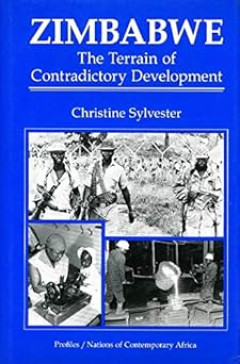
Zimbabwe: The terrain of contradictory development
A profile which focuses on the continuities and discontinuities in the historical patterns of political economy in Zimbabwe. It is a portrait of a country that potentially may be the pride of Africa but may also be only another example of a country whose socialist vision has not come to fruition.
- Edisi
- -
- ISBN/ISSN
- 0813306906
- Deskripsi Fisik
- xii, 212 pages : illustration ; 24 cm.
- Judul Seri
- Profiles nations of contemporary Africa series
- No. Panggil
- 338.96891 Syl z
One Southeast Asia in a new regional and international setting
The book consists of 17 papers and is devided into two parts. Part I consists of 7 papers dealing with issues on international regimes and the emerging new international order. Part II presents 10 papers discussing issues on ASEAN's expansion of its membership seen from the economic and socio-political dimensions.
- Edisi
- -
- ISBN/ISSN
- Hadi Soesastro
- Deskripsi Fisik
- xii, 204 pages : 25 cm
- Judul Seri
- -
- No. Panggil
- 338.959 Soe o

Japan between Asia and the West: Economic power and strategic balance
Japan seeks economic competitiveness vis-a-vis the West and economic dominance in Asia, but it mainly competes through cooperative use of economic resources, which facilitates realization of the goals of partner nations. This book studies Japan's balance between the United States and East Asia by focusing on the use of economic power - defense spending, consumption, and investment - to advance …
- Edisi
- -
- ISBN/ISSN
- 0-7656-0777-8
- Deskripsi Fisik
- xiv, 225 pages ; 23 cm.
- Judul Seri
- -
- No. Panggil
- 337.52 Wan j
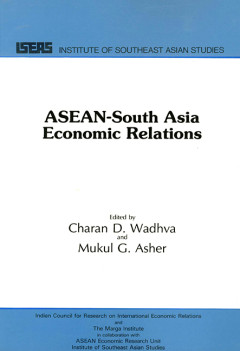
ASEAN-South Asia economic relations
This volume is the result of collaborative research between ASEAN and South Asian scholars and deals with economic relations between two important regions.
- Edisi
- -
- ISBN/ISSN
- 9971-902-98-2
- Deskripsi Fisik
- ix, 384 pages : illustrations (black and white) ; 24 cm
- Judul Seri
- -
- No. Panggil
- 337 Wad a
 Karya Umum
  Filsafat
  Agama
Agama  Ilmu-ilmu Sosial
  Bahasa
  Ilmu-ilmu Murni
  Ilmu-ilmu Terapan
  Kesenian, Hiburan, dan Olahraga
  Kesusastraan
  Geografi dan Sejarah