Ditapis dengan
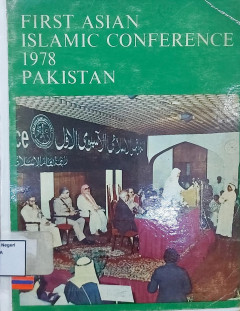
First Asian islamic conference 1978 Pakistan
The First Asian Islamic Conference 1978 – Pakistan presents a collection of papers, addresses, and resolutions produced during a landmark regional gathering of Muslim scholars, intellectuals, political representatives, and community leaders from across Asia. The conference sought to strengthen intra-Asian Islamic solidarity, examine the geopolitical and social challenges confronting Muslim so…
- Edisi
- -
- ISBN/ISSN
- -
- Deskripsi Fisik
- v, 147 pages; illustration: 25 cm
- Judul Seri
- -
- No. Panggil
- 060 TIM f

Pakistan: Glimpses of vistas, history and culture
Pakistan: Glimpses of Vistas, History, and Culture presents a comprehensive overview of Pakistan's rich natural resources, long history, and cultural diversity. Riaz Mohammad Khan describes a variety of stunning landscapes, from the northern mountains to the richly traditional hinterland. Furthermore, the book traces Pakistan's history from pre-independence times, the roles of key figures, and …
- Edisi
- -
- ISBN/ISSN
- 978-969-552-010-9
- Deskripsi Fisik
- 245 pages: illustration; 35 cm
- Judul Seri
- -
- No. Panggil
- 954.91 KHA p

Pakistan in search of democracy 1947-77
Pakistan in Search of Democracy 1947–77 examines Pakistan's long journey in building a democratic political system from its independence in 1947 to 1977. Hamid Yusuf provides an in-depth analysis of the challenges facing the new nation, including political instability, weak democratic institutions, internal conflicts, and the role of the military in governance. Through chronological analysis,…
- Edisi
- -
- ISBN/ISSN
- -
- Deskripsi Fisik
- xvi, 189 pages: 25 cm
- Judul Seri
- -
- No. Panggil
- 954.9 YUS p
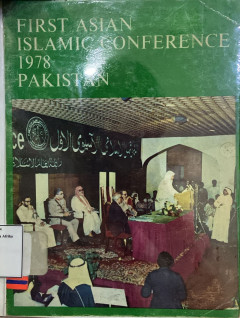
First Asian islamic conference 1978 Pakistan
The First Asian Islamic Conference 1978 compiles official documentation, speeches, and discussions from the first Asian Islamic Conference held in Pakistan in 1978. The conference brought together leaders, scholars, and delegates from various Asian countries to discuss key issues in the Islamic world, including solidarity among Muslim nations, strengthening political and economic cooperation, a…
- Edisi
- -
- ISBN/ISSN
- -
- Deskripsi Fisik
- v, 147 pages: illustration; 25 cm
- Judul Seri
- -
- No. Panggil
- 060 TIM f

Lahore: Its history, architectural remains and antiquites
Syad Muhammad Latif's Lahore: Its History, Architectural Remains, and Antiquities is an in-depth study of the long history of Lahore, one of the oldest centers of culture and civilization in South Asia. Written in 1892, this work documents Lahore's development from ancient times, through the Hindu-Buddhist period, through Muslim domination, the Mughal era, and through Sikh and British rule. In…
- Edisi
- -
- ISBN/ISSN
- -
- Deskripsi Fisik
- xii, 426 pages: illustration; 24 cm
- Judul Seri
- -
- No. Panggil
- 720,.954 LAT l
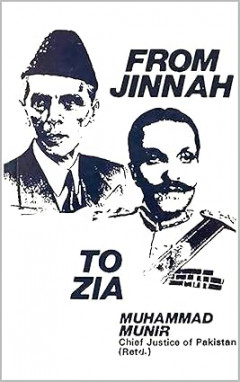
From jinnah to zia
This book concerned with a part of that history, namely, the ideological and geo¬graphical changes in Pakistan. Its aim is to show how from the Secularism of Quaid-i-Azam, Muhammad Ali Jinnah, the State has drafted into the hands of an orthodox element which claims that they will make Pakistan a totally Islamic State, as it was in the days of Nizam-i-Mustafa. There can be no doubt that Jinnah…
- Edisi
- Second Edition
- ISBN/ISSN
- -
- Deskripsi Fisik
- xx, 183 pages; 20 cm
- Judul Seri
- -
- No. Panggil
- 954.9205 MUN f
Pakistan: A Country study
Richard F. Nyrop's Pakistan: A Country Study (1983) is a comprehensive study of the geographic, social, political, economic, military, and cultural conditions of Pakistan in the early 1980s. The book is structured as an analytical report that provides a comprehensive overview of Pakistan's historical development from independence to the contemporary era. It examines the diverse social structur…
- Edisi
- -
- ISBN/ISSN
- -
- Deskripsi Fisik
- xvi, 453 pages: illustration; 24 cm
- Judul Seri
- -
- No. Panggil
- 954.910 NYR p
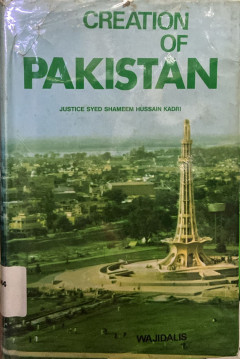
Creation of Pakistan
Justice Syed Shameem Hussain Kadri's book, Creation of Pakistan, examines the historical process, political dynamics, and social conditions that led to the formation of Pakistan in 1947. The author highlights the political struggle of Muslims in the Indian subcontinent, the roles of key figures, and the significant events that influenced the birth of the nation. Using a historical and analytica…
- Edisi
- -
- ISBN/ISSN
- -
- Deskripsi Fisik
- xviii, 521 pages: illustration; 23 cm
- Judul Seri
- -
- No. Panggil
- 954.91 KAD c

Foundations of Pakistan: All India muslim league documents: 1906-1947
Foundations of Pakistan: All-India Muslim League Documents, 1906–1947 is a comprehensive collection of primary documents chronicling the political journey of the Muslim movement in the Indian subcontinent prior to the founding of Pakistan. Compiled by Syed Sharifuddin Pirzada, the book chronicles resolutions, speeches, correspondence, meeting minutes, and key decisions of the All-India Muslim…
- Edisi
- -
- ISBN/ISSN
- -
- Deskripsi Fisik
- lxxiv, 605 pages: 25 cm
- Judul Seri
- -
- No. Panggil
- 954.9 PIR f
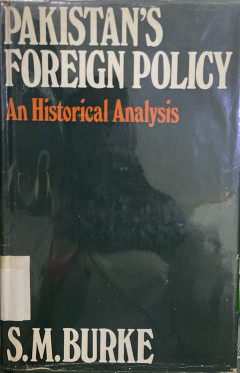
Pakistan's foreign policy
S. M. Burke's Pakistan's Foreign Policy provides an in-depth analysis of the dynamics, orientation, and evolution of Pakistan's foreign policy since its founding in 1947. Burke explores the historical, geopolitical, and ideological factors that shaped Pakistan's relations with major powers, including the United States, India, China, and the Soviet Union. The book also examines internal challeng…
- Edisi
- -
- ISBN/ISSN
- -
- Deskripsi Fisik
- ix, 432 pages: 25 cm
- Judul Seri
- -
- No. Panggil
- 327.5491 BUR p
 Karya Umum
  Filsafat
  Agama
Agama  Ilmu-ilmu Sosial
  Bahasa
  Ilmu-ilmu Murni
  Ilmu-ilmu Terapan
  Kesenian, Hiburan, dan Olahraga
  Kesusastraan
  Geografi dan Sejarah