Ditapis dengan
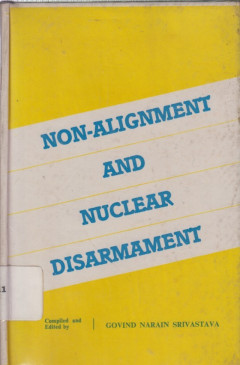
Non-alignment and nuclear disarmament
This volume examines the relationship between the Non-Aligned Movement (NAM) and global efforts toward nuclear disarmament. Compiled and edited by Govind Narain Srivastava, it analyzes NAM’s political stance on nuclear weapons, the advocacy for disarmament, and the movement’s influence on international peace negotiations. The book provides insights into the strategic, moral, and diplomatic …
- Edisi
- -
- ISBN/ISSN
- -
- Deskripsi Fisik
- 97 pages ; 22 cm
- Judul Seri
- -
- No. Panggil
- 327.174 SRI n
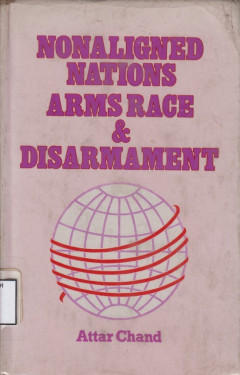
Nonaligned nations: Arms race and disarmament
This book presents a comprehensive study of the arms race, nuclear weapons, and global disarmament from the perspective of the Non-Aligned Nations. It analyzes the strategic importance of the Indian Ocean, the dynamics of détente, and the political role played by nonaligned countries within the United Nations. Through discussions on peace initiatives and global security issues, the author high…
- Edisi
- -
- ISBN/ISSN
- -
- Deskripsi Fisik
- xliv, 373 pages ; 22 cm
- Judul Seri
- -
- No. Panggil
- 327.17 CHA n
India and disarmament
Provides an analytical study of India’s disarmament policy and its role in global efforts to reduce and eliminate weapons of mass destruction. The book examines India’s historical commitment to universal disarmament, its diplomatic initiatives, and its proposals at international fora. It also discusses the constraints India faces — including national security considerations, geopolitical …
- Edisi
- -
- ISBN/ISSN
- -
- Deskripsi Fisik
- 294 pages ; 22,5 cm
- Judul Seri
- -
- No. Panggil
- 954.3271 IND i

The peninsula question: A chronicle of the second Korean nuclear crisis
Through interviews, gives a behind-the-scenes look at negotiations to denuclearize the Korean peninsula. Offering multiple perspectives on the second Korean nuclear crisis, provides a window of understanding on the historical, geopolitical, and security concerns at play on the peninsula since 2002, paying special attention to China's dealings with North Korea
- Edisi
- -
- ISBN/ISSN
- 978-0-8157-3010-1
- Deskripsi Fisik
- xii, 592 pages : index ; 25 cm.
- Judul Seri
- -
- No. Panggil
- 327.1747095193 Fun p

Disarmament as humanitarian action from perspective to practice
This volume provides practical insights from humanitarian contexts such as international work on explosive remnants of war, small arms and anti- personnel mines.
- Edisi
- -
- ISBN/ISSN
- 92-9045-182-3
- Deskripsi Fisik
- x, 168 pages ; 21 cm
- Judul Seri
- -
- No. Panggil
- 327.1747 Bor d

Disarmament: The world at a critical turning point
This publication includes the edited transcripts of the panel discussions held in the United Nations by the NGO Committee on Disarmament in 1998 and early 1999 and the presentations made by NGOs on May 11, 1999 at the third Prep Com for the Non-Proliferation Treary Review Conference to be held in the year 2000. We are very much dependent upon your reactions and suggestions to help us plan what …
- Edisi
- -
- ISBN/ISSN
- 92-1-142231-0
- Deskripsi Fisik
- vi, 356 pages ; 28 cm
- Judul Seri
- -
- No. Panggil
- 327.17405 Uni d
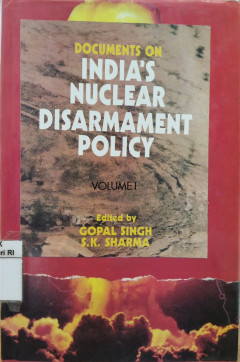
Documents on India's nuclear disarmament policy volume I
Contents: 1. Text of the UN general assembly resolution on principles governing the general regulations and reduction of armaments 41 (I) adopted on 14 December 1946. India supported it 2. Statement made by Vijaya Laxmi Pandit in the UN general assembly, 25 September 1948 (Extracts) 3. Statement made by Vijaya Laxmi Pandit in the UN general assembly, 4 November 1948 4. Text of the UN genera…
- Edisi
- Vol. 1 ; Cet. 1
- ISBN/ISSN
- 81-86565-64-7
- Deskripsi Fisik
- xviii, 573 pages ; 22 cm
- Judul Seri
- -
- No. Panggil
- 355.825119 Sin d
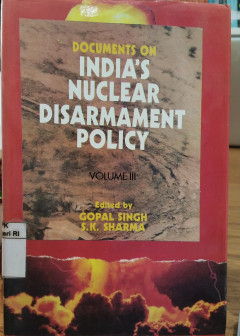
Documents on India's nuclear disarmament policy volume III
Contents: 1. Statement made by M. Dubey in the first committee of the UN on 15 November 1984 on disarmament 2. Statement made by M. Dubey in UN first committee on 27 November 1984 on draft resolutions on disarmament 3. Statement made by Khursheed Alan Khan in the UN general assembly on 26 September 1985 on nuclear disarmament (Extracts) 4. Statement made by G.G. Swell in the first committee…
- Edisi
- Vol. 3 ; Cet. 1
- ISBN/ISSN
- 81-86565-64-7
- Deskripsi Fisik
- xx, 1007-1562 pages ; 22 cm
- Judul Seri
- -
- No. Panggil
- 355.825119 Sin d
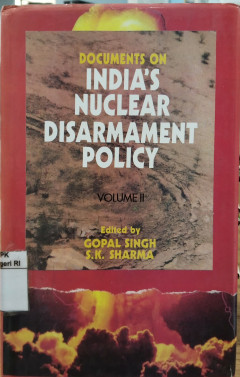
Documents on India's nuclear disarmament policy volume II
Contents: 1. Statement made by Sardar Swaran Singh in UN general assembly on 14 December 1964 2. Statement made by Sardar Swaran Singh in Rajya Sabha on 22 December 1964 (Extracts) 3. Statement made by V.C. Trivedi in the disarmament commission on 14 May 1965 on Chinese second nuclear explosion 4. The prime minister Lal Bahadur Shastri's statement on 15 May 1965 at an Indo-Soviet friendship…
- Edisi
- Vol. 2 ; Cet. 1
- ISBN/ISSN
- 81-86565-64-7
- Deskripsi Fisik
- xiv, 575-1006 pages ; 22 cm
- Judul Seri
- -
- No. Panggil
- 355.825119 Sin d

Beyond arms control: Challenges and choices for nuclear disarmament
Beyond arms control: challenges and choices for nuclear disarmament is a collaborative work of non-governmental researchers and activists who critically examine the mainstream discourse of nuclear weapons. The book explores some of the most important challenges that governments and civil society will face at the 2010 NPT Review Conference and beyond, highlighting the prospects and pitfalls for …
- Edisi
- -
- ISBN/ISSN
- -
- Deskripsi Fisik
- xii, 250 pages ; 21, 5 cm
- Judul Seri
- -
- No. Panggil
- 355.825119 Ach b
 Karya Umum
  Filsafat
  Agama
Agama  Ilmu-ilmu Sosial
  Bahasa
  Ilmu-ilmu Murni
  Ilmu-ilmu Terapan
  Kesenian, Hiburan, dan Olahraga
  Kesusastraan
  Geografi dan Sejarah