Ditapis dengan
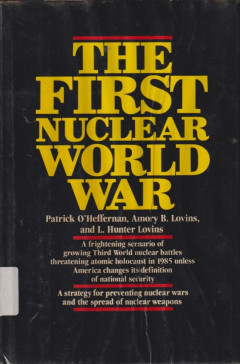
The First nuclear world war
The First Nuclear World War presents a strategic analysis aimed at preventing future nuclear conflicts and limiting the spread of nuclear weapons. Written by Patrick O’Heffernan, Amory B. Lovins, and L. Hunter Lovins, the book explores the political, military, and technological factors that shape global nuclear policy. It examines the dangers posed by nuclear proliferation, the risks of misca…
- Edisi
- -
- ISBN/ISSN
- 0-688-01589-1
- Deskripsi Fisik
- 444 pages ; 24 cm
- Judul Seri
- -
- No. Panggil
- 355.0217 OHE t
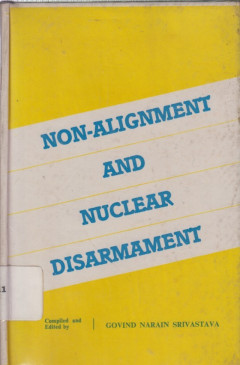
Non-alignment and nuclear disarmament
This volume examines the relationship between the Non-Aligned Movement (NAM) and global efforts toward nuclear disarmament. Compiled and edited by Govind Narain Srivastava, it analyzes NAM’s political stance on nuclear weapons, the advocacy for disarmament, and the movement’s influence on international peace negotiations. The book provides insights into the strategic, moral, and diplomatic …
- Edisi
- -
- ISBN/ISSN
- -
- Deskripsi Fisik
- 97 pages ; 22 cm
- Judul Seri
- -
- No. Panggil
- 327.174 SRI n
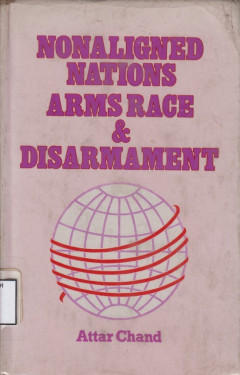
Nonaligned nations: Arms race and disarmament
This book presents a comprehensive study of the arms race, nuclear weapons, and global disarmament from the perspective of the Non-Aligned Nations. It analyzes the strategic importance of the Indian Ocean, the dynamics of détente, and the political role played by nonaligned countries within the United Nations. Through discussions on peace initiatives and global security issues, the author high…
- Edisi
- -
- ISBN/ISSN
- -
- Deskripsi Fisik
- xliv, 373 pages ; 22 cm
- Judul Seri
- -
- No. Panggil
- 327.17 CHA n
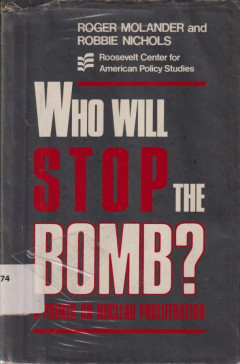
Who will stop the bomb?: A Primer on nuclear proliferation
This book provides a clear introduction to the issues surrounding nuclear proliferation and the global dangers posed by the spread of nuclear weapons. It explains the development of the nuclear arms race, the political and strategic motivations behind nations seeking nuclear capability, and the challenges faced by the international community in preventing further expansion. Molander and Nichols…
- Edisi
- -
- ISBN/ISSN
- 0-8160-1283-0
- Deskripsi Fisik
- x, 150 pages : illustration ; 23,5 cm
- Judul Seri
- -
- No. Panggil
- 327.174 MOL w

Red cloud at dawn: Truman, stalin, and the end of the atomic monopoly
Red Cloud at Dawn depicts the end of the United States' atomic bomb monopoly after the Soviet Union successfully detonated its first atomic bomb in 1949. Michael D. Gordin traces the geopolitical dynamics between Truman and Stalin, the developments in nuclear intelligence, and the global impact of the birth of the nuclear arms competition era. The book combines political history, diplomacy, and…
- Edisi
- Edisi pertama
- ISBN/ISSN
- 978-0-374-25682-1
- Deskripsi Fisik
- xii, 402 pages : illustration ; 23,5 cm
- Judul Seri
- -
- No. Panggil
- 355.0217 GOR d
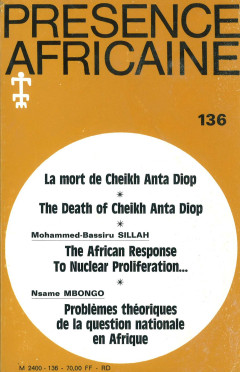
Presence Africaine: Revue culturelle du nonde noir, no. 136
The 136th issue of Présence Africaine contains several important articles on contemporary African figures and issues. The edition opens with an article on the death of the great historian and anthropologist Cheikh Anta Diop, followed by Mohammed-Bassiru Sillah's study of African states' responses to the issue of global nuclear proliferation. Another article, written by M. Mbongo, addresses the…
- Edisi
- -
- ISBN/ISSN
- -
- Deskripsi Fisik
- 187 pages ; 21,5 cm
- Judul Seri
- -
- No. Panggil
- 960.3 SIL p

A World beyond healing: The Prologue and aftermath of nuclear war
Nicholas Wade's A World Beyond Healing is a profound study of the devastating effects of nuclear war, both before and after the explosion. Wade describes how geopolitical tensions and the nuclear arms race create a constant threat to humanity. The book examines the medical, ecological, psychological, and social consequences of nuclear war, as well as the inability of the international system to…
- Edisi
- -
- ISBN/ISSN
- 0-393-02335-4
- Deskripsi Fisik
- 190 pages : illustration ; 21,5 cm
- Judul Seri
- -
- No. Panggil
- 355.0217 WAD w

Political realism and international morality: Ethics in the nuclear age
This book is a collection of papers presented at the Tenth Plenary Conference of the American Section of the International Association for Philosophy of Law and Social Philosophy, held in 1984 at the University of Notre Dame. It provides an in-depth discussion of the relationship between political realism and international morality, particularly in the context of the nuclear age. The contributo…
- Edisi
- -
- ISBN/ISSN
- 0-8133-0456-3
- Deskripsi Fisik
- x, 271 pages ; 23 cm
- Judul Seri
- -
- No. Panggil
- 172.4 KIP p
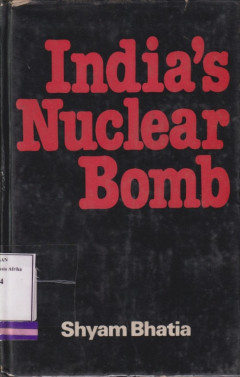
India's nuclear bomb
An in-depth investigation into India’s pursuit of nuclear capability during the Cold War era. The book examines political motivations, scientific developments, and strategic calculations behind India’s nuclear programme. Bhatia discusses key events leading to the first nuclear test in 1974 (“Smiling Buddha”), responses from global powers, and the domestic debates surrounding nuclear pol…
- Edisi
- -
- ISBN/ISSN
- 0-7069-0770-5
- Deskripsi Fisik
- 169 pages ; 22 cm
- Judul Seri
- -
- No. Panggil
- 355.8251 BHA i
Nuclear India: Volume II
This first volume of Nuclear India by J. P. Jain provides an in-depth introduction to the origins, development, and strategic foundations of India’s nuclear program. The book examines India’s political motivations, scientific progress, and security concerns within the regional and global context. Jain discusses historical milestones, policy debates, technological challenges, and India’s p…
- Edisi
- -
- ISBN/ISSN
- -
- Deskripsi Fisik
- vxvii, 440 pages ; 22 cm
- Judul Seri
- -
- No. Panggil
- 355.0217 JAI n
 Karya Umum
  Filsafat
  Agama
Agama  Ilmu-ilmu Sosial
  Bahasa
  Ilmu-ilmu Murni
  Ilmu-ilmu Terapan
  Kesenian, Hiburan, dan Olahraga
  Kesusastraan
  Geografi dan Sejarah