Ditapis dengan

From vulnerability to opportunity: The role of education in safeguarding migr…
Children of Indonesian migrant workers in Sabah face significant barriers to legal documentation, access to education, and protection from exploitation. These challenges present both a humanitarian concern and a diplomatic priority for Indonesia. This policy brief proposes a comprehensive approach to safeguarding their educational rights through strengthened bilateral diplomacy with Malaysia, g…
- Edisi
- -
- ISBN/ISSN
- -
- Deskripsi Fisik
- -
- Judul Seri
- -
- No. Panggil
- Sesparlu 76-2025

Efforts to shorten the communication gap between Indonesian citizens and Indo…
Since 2015, the Government of Indonesia has implemented a moratorium on sending Indonesian Migrant Workers (PMI) to Middle Eastern countries. This was done because of the high number of PMI problems in the Middle East. However, sending PMIs to the Middle East continues using various methods, including non-procedural methods. Sending PMI with non-procedural methods causes PMI to be vulnerable t…
- Edisi
- -
- ISBN/ISSN
- -
- Deskripsi Fisik
- Digital File
- Judul Seri
- -
- No. Panggil
- Sesdilu 72-2022

Finding the best policy fot ex-islamic states (IS) refugee in Syria; to repat…
This paper examines repatriation policy for approximately 1,276 Indonesian ex-ISIS members taking refuge in three camps managed by the Syrian Democratic Force (SDF): Ain-Issa, Al-Hol, and Al-Roj. Although President Joko Widodo announced in February 2020 that Indonesia would not repatriate them except for orphans aged 10 or under in particular cases, repatriation opportunities remain open based …
- Edisi
- -
- ISBN/ISSN
- -
- Deskripsi Fisik
- -
- Judul Seri
- -
- No. Panggil
- Sesdilu 69-2021

The loophole of the protection in the individual Scheme of Indonesian Specifi…
This paper examines protection gaps faced by Indonesian Specified Skilled Workers (SSW) in Japan under the individual sending scheme, despite the bilateral cooperation established in 2019 and a significant increase to 69,537 workers as of June 2025. Analysis using systems thinking and design thinking identifies key weaknesses: lack of worker awareness regarding mortality and health insurance, l…
- Edisi
- -
- ISBN/ISSN
- -
- Deskripsi Fisik
- -
- Judul Seri
- -
- No. Panggil
- Sesdilu 80-2026
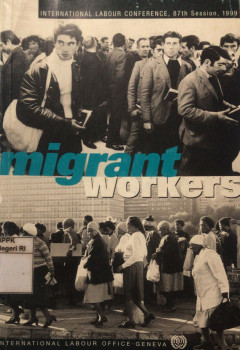
Migrant workers
The contents of this book: I. Review of standards and activities relating to the protection of migrant workers. II. Scope of the instruments. III. The migration process. IV. Migrant workers who are in an irregular situation and/or illegally employed. V. Equality of opportunity and treatment. VI. Migrants in society. VII. Employment, residence and return.
- Edisi
- -
- ISBN/ISSN
- 92-2-110808-2
- Deskripsi Fisik
- xiv, 323 pages ; 24 cm
- Judul Seri
- -
- No. Panggil
- 331.062 Con m
 Karya Umum
 Filsafat
 Agama
 Ilmu-ilmu Sosial
 Bahasa
 Ilmu-ilmu Murni
 Ilmu-ilmu Terapan
 Kesenian, Hiburan, dan Olahraga
 Kesusastraan
 Geografi dan Sejarah