Ditapis dengan

No to exploitation: The Economic sase of the non-aligned
This book examines the economic arguments underlying the Non-Aligned Movement's stance against global economic exploitation. Menon and Sharma outline the structural inequalities between developed and developing countries and offer an analysis of the need for a more equitable international economic order. Through historical, economic, and political analysis, the book explains how non-aligned cou…
- Edisi
- -
- ISBN/ISSN
- -
- Deskripsi Fisik
- xxxii, 163 pages ; 25 cm
- Judul Seri
- -
- No. Panggil
- 327.172 MEN n

ASEAN economic cooperation and integration: Progress, challenges and future d…
ASEAN economic cooperation and integration have come a long way since the organisation's early days, when cooperation was more political and diplomatic than economic in nature. ASEAN now constitutes the most ambitious organization of regional cooperation in the developing world. This book investigates the economics of various ASEAN and ASEAN-centric economic integration initiatives, focusing in…
- Edisi
- -
- ISBN/ISSN
- 978-1-107-50387-8
- Deskripsi Fisik
- xxi, 195 pages : illustrations ; 22 cm.
- Judul Seri
- -
- No. Panggil
- 330.959 Chi a
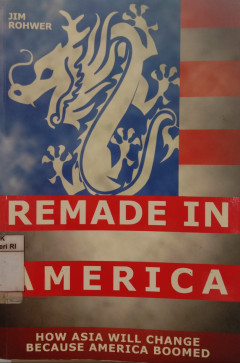
Remade in America: How Asia will change because America boomed
Armed with a thorough knowledge of Asia, Jim Rohwer is a benevolent but sharp witness of the region's fortunes. He gathers hard facts and opinions from impeccable sources and builds around them a very compelling picture of Asia's need to feed on the best standards America can offer. Asia ought to be selective in the process, and Jim Rohwer offers penetrating views on how the countries of the re…
- Edisi
- -
- ISBN/ISSN
- 0-471-47921-7
- Deskripsi Fisik
- xxi, 409 pages : illustrations : index ; 24 cm
- Judul Seri
- -
- No. Panggil
- 330.95 Roh r

Global Paradox: The bigger the world economy, the more powerful its smallest …
In Global Paradox, John Naisbitt explores the new global environment of the 1990s and the enormous opportunities and challenges that countries, businesses and individuals will face in this period of growth and transformation at the end of the millennium.
- Edisi
- -
- ISBN/ISSN
- 0-380-72489-8
- Deskripsi Fisik
- 392 pages : index ; 18 cm.
- Judul Seri
- -
- No. Panggil
- 330.900112 Nai g

New Zealand in world affairs, 1945-1957
The authoritative New Zealand in World Affairs Volume I, covering the period from the Second World War until 1957, was first published in 1977. Still in demand, it has been reprinted in conjunction with the publication of New Zealand in World Affairs Volume II 1957-1972.
- Edisi
- Volume I
- ISBN/ISSN
- 0-7055-0638-X
- Deskripsi Fisik
- 204 pages : index ; 22 cm
- Judul Seri
- -
- No. Panggil
- 327.93 New n

New Zealand in world affairs, 1957-1972
New Zealand in World Affairs Volume II covers the period from 1957 to 1972, when New Zealand diplomacy moved irrevocably away from the Commonwealth and British framework of the past, and when foreign relations first became the object of sustained debate within the country. The volume is introduced by Malcolm Templeton and essays are contributed by Roderic Alley, Roberto Rabel, Rita Ricketts and…
- Edisi
- Volume II
- ISBN/ISSN
- 0-908772-11-4
- Deskripsi Fisik
- xi, 261 pages : ilustrasi : index ; 22 cm
- Judul Seri
- -
- No. Panggil
- 327.93 Kin n

Beyond fifty years of Nigeria's foreign policy: Issues, challenges, and prosp…
How does one predict the future course a country should take to achieve its "vision" in a globalizing world that is very dynamic? It is important to understand the nature of the global order in order to be able to craft a foreign policy that serves, Nigeria's national interest.
- Edisi
- -
- ISBN/ISSN
- 978-002-092-6
- Deskripsi Fisik
- xxiv, 536 pages : index ; 23 cm
- Judul Seri
- -
- No. Panggil
- 327.669 Eze b

Globalization: An Asian perspective on modernity and politics in America
Rappa analyzes the nature of neo-liberalism by raising important theoretical questions about the current relationships between American business structures, political norms, popular culture, and the world of business. The book is refreshing because it focuses on the three themes of "hope," "optimism," and "progress" that constitute what has arguably come to represent the American Dream.
- Edisi
- -
- ISBN/ISSN
- 9812104186
- Deskripsi Fisik
- xii, 322 pages : index ; 23 cm.
- Judul Seri
- -
- No. Panggil
- 320.973 5 Rap g

Security: A new framework for analysis
The authors argue that security is a particular type of politics applicable to a wide range of issues. Answering the traditionalist charge that this model makes the subject incoherent, they offer a constructivist operational method for distinguishing the process of securitization from that of politicization. Their approach incorporates the traditionalist agenda and dissolves the artificial boun…
- Edisi
- -
- ISBN/ISSN
- 1-55587-784-2
- Deskripsi Fisik
- viii, 239 pages : bibl: hlm 215-230 : index ; 23 cm
- Judul Seri
- -
- No. Panggil
- 303.482 Buz s
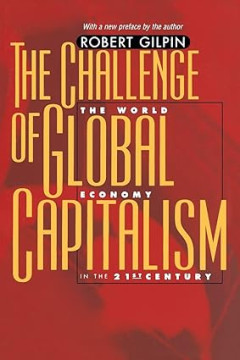
The challenge of global capitalism
Many individuals proclaim that global capitalism is here to stay. Unfettered markets, they argue, now drive the world, and all countries must adjust, no matter how painful this may be for some. Robert Gilpin, author of the widely acclaimed Political Economy of International Relations (Princeton, 1987), urges us, however, not to take an open and integrated global economy for granted. Rather, we …
- Edisi
- -
- ISBN/ISSN
- 0-691-04935-1
- Deskripsi Fisik
- xxxiv, 373 pages ; 23 cm
- Judul Seri
- -
- No. Panggil
- 337.21 Gil c
 Karya Umum
  Filsafat
  Agama
Agama  Ilmu-ilmu Sosial
  Bahasa
  Ilmu-ilmu Murni
  Ilmu-ilmu Terapan
  Kesenian, Hiburan, dan Olahraga
  Kesusastraan
  Geografi dan Sejarah