Ditapis dengan

Koran, Kalashnikov and Laptop : The Neo-Taliban insurgency in Afghanistan
Since the Allied invasion of Afghanistan in 2002, the Bush administration has celebrated the imminent demise of the Taliban, with claims of a "moral and psychological defeat" playing a prominent role in the presidential elections of 2004. Some commentators suggested that "reconstruction and development" had won over the Afghan population, despite widespread criticism of the meager distribution …
- Edisi
- -
- ISBN/ISSN
- 978-1-85065-872-6
- Deskripsi Fisik
- xv, 259 pages : illustrations ; 23 cm
- Judul Seri
- -
- No. Panggil
- 958.1047 GIO k

The marketing of rebellion: Insurgents, media, and international activism
How do a few Third World political movements become global causes célèbres, while most remain isolated? This book rejects dominant views that needy groups readily gain help from selfless nongovernmental organizations (NGOs). Instead, they face a Darwinian struggle for scarce resources where support goes to the savviest, not the neediest. Examining Mexico's Zapatista rebels and Nigeria's Ogoni…
- Edisi
- First Published
- ISBN/ISSN
- 978-0-521-60786-5
- Deskripsi Fisik
- xiv, 237 pages : bibl: hlm 207-225 : index ; 23 cm
- Judul Seri
- -
- No. Panggil
- 322.4 Bob m

The struggle for Yemen and challenge of Al-Qaeda in the Arabian Peninsula
In recent years, al-Qaeda in the Arabian Peninsula (AQAP) has been widely recognized as a more dangerous regional and international terrorist organization than the original al-Qaeda led by Osama bin Laden until his death in 2011. In 2010-11, AQAP was able to present a strong challenge to Yemen's government by capturing and retaining large areas in the southern part of the country. Yemen's new r…
- Edisi
- -
- ISBN/ISSN
- 1-58487-576-3
- Deskripsi Fisik
- xiii, 105 pages ; 23 cm
- Judul Seri
- -
- No. Panggil
- 355.07 Ter s
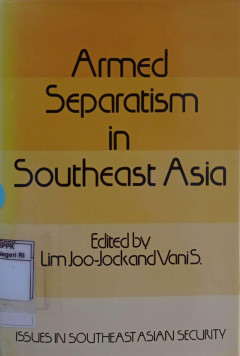
Armed separatism in Southeast Asia
This book is the second in a series Issues in Southeast Asian Security and deals with armed separatism in Southeast Asia. The situation differs markedly in the several countries studied. Besides the analyses of the politics of separatism and its military aspects, the questions of development, of culture and ethnicity are centrally relevant to the growth of separatist tendencies. All these are e…
- Edisi
- -
- ISBN/ISSN
- 9971902516
- Deskripsi Fisik
- vii, 270 pages : maps ; 23 cm
- Judul Seri
- -
- No. Panggil
- 363.959 Lim a

Burma: Insurgency and the politics of ethnicity
Burma remains a land in deep crisis. The popular uprising of 1988 swept away 26 years of military rule under General Ne Win in name only. The National League for Democracy of Aung San Suu Kyi won a landslide victory in the 1990 election. But, as this book relates, the military remained in control and the future of Burma looks more problematic than ever. With unparalleled command of largely inac…
- Edisi
- First Edition
- ISBN/ISSN
- 0862328691
- Deskripsi Fisik
- xviii, 492 pages : index, notes ; 25 cm
- Judul Seri
- -
- No. Panggil
- 959.105 Smi b
 Karya Umum
  Filsafat
  Agama
Agama  Ilmu-ilmu Sosial
  Bahasa
  Ilmu-ilmu Murni
  Ilmu-ilmu Terapan
  Kesenian, Hiburan, dan Olahraga
  Kesusastraan
  Geografi dan Sejarah