Ditapis dengan
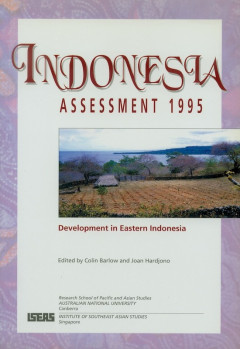
Indonesia assessment 1995: Development in Eastern Indonesia
Indonesia Assessment 1995 contains two main sections: one overviewing current Indonesian economic and political conditions, and one examining economic and social developments in Eastern Indonesia. This is the vast region of 25 million people, lying between Java, Malaysia, the Philippines and Australia. The book provides not only an up-do-date overview of Indonesia in 1995, but also one of the f…
- Edisi
- -
- ISBN/ISSN
- 981-3055-18-9
- Deskripsi Fisik
- xxviii, 287 pages : illustrations (black and white) : index ; 22 cm
- Judul Seri
- -
- No. Panggil
- 330.9598 Bar i

Indonesia in transition: Social aspects of reformasi and crisis
Indonesia enters the new millennium at a time of transition. It has experienced several crises - in particular the economic crisis of 1997-98, a severe intensification of its environmental degradation, and more recently the East Timor crisis, the ongoing Aceh demand for independence, the change of government from the autocratic Soeharto regime to one democratically elected and under the leaders…
- Edisi
- -
- ISBN/ISSN
- 9812300937
- Deskripsi Fisik
- xxviii, 379 pages : index ; 23 cm
- Judul Seri
- -
- No. Panggil
- 320.9598 Man i

The kapitan Cina of Batavia 1837-1942: A history of Chinese establishment in …
In the Dutch East Indies, in Batavia in particular, the kapitan Cina institution lasted until the last days of Dutch rule. And whereas in other parts of Southeast Asia, such as the Straits Settlements, the kapitan Cina was an unofficial position, in the Dutch East Indies it was an integral part of the colonial administration
- Edisi
- -
- ISBN/ISSN
- 979-428-257-X
- Deskripsi Fisik
- xii, 287 pages : illustration : bibl: hlm 260-278 : index ; 22 cm
- Judul Seri
- -
- No. Panggil
- 305.89510598 Loh k
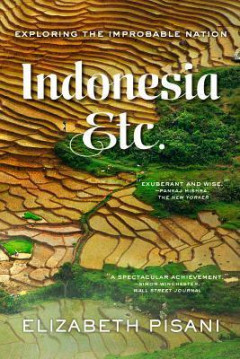
Indonesia etc
An entertaining and thought-provoking portrait of Indonesia: a rich, dynamic, and often maddening nation awash with contradictions. Jakarta tweets more than any other city on earth, but 80 million Indonesians live without electricity and many of its communities still share in ritual sacrifices. Declaring independence in 1945, Indonesia said it would 'work out the details of the transfer of powe…
- Edisi
- -
- ISBN/ISSN
- 978-0-393-35127-9
- Deskripsi Fisik
- 404 pages : illustrations (black and white) ; 25 cm
- Judul Seri
- -
- No. Panggil
- 910.4 Pis i
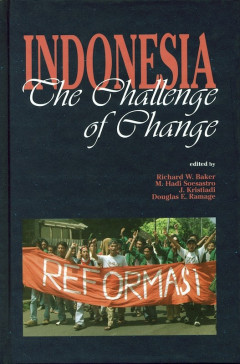
Indonesia: The challenge of change
Indonesian and US political scholars explore the impact of economic growth on twelve major Indonesian institutions, including private and public enterprises, formal political institutions, the armed forces, the bureaucracy, non-governmental organizations, the media, and trade unions. They find that the growing gap between a governing structure that is slow to change and a dynamic broader societ…
- Edisi
- -
- ISBN/ISSN
- 9813055693
- Deskripsi Fisik
- xvii,305 pages.; 23 cm
- Judul Seri
- -
- No. Panggil
- 338.9598 Bak i
 Karya Umum
  Filsafat
  Agama
Agama  Ilmu-ilmu Sosial
  Bahasa
  Ilmu-ilmu Murni
  Ilmu-ilmu Terapan
  Kesenian, Hiburan, dan Olahraga
  Kesusastraan
  Geografi dan Sejarah