Ditapis dengan

Konfrontasi Revisited: Indonesia's foreign policy under Soekarno
This book re-examines Indonesia’s foreign policy during the presidency of Soekarno, with particular emphasis on the period of political confrontation and its international context. It analyzes the ideological, political, and strategic factors that shaped Indonesia’s foreign policy orientation, including its relations with Western countries, the Eastern Bloc, and the emerging nations of the …
- Edisi
- -
- ISBN/ISSN
- 979-8026-52-7
- Deskripsi Fisik
- xiv, 226 pages ; 25 cm
- Judul Seri
- -
- No. Panggil
- 327.598 DJI k

Peranan Indonesia sebagai pendiri Gerakan Non Blok dalam usaha memurnikan tuj…
The book "Indonesia's Role as the Founder of the Non-Aligned Movement in Efforts to Purify Its Goals and Principles" was published by the Research and Development Agency of the Ministry of Foreign Affairs of the Republic of Indonesia in 1986. This book discusses Indonesia's contribution to the birth of the Non-Aligned Movement (NAM) from the 1955 Asian-African Conference to the 1961 Belgrade Su…
- Edisi
- -
- ISBN/ISSN
- -
- Deskripsi Fisik
- iv, 145 pages : illustrations ; 23,5 cm
- Judul Seri
- -
- No. Panggil
- 327.172 BAD p
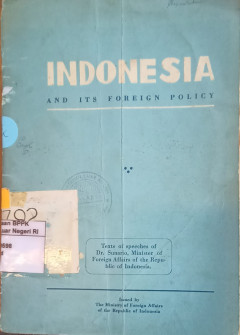
Indonesia and its Foreign policy
Indonesia's foreign policy is characterized by its commitment to an independent and active role in international affairs. This compilation explores the core principles, objectives, and key features of Indonesia's foreign policy. It emphasizes Indonesia's pursuit of a free and active foreign policy, its adherence to the principles of non-alignment and diplomacy, and its dedication to regional st…
- Edisi
- -
- ISBN/ISSN
- -
- Deskripsi Fisik
- 36 pages ; 22 cm
- Judul Seri
- -
- No. Panggil
- 327.9598 Ind i

Not just the 'other emerging powers': Indonesia, South Africa and Turkey in t…
This contents of this book: 1. Emerging powers: Between BRIC and non-BRIC 2. Pivot state and analytic eclectism 3. Background for the case studies 4. Indonesia as a pivot? An analysis of three case studies
- Edisi
- -
- ISBN/ISSN
- 978-979-456-710-4
- Deskripsi Fisik
- xx, 329 pages ; 21 cm
- Judul Seri
- -
- No. Panggil
- 327.598 San n
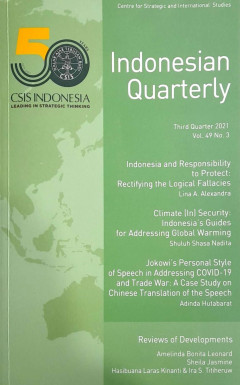
Indonesian quarterly
Indonesian Quarterly is a peer-reviewed policy-oriented journal published by the Centre for Strategic and International Studies (CSIS), Indonesia. It is a medium for research findings, evaluations, and views of scholars, statesmen and thinkers on issues related to Indonesia and its political, economic, and strategic challenges. The opinions expressed in Indonesian Quarterly are those of their a…
- Edisi
- Vol. 49 No. 3
- ISBN/ISSN
- 0304-2170
- Deskripsi Fisik
- 345 pages; 24 cm
- Judul Seri
- -
- No. Panggil
- 327 Ind i
 Karya Umum
  Filsafat
  Agama
Agama  Ilmu-ilmu Sosial
  Bahasa
  Ilmu-ilmu Murni
  Ilmu-ilmu Terapan
  Kesenian, Hiburan, dan Olahraga
  Kesusastraan
  Geografi dan Sejarah