Ditapis dengan

Modern India: The origins of an Asian democracy, second edition
This comprehensive study explores the historical evolution of India into the world’s largest democracy. Judith M. Brown analyzes the complex processes of change from the height of British imperial rule in the 19th century to the challenges of the late 20th century. The book examines how India's diverse social structures, nationalist movements, and colonial legacy interacted to shape its uniqu…
- Edisi
- -
- ISBN/ISSN
- 0-19-873113-2
- Deskripsi Fisik
- xiv, 459 pages : illustration ; 23 cm
- Judul Seri
- -
- No. Panggil
- 954 BRO m
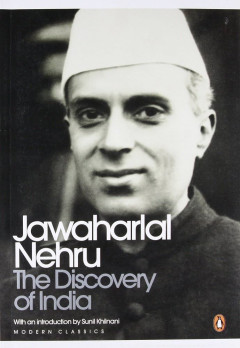
The discovery of India
This book was written by me in Ahmadnagar Fort prison during the five months, April to September, 1944. Some of my colleagues in prison were good enough to read the manuscript and make a number of valuable suggestions. On revising the book in prison 1 took advantage of these suggestions and made some additions. No one, I need hardly add, is responsible for what I have written or necessarily agr…
- Edisi
- -
- ISBN/ISSN
- 0-14-303103-1
- Deskripsi Fisik
- viii, 642 pages : index ; 25 cm
- Judul Seri
- -
- No. Panggil
- 920 Neh r
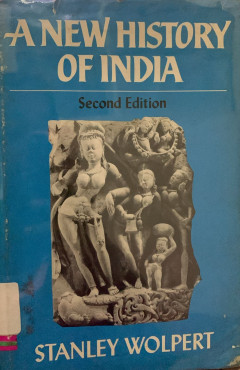
A New history of India
The New History of India by Stanley Wolpert offers a readable yet comprehensive narrative of India’s history, covering nearly 4,000 years from ancient civilization to modern political developments. Wolpert examines major themes such as religion, empire, nationalism, and identity, while paying close attention to persistent social inequalities, corruption, and political challenges. He highlight…
- Edisi
- 2
- ISBN/ISSN
- 0-19-502949-6
- Deskripsi Fisik
- 472 pages : illustrations ; 23,5 cm
- Judul Seri
- -
- No. Panggil
- 954 WOL n
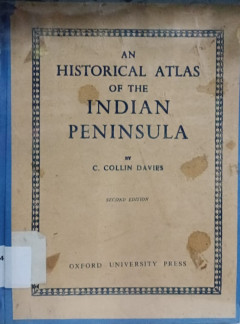
An Historical atlas of the Indian peninsula
A comprehensive visual reference designed to illustrate the historical evolution of the Indian subcontinent. The atlas presents a collection of meticulously prepared maps that trace political, cultural, and territorial developments from ancient to early modern periods. It includes detailed cartographic depictions of major dynasties, kingdoms, trade routes, administrative divisions, and historic…
- Edisi
- -
- ISBN/ISSN
- -
- Deskripsi Fisik
- 46 pages : illustrations ; 25 cm
- Judul Seri
- -
- No. Panggil
- 911.54 DAV h
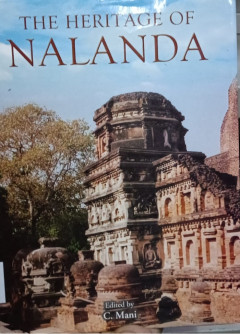
The Heritage of Nalanda
Explores the historical, cultural, and spiritual legacy of Nalanda, the world-renowned Buddhist monastic university that flourished in ancient India. This volume, published by Asoka Mission and Aryan Books International, brings together scholarly essays examining Nalanda’s role as a major intellectual center from the 5th century CE onwards. The book discusses its architectural development, ar…
- Edisi
- -
- ISBN/ISSN
- 978-81-7305-330-6
- Deskripsi Fisik
- xxxviii, 296 pages : illustrations ; 30,3 cm
- Judul Seri
- -
- No. Panggil
- 954.15 MIS h
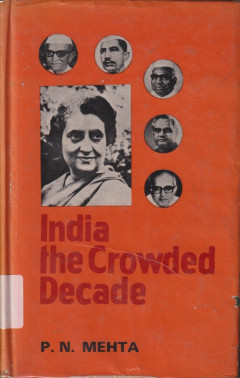
India: The Crowded decade
India: The Crowded Decade by P. N. Mehta offers an insightful analysis of a pivotal decade in India’s post-independence history. The book examines major political events, economic developments, social changes, and demographic pressures shaping the nation during this period. Mehta evaluates government policies, leadership challenges, and the impact of rapid population growth on national planni…
- Edisi
- -
- ISBN/ISSN
- -
- Deskripsi Fisik
- 446 pages ; 22,5 cm
- Judul Seri
- -
- No. Panggil
- 954.04 MEH i

Ancient history of Western Asia, India, and Crete
Ancient History of Western Asia, India, and Crete presents a comprehensive overview of the early civilizations that shaped the ancient world. Bedřich Hrozný discusses the political, cultural, and social development of Western Asia, including Mesopotamia and the Near East, alongside the evolving civilizations of ancient India and Crete. Through archaeological findings, inscriptions, and histor…
- Edisi
- -
- ISBN/ISSN
- -
- Deskripsi Fisik
- viii, 259 pages ; 25 cm
- Judul Seri
- -
- No. Panggil
- 954 HRO a
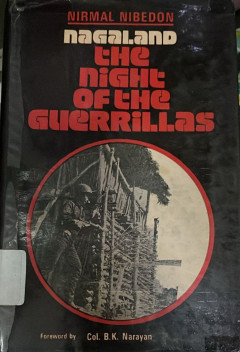
Nagaland : The Night of the guerrillas
This is the explosive story of the underground movement in Nagaland never written before. It is an investigative report of the secret trails where the dew never dries, a trail which ended far beyond the Indian borders, snaking into the monsoon-soaked jungles of Kachin, where men like Zewtu fought and died unsung. These were the forests of no return where men like Kaito, Zhukiye. Mowu, Zuheto a…
- Edisi
- -
- ISBN/ISSN
- 978-18978-2938-7
- Deskripsi Fisik
- 404 pages : illustrations ; 23 cm
- Judul Seri
- -
- No. Panggil
- 954.165 NIB n
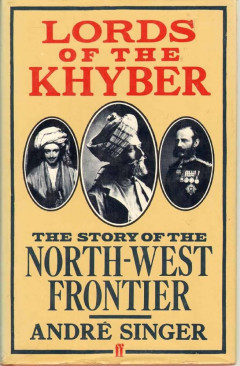
Lord of the Kyber : The Story of the North West frontier
One hundred and forty years before Russians invaded Afghanistan in 1979, causing an outcry of protest from the West. The British had marched into Kabul and put their puppet king on the throne. The years which followed saw three wars, countless skirmishes and thousands of deaths - but the Pathans, or Pushtuns, and their fellow tribesmen of the NorthWest Frontier, remained undefeated. Pushtun…
- Edisi
- -
- ISBN/ISSN
- 0-571-11796-1
- Deskripsi Fisik
- 234 pages : illustrations ; 23 cm
- Judul Seri
- -
- No. Panggil
- 954.91 SIN l
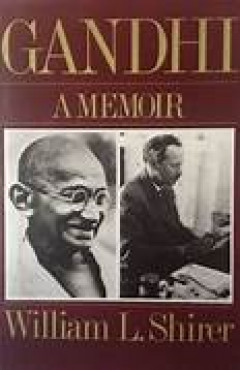
Gandhi: A Memoir
Gandhi: A Memoir presents William L. Shirer’s personal reflections on his encounters with Mahatma Gandhi and his impressions of Gandhi’s political and moral influence. Shirer, an American journalist covering India, shares his personal observations about Gandhi—from his simplicity and spiritual discipline to his brilliance in leading a nonviolent resistance against British imperialism. Shi…
- Edisi
- -
- ISBN/ISSN
- 0-671-25079-5
- Deskripsi Fisik
- 255 pages : illustrations ; 24 cm
- Judul Seri
- -
- No. Panggil
- 923.254 SHI g
 Karya Umum
  Filsafat
  Agama
Agama  Ilmu-ilmu Sosial
  Bahasa
  Ilmu-ilmu Murni
  Ilmu-ilmu Terapan
  Kesenian, Hiburan, dan Olahraga
  Kesusastraan
  Geografi dan Sejarah