Ditapis dengan

India, Pakistan, Nepal and Bangladesh: India as a factor in the intra-regiona…
This book examines the political dynamics and intra-regional interactions among India, Pakistan, Nepal, and Bangladesh in South Asia. P. K. Mishra analyzes India’s central role in shaping regional relations, focusing on historical, political, and strategic factors that influence cooperation and conflict. The study highlights bilateral issues, regional power asymmetry, and the evolution of Sou…
- Edisi
- -
- ISBN/ISSN
- -
- Deskripsi Fisik
- viii, 286 pages : illustration ; 22 cm
- Judul Seri
- -
- No. Panggil
- 327.54 MIS i

Diplomacy in peace and war: Recollections and reflections
This memoir by T. N. Kaul offers personal reflections on his long diplomatic career and provides insights into India’s foreign policy during critical moments of the twentieth century. The book recounts Kaul’s experiences in major postings and international negotiations, while also examining the broader dynamics of peace, war, and global diplomacy. Combining autobiographical narrative with p…
- Edisi
- -
- ISBN/ISSN
- 0-7069-0749-3
- Deskripsi Fisik
- x, 251 pages : illustration ; 21 cm
- Judul Seri
- -
- No. Panggil
- 327.54 KAU d
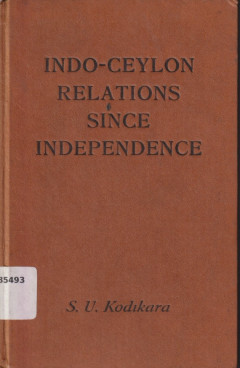
Indo-Ceylon relations since independence
This book examines the development of bilateral relations between India and Ceylon (Sri Lanka) since both countries gained independence. S. U. Kodikara outlines the historical, political, economic, and social factors influencing the dynamics of relations between the two countries, including the issue of citizenship of Indian Tamils, political agreements, and India's role in the stability of the…
- Edisi
- -
- ISBN/ISSN
- -
- Deskripsi Fisik
- viii, 262 halaman: illustration; 23 cm
- Judul Seri
- -
- No. Panggil
- 327.5493 KOD i

India and the world through the eyes of Indians diplomats
If there is anything constant in the world, it is change, especially in today's globalised world. Thirty mandarins of the South Block look at the current changes in different parts of the world, try to connect them with developments of the recent past, analyse and dissect them with experience and understanding spanning decades and strive to foresee what's likely to happen and weigh how that co…
- Edisi
- -
- ISBN/ISSN
- 978-81-8328-3847
- Deskripsi Fisik
- xxiii, 459 pages ; 24 cm
- Judul Seri
- -
- No. Panggil
- 327.54 KUM i

The Making of India's foreign policy : The Indian national congress and world…
India's foreign policy has a historical background which has not so far been systematically studied. The Indian National Congress, the main organization that carried the struggle for national freedom, showed interest in questions of foreign policy right from its birth in 1885. This interest, at first limited, grew with the broadening of its general political outlook. Gradually, certain principl…
- Edisi
- -
- ISBN/ISSN
- 978-81-925354-8-7
- Deskripsi Fisik
- xxvi, 301 pages ; 23 cm
- Judul Seri
- -
- No. Panggil
- 327.54 PRA m
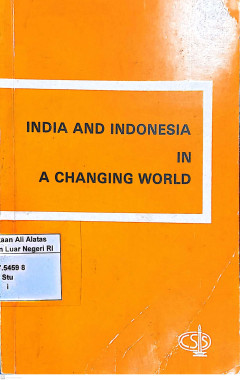
India and Indonesia in a changing world
Neither India nor Indonesia may yet be categorized as a super- power, rather, they are both developing countries within the total spectrum of nations in this single world. This reality can not be denied. However, even though neither of us are superpowers, both In- dia and Indonesia have definite roles to play in international relations. There can be no doubt that the roles of India and Indonesi…
- Edisi
- First Edition
- ISBN/ISSN
- -
- Deskripsi Fisik
- x, 131 pages ; 22 cm
- Judul Seri
- -
- No. Panggil
- 327.54598 Stu i

China, India and the future of international society
This volume unpicks common assumptions about the global influence of China and India to examine their future impact on international society. China and India have huge potential to exert global influence due to their geography, population size and material resources. Now their spectacular economic growth has led many commentators to predict a shift in power from West to East and the dawn of an …
- Edisi
- -
- ISBN/ISSN
- 978-1-78348-260-3
- Deskripsi Fisik
- vii, 176 pages : bibliography: page 155-171 : index ; 23 cm
- Judul Seri
- -
- No. Panggil
- 327.51 Gas c
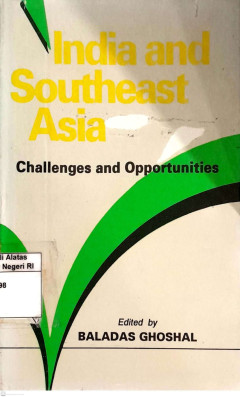
India and Southeast Asia: Challenges and opportunities
Today, India and Southeast Asia look at each other in a more positive light than perhaps at any other time over the last three decades. In this book, seven specialists and scholars on Southeast Asia look at the challenges and opportunities before India to develop more meaningful and cooperative relationship with the region. The study also charts out a programme of action and policies to attract…
- Edisi
- -
- ISBN/ISSN
- 81-220-04121
- Deskripsi Fisik
- viii, 127 pages : index ; 23 cm
- Judul Seri
- -
- No. Panggil
- 327.54059 Gho i

The peacock and the garuda: An overview of India-Indonesia relations
Indonesia, one of the largest democracies of Asia, held its Presidential elections in 2014, testifying to its evolution as a mature democracy. Its civilisational mosaic, multicultural and multi-religious ethos and increasingly decentralising federal structure of domestic polity have strengthened Indonesia's position in the world. However, the debate continues whether Indonesia will be able to e…
- Edisi
- -
- ISBN/ISSN
- 978-93-83649-61-7
- Deskripsi Fisik
- xv, 174 pages : index ; 24 cm
- Judul Seri
- -
- No. Panggil
- 327.598054 Bha p

India in a turbulent world: Perspective in foreign and security policies
- Edisi
- -
- ISBN/ISSN
- 81-7003-265-2
- Deskripsi Fisik
- xiv,321 Halaman : index ;21 cm
- Judul Seri
- -
- No. Panggil
- 327.54 Pat i
- Edisi
- -
- ISBN/ISSN
- 81-7003-265-2
- Deskripsi Fisik
- xiv,321 Halaman : index ;21 cm
- Judul Seri
- -
- No. Panggil
- 327.54 Pat i
 Karya Umum
  Filsafat
  Agama
Agama  Ilmu-ilmu Sosial
  Bahasa
  Ilmu-ilmu Murni
  Ilmu-ilmu Terapan
  Kesenian, Hiburan, dan Olahraga
  Kesusastraan
  Geografi dan Sejarah