Ditapis dengan
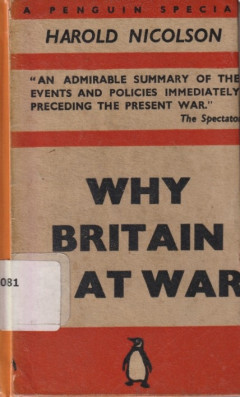
Why Britain is at war
This book contains Harold Nicolson's explanation of why Britain entered World War II, written at the very beginning of the conflict in 1939. Nicolson outlines the political conditions in Europe, the rise of Nazi Germany, the failure of appeasement, and the danger of Hitler's expansion to international security. As a diplomat and member of the British Parliament, Nicolson's views provide a direc…
- Edisi
- -
- ISBN/ISSN
- -
- Deskripsi Fisik
- 160 pages ; 18 cm
- Judul Seri
- -
- No. Panggil
- 941.081 NIC w

Great Britain: Foreign policy and the Span of Empire, 1689–1971
Volume III of Great Britain: Foreign Policy and the Span of Empire, 1689–1971 is a documentary series that presents primary sources on British foreign policy and the development of the British Empire over nearly three centuries. Compiled by Joel H. Wiener, this book brings together official documents, speeches, government reports, and contemporary writings that reflect the dynamics of interna…
- Edisi
- Volume 3
- ISBN/ISSN
- 0-07-079730-7
- Deskripsi Fisik
- 2727 pages ; 24 cm
- Judul Seri
- -
- No. Panggil
- 327.42 WIE g

British Diplomacy in Asia: Persian Gulf, Soviet Central Asia, Tibet, China, I…
British Diplomacy in Asia by Mahavir P. Srivastava provides an in-depth examination of British diplomatic policy and strategy in Asia from the colonial era to the early 20th century. The discussion covers Britain's role in the Persian Gulf, Soviet Central Asia, Tibet, China, India, and Burma, as well as the geopolitical dynamics that shaped international relations in the region. The author anal…
- Edisi
- -
- ISBN/ISSN
- -
- Deskripsi Fisik
- 321 pages ; 22 cm
- Judul Seri
- -
- No. Panggil
- 327.4105 SRI b

The Realities behind diplomacy: Background influences on British external pol…
This book examines the fundamental factors that influenced British foreign policy from the mid-19th century to 1980. Paul Kennedy examines the various aspects—economic strength, geographic location, social structure, strategic interests, and global power dynamics—that shaped how Britain responded to international change. Using historical approaches and political analysis, the book explains …
- Edisi
- -
- ISBN/ISSN
- -
- Deskripsi Fisik
- 416 pages ; 19,5 cm
- Judul Seri
- -
- No. Panggil
- 327.41009 KEN r

A peace to end all peace: The fall of the ottoman empire and the creation of …
In A Peace to End All Peace, David Fromkin reveals how and why the Allies came to remake the geography and politics of the Middle East, drawing lines on an empty map that eventually became the new countries of Iraq, Israel, Jordan, and Lebanon. Focusing on the formative years of 1914 to 1922, when all-even an alliance between Arab nationalism and Zionism-seemed possible he raises questions abou…
- Edisi
- -
- ISBN/ISSN
- 0-8050-6884-8
- Deskripsi Fisik
- 635 pages : illustrations (black and white) : bibl: hlm 607-620 : index ; 21 cm
- Judul Seri
- -
- No. Panggil
- 327.41056 Fro p
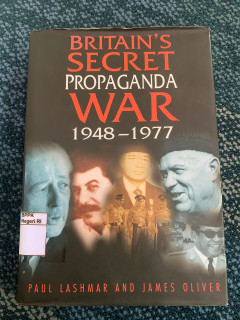
Britains secret propaganda war 1948-1977
Set up under the Labour Government in 1948 and clandestinely financed from the Secret Intelligence Service budget, the Information Research Department waged a vigorous covert propaganda campaign against Communism around the world. IRD was a large organization with close links to Ml6 with whom it shared many personnel. Parliament, had it known of the true purpose of IRD's existence, may well hav…
- Edisi
- -
- ISBN/ISSN
- 0-7509-1668-0
- Deskripsi Fisik
- xiii, 223 pages ; index ; 25 cm
- Judul Seri
- -
- No. Panggil
- 303.6 Las b
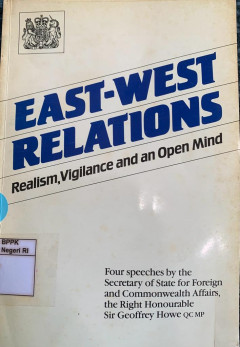
East-West relations: Realism, vigilance and open mind
The Foundations and Future of British Security (pp.5-16) by The Royal Society of Arts under the auspices of the International Institute for Strategic Studies (IISS); European Security (pp. 17-24) by The Royal Institute of International Relations (IRRI); Transatlantic Relations (pp. 25-33) by The Chicago Council on Foreign Relations; East-West Relations: The British Role (pp.35-43) by The Roy…
- Edisi
- -
- ISBN/ISSN
- -
- Deskripsi Fisik
- 43 pages ; 25 cm
- Judul Seri
- -
- No. Panggil
- 327. 1171 How e
 Karya Umum
  Filsafat
  Agama
Agama  Ilmu-ilmu Sosial
  Bahasa
  Ilmu-ilmu Murni
  Ilmu-ilmu Terapan
  Kesenian, Hiburan, dan Olahraga
  Kesusastraan
  Geografi dan Sejarah