Ditapis dengan

Koran, Kalashnikov and Laptop : The Neo-Taliban insurgency in Afghanistan
Since the Allied invasion of Afghanistan in 2002, the Bush administration has celebrated the imminent demise of the Taliban, with claims of a "moral and psychological defeat" playing a prominent role in the presidential elections of 2004. Some commentators suggested that "reconstruction and development" had won over the Afghan population, despite widespread criticism of the meager distribution …
- Edisi
- -
- ISBN/ISSN
- 978-1-85065-872-6
- Deskripsi Fisik
- xv, 259 pages : illustrations ; 23 cm
- Judul Seri
- -
- No. Panggil
- 958.1047 GIO k

Regime Change in Afghanistan : Foreign intervention and the politics of legit…
This book is a study of regime change in an underdeveloped country with a weak state and strong autonomous social organizations. Regime change is in many countries a traumatic and disruptive experience, but few countries have paid as high a cost to retain traditionally accepted relationships of authority as has Afghanistan since the communist coup
- Edisi
- -
- ISBN/ISSN
- 0-8133-1326-0
- Deskripsi Fisik
- viii, 190 pages : 21 cm
- Judul Seri
- -
- No. Panggil
- 958.1040 SAI r
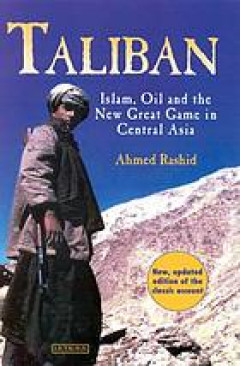
Taliban : Islam, oil and the new great game in central Asia
Since 9/11, the Taliban have dominated headlines around the world. The Taliban government, allied to Osama Bin Laden, collapsed dramatically following the Anglo-American invasion of 2001. Since then however the movement has showed an unexpected ability to evolve, and has drawn the world's only superpower into a protracted and seemingly unwinnable conflict in this strategically vital country. No…
- Edisi
- -
- ISBN/ISSN
- 978 1 84511 788 7
- Deskripsi Fisik
- xxi, 276 pages : 20 cm
- Judul Seri
- -
- No. Panggil
- 958.104 RAS t
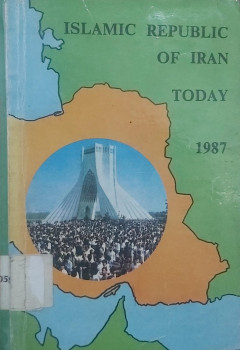
Islamic republic of Iran today (1987)
This book provides an overview of the Islamic Republic of Iran in 1987, highlighting the political, social, and cultural conditions of the country following the 1979 Islamic Revolution. It presents contemporary developments in Iran, including national identity, governance, society, and the experiences of the Iranian people during the early years of the Islamic Republic.
- Edisi
- -
- ISBN/ISSN
- -
- Deskripsi Fisik
- 341 pages : illustrations ; 21 cm
- Judul Seri
- -
- No. Panggil
- 955.053 ISL i

Letters to my torturer: Love, revolution, and imprisonment in Iran
Letters to My Torturer is a powerful memoir by Iranian journalist and political activist Houshang Asadi, recounting his arrest, torture, and imprisonment under the Iranian regime. Presented as a series of letters addressed to his torturer, the book exposes the brutality of political repression in Iran, while also exploring themes of love, memory, faith, and resilience. Asadi reflects on his exp…
- Edisi
- -
- ISBN/ISSN
- 978-1-85168-750-3
- Deskripsi Fisik
- x, 325 pages ; 23 cm
- Judul Seri
- -
- No. Panggil
- 955 ASA l
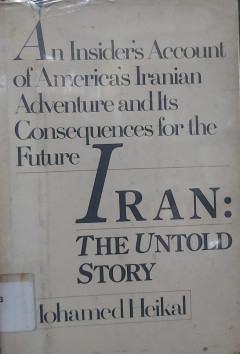
Iran: The Untold story
This book provides a detailed historical narrative of the final years of the Pahlavi monarchy in Iran. William H. Forbis examines the political, social, and economic conditions that led to growing unrest, culminating in the 1979 Iranian Revolution. Through journalistic analysis, he portrays the complexities of the Shah’s rule, the rise of opposition movements, and the factors that contributed…
- Edisi
- -
- ISBN/ISSN
- 0-394-52275-3
- Deskripsi Fisik
- 217 pages ; 24 cm
- Judul Seri
- -
- No. Panggil
- 955.053 HEI i
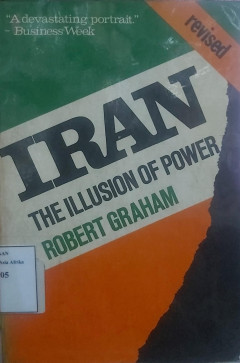
Iran: The Illusion of power
Already acclaimed as "a devastating portrait" (Business Week), this revised and updated edition of Robert Graham's book is particularly revealing of how the Shah of Iran's neglect of his country's basic needs, and misreading of its mood, led to one of the most stunning political reversals of the century. Powerfully persuasive, as well as timely in light of today's headlines, Iran: The Illus…
- Edisi
- -
- ISBN/ISSN
- 0-312-43588-6
- Deskripsi Fisik
- 276 pages ; 21 cm
- Judul Seri
- -
- No. Panggil
- 330.95505 GRA i
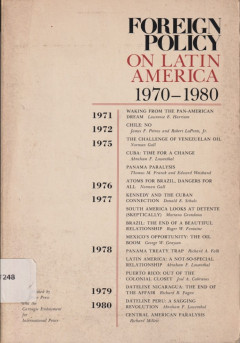
Foreign policy on Latin America 1970-1980
This volume analyzes a decade of Latin American foreign policy, focusing on the political, economic, and diplomatic developments between 1970 and 1980. Compiled by the staff of Foreign Policy magazine, the book examines major regional dynamics, the impact of global power structures, and the role of the United States in shaping Latin America’s international relations. It offers case studies, p…
- Edisi
- -
- ISBN/ISSN
- -
- Deskripsi Fisik
- vii, 184 pages ; 25 cm
- Judul Seri
- -
- No. Panggil
- 327.8 STA f
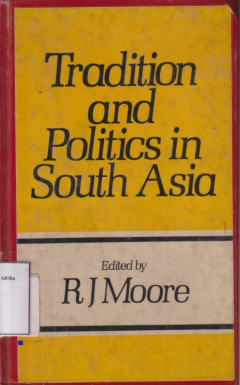
Tradition and politics in South Asia
This volume examines the complex interactions between political structures, traditional institutions, and cultural practices in South Asia. Edited by R. J. Moore, the book brings together scholarly essays that explore how historical traditions have shaped political behavior, governance, and social change across countries such as India, Pakistan, Bangladesh, and Sri Lanka. The work provides insi…
- Edisi
- -
- ISBN/ISSN
- 0-7069-0608-X
- Deskripsi Fisik
- xxii, 266 pages ; 21 cm
- Judul Seri
- -
- No. Panggil
- 320.954 MOO t
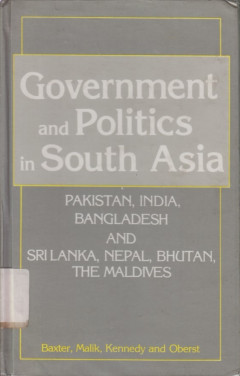
Government and politics in South Asia
Government and Politics in South Asia provides a comprehensive examination of the political systems, institutions, and governing structures of countries in South Asia, including India, Pakistan, Bangladesh, Sri Lanka, and Nepal. Written by leading scholars, the book analyzes historical developments, constitutional frameworks, political parties, military influence, regional tensions, and pattern…
- Edisi
- -
- ISBN/ISSN
- -
- Deskripsi Fisik
- xv, 415 pages : illustrations ; 22,5 cm
- Judul Seri
- -
- No. Panggil
- 320.954 BAX g
 Karya Umum
  Filsafat
  Agama
Agama  Ilmu-ilmu Sosial
  Bahasa
  Ilmu-ilmu Murni
  Ilmu-ilmu Terapan
  Kesenian, Hiburan, dan Olahraga
  Kesusastraan
  Geografi dan Sejarah