Ditapis dengan

Creating A Pool of Negotiators for Environment Issues
Presidential Regulation No. 116 of 2020 reinforces Indonesia’s Ministry of Foreign Affairs (MOFA) as the coordinator of the government’s foreign policy and international relations. To address fragmented sectoral activities and ensure continuity in managing foreign policy issues, MOFA needs to strengthen its internal coordination and diplomatic expertise. This paper proposes establishing spe…
- Edisi
- -
- ISBN/ISSN
- -
- Deskripsi Fisik
- -
- Judul Seri
- -
- No. Panggil
- SESDILU 70-2021

Management of Indonesian diaspora: Policy options for the Ministry of Foreign…
This paper examines Indonesia's need to develop comprehensive diaspora management, noting that Indonesia is the eleventh largest country with approximately 4.5–8 million diaspora population worldwide (based on 2019 data from UN DESA and Indonesia Diaspora Network Global), yet lacks a comprehensive plan to manage its diaspora abroad. Case studies from India, China, and Turkey affirm that diasp…
- Edisi
- -
- ISBN/ISSN
- -
- Deskripsi Fisik
- -
- Judul Seri
- -
- No. Panggil
- Sesdilu 69-2021

Enhancing the role of the Ministry of Foreign Affairs as a Foreign Affairs Co…
This paper examines the need to strengthen the role of the Ministry of Foreign Affairs (MoFA) as coordinator of foreign relations and foreign policy implementation, as set out in Law No. 37 of 1999 and Presidential Decree No. 116 of 2020. While the MoFA prioritises coordination with Indonesian representatives, ministries and agencies, and other stakeholders, there is still room for improvement …
- Edisi
- -
- ISBN/ISSN
- -
- Deskripsi Fisik
- -
- Judul Seri
- -
- No. Panggil
- Sesdilu 76-2024

Constructing Indonesia's foreign policy toward artificial intelligences as on…
This paper examines Indonesia's critical juncture in shaping its foreign policy towards artificial intelligence (AI) development as a transformative force reshaping economies, industries, and societies globally. While AI offers promise for innovation, productivity, and economic growth, it also presents multifaceted risks spanning economic, social, and geopolitical dimensions that require compre…
- Edisi
- -
- ISBN/ISSN
- -
- Deskripsi Fisik
- -
- Judul Seri
- -
- No. Panggil
- Sesdilu 76-2024

Enhancing diplomacy, advancing accession: How the Ministry of Foreign Affairs…
This study examines the role of the Ministry of Foreign Affairs in supporting Indonesia’s Organisation for Economic Co-operation and Development (OECD) accession process. This involves engagement with 26 OECD committees and alignment with over 240 legal instruments. As vice-chair of the National Team, the Ministry faces challenges such as limited institutional arrangements, coordination gaps …
- Edisi
- -
- ISBN/ISSN
- -
- Deskripsi Fisik
- -
- Judul Seri
- -
- No. Panggil
- Sesdilu 79-2025

Empowering Papua: Towards an inclusive Indonesian foreign policy
This study examines strategies to enhance Papua’s participation and representation in Indonesia’s foreign policy formulation. Drawing on Stakeholder Theory, Deliberative Democracy, and Network Governance, the study proposes three approaches: strengthening Papuan participation in policy processes, developing mindful communication strategies to improve international perceptions, and establish…
- Edisi
- -
- ISBN/ISSN
- -
- Deskripsi Fisik
- -
- Judul Seri
- -
- No. Panggil
- Sesdilu 77-2024

From diaspora dependence to market creation: Refocusing Indonesia’s gastrod…
The role of gastrodiplomacy in the strengthening of Indonesia's economic diplomacy in the direction of the 2045 national vision is the subject of this paper. Using SWOT, systems thinking and design thinking analyses, it identifies structural challenges, such as inconsistent policies, poor quality control and logistics, and limited funding, while recognising opportunities in global food trends, …
- Edisi
- -
- ISBN/ISSN
- -
- Deskripsi Fisik
- -
- Judul Seri
- -
- No. Panggil
- Sesdilu 79-2025

Enhancing diplomacy’s performance by addressing the needs of third culture…
The present analysis investigates the requirements of Third Culture Kids (TCKs) in order to facilitate the effectiveness of diplomats and the Ministry of Foreign Affairs. Diplomatic assignments involving repeated relocations between countries can present difficulties for children in terms of their education, social relationships, identity and emotional well-being. The study therefore recommends…
- Edisi
- -
- ISBN/ISSN
- -
- Deskripsi Fisik
- -
- Judul Seri
- -
- No. Panggil
- Sesdilu 79-2025
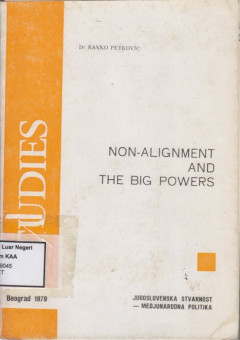
Non-Alignment and the big powers
Non-Alignment and the Big Powers analyzes the development, principles, and political significance of the Non-Aligned Movement in the context of global power rivalry. Dr. Ranko Petkovic examines how non-aligned countries attempted to assert independence from the dominant blocs during the Cold War while promoting peace, sovereign equality, and collective cooperation. The book also explores the re…
- Edisi
- -
- ISBN/ISSN
- -
- Deskripsi Fisik
- 46 pages ; 20 cm
- Judul Seri
- -
- No. Panggil
- 327.17 PET n
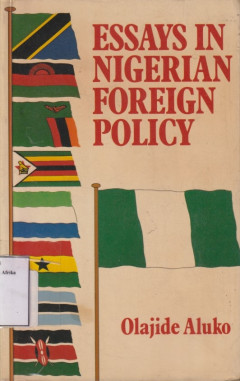
Essays on Nigerian foreign policy
Essays on Nigerian Foreign Policy by Olajide Aluko is a collection of scholarly analyses examining the development, direction, and challenges of Nigeria’s foreign policy. Written by one of Nigeria’s leading experts in international relations, the essays explore Nigeria’s diplomatic posture within Africa and the global arena, its relations with major powers, and the impact of domestic poli…
- Edisi
- -
- ISBN/ISSN
- -
- Deskripsi Fisik
- 288 pages ; 21,5 cm
- Judul Seri
- -
- No. Panggil
- 327.669 ALU e
 Karya Umum
  Filsafat
  Agama
Agama  Ilmu-ilmu Sosial
  Bahasa
  Ilmu-ilmu Murni
  Ilmu-ilmu Terapan
  Kesenian, Hiburan, dan Olahraga
  Kesusastraan
  Geografi dan Sejarah