Ditapis dengan

A History of Europe from 911 to 1198
This book by Z. N. Brooke provides a detailed account of European history from 911 to 1198, a formative period in the development of medieval Europe. It examines political, social, and religious transformations, including the rise of monarchies, the influence of the Church, the growth of feudal institutions, and the shaping of medieval society. The narrative offers insight into major events and…
- Edisi
- -
- ISBN/ISSN
- -
- Deskripsi Fisik
- xx, 553 pages : illustration ; 22 cm
- Judul Seri
- -
- No. Panggil
- 940.12 BRO h

The Congress of Vienna: A Study in allied unity, 1812–1822
The Congress of Vienna: A Study in Allied Unity, 1812–1822 by Harold Nicolson offers a detailed examination of the diplomatic negotiations that shaped Europe after the Napoleonic Wars. Nicolson analyzes the personalities, motives, and diplomatic maneuvers of the major powers involved, including Britain, Austria, Prussia, Russia, and France. The book explores how statesmen sought to restore st…
- Edisi
- -
- ISBN/ISSN
- -
- Deskripsi Fisik
- xiii, 312 pages : illustration ; 22 cm
- Judul Seri
- -
- No. Panggil
- 327.11 NIC c
The East European revolution
The East European Revolution by Hugh Seton-Watson provides an authoritative analysis of the political and social transformations that reshaped Eastern Europe after World War II. The book examines the rise of communist governments, the role of the Soviet Union in restructuring regional politics, the collapse of prewar institutions, and the emergence of new revolutionary elites. Seton-Watson offe…
- Edisi
- -
- ISBN/ISSN
- -
- Deskripsi Fisik
- xix, 435 pages : illustration ; 22 cm
- Judul Seri
- -
- No. Panggil
- 947 WAT e

Memoires over de tweede wereldoorlog: De Storm steekt op – Van oorlog tot o…
This book is part of Winston Churchill's memoir series, which reviews world developments from the end of World War I to the outbreak of World War II. In De Storm Steekt Op – Van oorlog tot oorlog 1919–1939, Churchill describes the emergence of global political tensions, the rise of totalitarian powers such as Nazi Germany, Fascist Italy, and the Soviet Union, and the failure of the internat…
- Edisi
- -
- ISBN/ISSN
- -
- Deskripsi Fisik
- 497 pages : illustration ; 22,5 cm
- Judul Seri
- -
- No. Panggil
- 940.531 CHU m

Histoire des relations internationales. Tome cinquième : Le XIXᵉ siècle. …
This book is the fifth volume in the “Histoire des relations internationales” series written by Pierre Renouvin. In this volume, Renouvin examines the dynamics of international relations from 1815 to 1871, a period when Europe experienced the rise of nationalism, political restructuring after the Congress of Vienna, and the emergence of new powers on the international stage. The analysis co…
- Edisi
- -
- ISBN/ISSN
- -
- Deskripsi Fisik
- 421 pages : illustration ; 22 cm
- Judul Seri
- -
- No. Panggil
- 327.0903 REN h

Histoire des relations internationales. Tome premier, Le Moyen Âge
This book is the first volume of the “Histoire des relations internationales” series, written under the direction of Pierre Renouvin. François-L. Ganshof examines the development of international relations during the Middle Ages, from the collapse of the Roman Empire to the end of the Middle Ages. The analysis covers the political interactions between kingdoms, churches, and empires, as we…
- Edisi
- -
- ISBN/ISSN
- -
- Deskripsi Fisik
- xvii, 331 pages : illustration ; 22 cm
- Judul Seri
- -
- No. Panggil
- 940.1 REN h
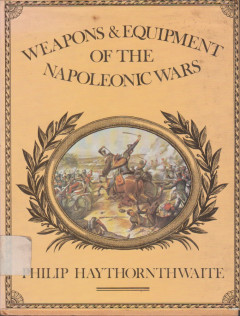
Weapons & equipment of the Napoleonic Wars
This book is a comprehensive study of the weapons and military equipment of the Napoleonic Wars (1789–1815). Philip J. Haythornthwaite describes the various weapons, equipment, uniforms, and military technology used by European armies. Featuring line illustrations by John Mollo and drawings by Peter Sarson and Tony Bryan, this book provides a comprehensive understanding of the technical and v…
- Edisi
- -
- ISBN/ISSN
- 0-7137-0906-5
- Deskripsi Fisik
- 190 pages : illustration ; 25,5 cm
- Judul Seri
- -
- No. Panggil
- 940.27 HAY w
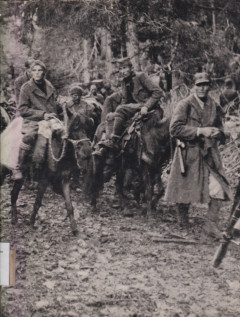
Partisans and Guerrillas
Partisans and Guerrillas explores the widespread resistance movements that emerged across Europe during World War II. Written by Ronald H. Bailey with the editors of Time-Life Books, the volume highlights the daring operations of underground fighters, from the Balkans to Western Europe, who conducted sabotage, intelligence gathering, and guerrilla warfare against Axis occupation forces. The boo…
- Edisi
- -
- ISBN/ISSN
- -
- Deskripsi Fisik
- 208 pages : illustration ; 29 cm
- Judul Seri
- -
- No. Panggil
- 940.542 BAI p
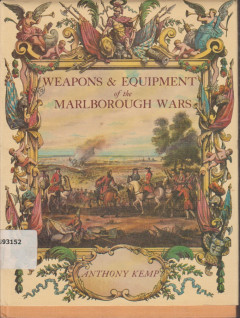
Weapons and equipment of the Marlborough Wars
This book is an in-depth study of the weapons and military equipment used in the Marlborough War (1702–1713), one of the major European conflicts of the early 18th century. Anthony Kemp explains the developments in weapons technology, military tactics, and military equipment that played a crucial role in the Duke of Marlborough's victory. Complete with detailed illustrations by John Mollo, th…
- Edisi
- -
- ISBN/ISSN
- 0-7137-1013-6
- Deskripsi Fisik
- 172 pages : illustration ; 26,5 cm
- Judul Seri
- -
- No. Panggil
- 623.4094 KEM w
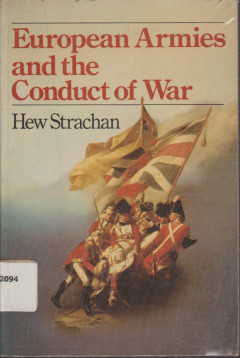
European armies and the conduct of war
European Armies and the Conduct of War by Hew Strachan presents an in-depth analysis of the development of doctrine, organization, and methods of warfare in Europe from the 18th century to the modern era. This book explores how changes in technology, social structure, politics, and military culture have influenced the way wars are planned and executed. Strachan delves into the evolution of the …
- Edisi
- -
- ISBN/ISSN
- 0-04-940070-3
- Deskripsi Fisik
- 226 pages ; 23,5 cm
- Judul Seri
- -
- No. Panggil
- 355.02094 STR e
 Karya Umum
  Filsafat
  Agama
Agama  Ilmu-ilmu Sosial
  Bahasa
  Ilmu-ilmu Murni
  Ilmu-ilmu Terapan
  Kesenian, Hiburan, dan Olahraga
  Kesusastraan
  Geografi dan Sejarah