Ditapis dengan

Scale up the role of the Ministry of Foreign Affairs of the Republic of Indon…
This paper examines scaling up the role of the Ministry of Foreign Affairs of the Republic of Indonesia in promoting the creative economy as a catalyst for national economic growth. The creative economy sector contributed IDR 1.105 trillion to Indonesia's GDP in 2018, with USD 20.5 billion in export value, employed 17 million workers, and supported SDGs implementation. Creative economy is one o…
- Edisi
- -
- ISBN/ISSN
- -
- Deskripsi Fisik
- -
- Judul Seri
- -
- No. Panggil
- Sesdilu 69-2021

Strengthening the strategic role of Mofa in advancing creative economy cooper…
Indonesia can strengthen ASEAN creative economy cooperation by improving cross-pillar coordination between the ASEAN Socio-Cultural and Economic Communities. Despite the growing importance of the creative economy, regional cooperation remains fragmented due to differing approaches and mandates among relevant institutions. The Ministry of Foreign Affairs can strengthen its strategic role by faci…
- Edisi
- -
- ISBN/ISSN
- -
- Deskripsi Fisik
- -
- Judul Seri
- -
- No. Panggil
- Sesdilu 77-2024

Southeast Asia and New Zealand: A History of regional and bilateral relations
This volume provides a comprehensive examination of the historical development of both regional and bilateral relations between Southeast Asia and New Zealand. Edited by Anthony L. Smith, the book explores political, strategic, and economic interactions that have shaped engagement between the two regions from early contact to the contemporary era. Through contributions from multiple scholars, i…
- Edisi
- -
- ISBN/ISSN
- 0-86473-519-7
- Deskripsi Fisik
- xiv, 392 pages ; 23 cm
- Judul Seri
- -
- No. Panggil
- 327.59 SMI s

Our Zimbabwe: An element of political economy
Our Zimbabwe: An Element of Political Economy offers an analytical overview of Zimbabwe’s economic and political structures in the years following independence. Arthur Jim Patsanza examines the nation’s development challenges, economic policies, and the relationship between political decision-making and economic outcomes. The book discusses issues such as state planning, resource distributi…
- Edisi
- -
- ISBN/ISSN
- 0-7974-0832-0
- Deskripsi Fisik
- 246 pages ; 21,5 cm
- Judul Seri
- -
- No. Panggil
- 338.9689 PAT o
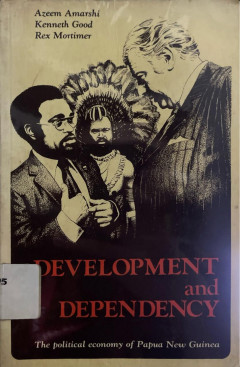
Development and Dependency
Development and Dependency examines the contrasting theories of economic development and dependency that have shaped global development discourse. The book analyzes how historical, political, and economic structures contribute to persistent inequalities between industrialized and developing nations. It explores concepts such as modernization, exploitation, peripheral economies, and the influenc…
- Edisi
- 1
- ISBN/ISSN
- 0 19 550582 4
- Deskripsi Fisik
- xviii, 261 pages : illustrations ; 21,5 cm
- Judul Seri
- -
- No. Panggil
- 330.9 AMA z

Iraq: The Eternal fire 1972 Iraqi oil nationalizaation in perspective
Iraq: The Eternal Fire – 1972 Iraqi Oil Nationalization in Perspective examines one of the most significant turning points in Iraq’s modern economic and political history: the nationalization of its oil industry in 1972. The book analyzes the circumstances that led to the decision, including international pressures, domestic political shifts, and Iraq’s growing assertion of sovereignty ov…
- Edisi
- 11
- ISBN/ISSN
- 0 86199 004 8
- Deskripsi Fisik
- 255 pages; 22,5 cm
- Judul Seri
- -
- No. Panggil
- 338.2 HUS i

A strong Indonesian economy built on a record of tremendous achievement
From the extreme difficulties inherited by Indonesia's New Order Government in 1966, when inflation was running at over 600 percent annually and the nation could barely provide the basic necessities of life for its people, the Indonesian economy emerged remarkably transformed by the close of the country's first 25 Year Development Plan in 1993/1994
- Edisi
- -
- ISBN/ISSN
- -
- Deskripsi Fisik
- i, 14 pages ; 28 cm
- Judul Seri
- -
- No. Panggil
- 330. 959 Ind s
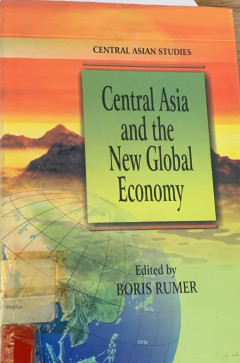
Central Asia and the new global economy
This book contains: 1. Economic crisis and growing intraregional tensions 2. The economic development of Central Asia in the 1990s 3. Basic problems of market transition in Central Asia 4. Adapting globalization 5. Foreign trade and investment 6. Kazakhstan and Uzbekistan: The economic consequences of membership in the World Trade Organization 7. Central Asia and the Asian-Pacific Region…
- Edisi
- -
- ISBN/ISSN
- 81-87879-09-2
- Deskripsi Fisik
- xiii, 288 pages : index ; 22 cm
- Judul Seri
- -
- No. Panggil
- 330.95 Rum c

Regional dynamics : Security, political and economic issues in the Asia-Pasif…
This collection of papers is only a subset of a much larger body of papers, the result of a collaboration among about 50 scholars from the Asia Pacific region, which have been commissioned under the so-called "Quadrilateral Project." That project was jointly sponsored by the Institute of East Asian Studies, University of California, Berkeley; the University of Tokyo, the Centre for Strategic an…
- Edisi
- -
- ISBN/ISSN
- 979-8026-10-1
- Deskripsi Fisik
- vi, 418 pages ; 21 cm
- Judul Seri
- -
- No. Panggil
- 330.95 Sca r

Secrets, lies and democracy
Another illusion-shattering piece from the man "The New York Times" called "arguably the most important intellectual alive". In 1970, about 90 per cent of international capital was used for trade and long-term investment - more or less productive things - and 10 per cent for speculation. By 1990, these figures had reversed. Haiti, a starving island, is exporting food to the US - about 35 times …
- Edisi
- First Published
- ISBN/ISSN
- 978-1-878-82504-9
- Deskripsi Fisik
- 128 pages ; 21 cm.
- Judul Seri
- -
- No. Panggil
- 330.9048 Cho s
 Karya Umum
  Filsafat
  Agama
Agama  Ilmu-ilmu Sosial
  Bahasa
  Ilmu-ilmu Murni
  Ilmu-ilmu Terapan
  Kesenian, Hiburan, dan Olahraga
  Kesusastraan
  Geografi dan Sejarah