Ditapis dengan

The Soviet empire: Expansion & détente
The book The Soviet Empire: Expansion & Détente is one volume in the Critical Choices for Americans series, which discusses the development of Soviet foreign policy from the beginning of the Cold War to the mid-1970s. This work describes the dynamics of Soviet geopolitical expansion, whether through military influence, ideology, or intervention in various regions of the world. In addition, th…
- Edisi
- -
- ISBN/ISSN
- 0-669-00421-9
- Deskripsi Fisik
- xix, 417 pages ; 23,5 cm
- Judul Seri
- -
- No. Panggil
- 327.47 GRI s
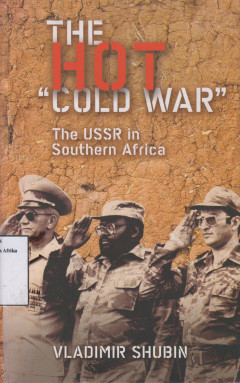
he Hot “Cold War”: The USSR in Southern Africa
This book provides a detailed examination of the Soviet Union’s political, military, and ideological involvement in Southern Africa during the Cold War. Vladimir Shubin, a former Soviet official directly engaged in African affairs, offers a unique insider perspective on Moscow’s role in liberation movements in Angola, Mozambique, Namibia, and South Africa. Drawing on archival material, inte…
- Edisi
- -
- ISBN/ISSN
- 978-0-7453-2472-2
- Deskripsi Fisik
- xvi, 320 pages : illustrations ; 21,5 cm
- Judul Seri
- -
- No. Panggil
- 327.47068 SHU h

Soviet foreign policy in a changing world
This book is a collection of essays and academic studies on the changes and dynamics of the Soviet Union's foreign policy after 1975. Editors Robbin F. Laird and Erik P. Hoffmann present in-depth analyses of Soviet international political strategy, including relations with developing countries, reactions to global changes, and the role of ideology and internal power structures in shaping Soviet…
- Edisi
- -
- ISBN/ISSN
- 0-202-24167-X
- Deskripsi Fisik
- xxiv, 969 pages ; 23,5 cm
- Judul Seri
- -
- No. Panggil
- 327.47 LAI s

Soviet foreign policy since world war II
This second edition of Soviet Foreign Policy Since World War II provides a comprehensive analysis of the Soviet Union's foreign policy from the end of World War II to the early 1980s. Joseph L. Nogee and Robert H. Donaldson discuss the dynamics of ideology, strategic interests, international relations, and changes in Soviet leadership that influenced foreign policy. This book combines a framewo…
- Edisi
- Second edition
- ISBN/ISSN
- 0-08-030151-7
- Deskripsi Fisik
- vii, 351 pages ; 23 cm
- Judul Seri
- -
- No. Panggil
- 327.47 NOG s
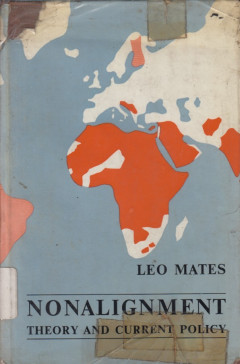
Nonalignment: Theory and current policy
This book provides a foundational theoretical and historical study of the Non-Aligned Movement, written by Leo Mates, one of Yugoslavia’s leading scholars on international politics. It examines the conceptual origins of nonalignment, its evolution in global politics, and its role as a strategic alternative during the Cold War. The author discusses the principles, objectives, and diplomatic pr…
- Edisi
- -
- ISBN/ISSN
- 0-379-00170-5
- Deskripsi Fisik
- 543 pages ; 23,5 cm
- Judul Seri
- -
- No. Panggil
- 327.17 MAT n

The Elephants and the grass: A Study of nonalignment
This book provides an in-depth analysis of the Nonaligned Movement during the Cold War, exploring how emerging nations sought to maintain independence from the influence of major global powers. Cecil V. Crabb, Jr. examines the political dynamics between the superpowers (“the elephants”) and the smaller, developing nations (“the grass”), highlighting the movement’s origins, strategies,…
- Edisi
- -
- ISBN/ISSN
- -
- Deskripsi Fisik
- xiii pages ; 20,5 cm
- Judul Seri
- -
- No. Panggil
- 327.17 CRA e

International politics in East Asia since world war II
This book provides a comprehensive overview of the major political developments and international relations in East Asia following World War II. Donald F. Lach and Edmund S. Wehrle analyze key regional dynamics, including the rise of new nation-states, ideological conflicts, Cold War tensions, and shifting power structures. Through historical context and political analysis, the authors explore …
- Edisi
- -
- ISBN/ISSN
- -
- Deskripsi Fisik
- x, 388 pages : illustration ; 23 cm
- Judul Seri
- -
- No. Panggil
- 327.51 LAC i

Cold war captives: Imprisonment, escape, and brainwashing
This book examines the ways imprisonment, escape, and the notion of “brainwashing” shaped American cultural and political perceptions during the Cold War. Susan L. Carruthers explores how captivity narratives, political prisoners, defections, and repatriation stories were represented in media, motion pictures, literature, and popular culture. Through historical documentation and cultural an…
- Edisi
- -
- ISBN/ISSN
- 978-0-520-25730-6
- Deskripsi Fisik
- xiii, 335 pages : illustration ; 23 cm
- Judul Seri
- -
- No. Panggil
- 909.825 CAR c
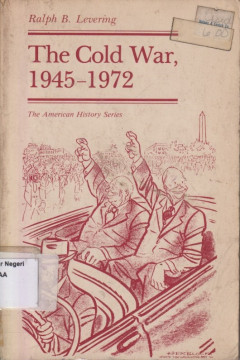
The Cold war, 1945–1972
The Cold War, 1945–1972 by Ralph B. Levering offers a concise and analytical overview of the political, diplomatic, and ideological tensions between the United States and the Soviet Union during the early decades of the Cold War. As part of The American History Series, the book provides a clear narrative covering the origins of the conflict, the development of containment policies, crises suc…
- Edisi
- -
- ISBN/ISSN
- 0-88295-811-9
- Deskripsi Fisik
- xi, 165 pages : illustrations ; 20 cm
- Judul Seri
- -
- No. Panggil
- 327.73 LEV t

We now know: Rethinking cold war history
We Now Know: Rethinking Cold War History offers a groundbreaking reinterpretation of the Cold War using newly available archival evidence from the former Soviet Union, China, and Eastern Europe. John Lewis Gaddis analyzes the ideological, political, and strategic forces shaping the global conflict between the United States and the Soviet Union. The book re-examines major events—including the …
- Edisi
- -
- ISBN/ISSN
- 0-19-878071-0
- Deskripsi Fisik
- x, 425 pages ; 23,5 cm
- Judul Seri
- -
- No. Panggil
- 327.12 GAD w
 Karya Umum
  Filsafat
  Agama
Agama  Ilmu-ilmu Sosial
  Bahasa
  Ilmu-ilmu Murni
  Ilmu-ilmu Terapan
  Kesenian, Hiburan, dan Olahraga
  Kesusastraan
  Geografi dan Sejarah