Ditapis dengan

China's future: Foreign policy and economic development in the post-Mao era
This book analyzes China’s foreign policy and economic development in the period following the death of Mao Zedong. Written within the framework of the Council on Foreign Relations’ 1980s Project, the study examines how domestic economic reforms and international strategic considerations shaped China’s evolving role in global politics. The authors explore policy choices, external relation…
- Edisi
- -
- ISBN/ISSN
- 0-07-069958-5
- Deskripsi Fisik
- xiv, 202 pages ;23 cm
- Judul Seri
- -
- No. Panggil
- 327.51 WHI c
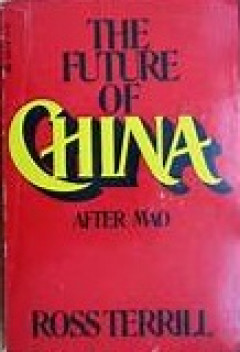
The Future of China After Mao
Examines China's future and political balance of power by analyzing the goals and methods of Hua Kuo-feng, Mao's successor, together with domestic problems, social and economic developments, and foreign relations
- Edisi
- -
- ISBN/ISSN
- 0-440-52612-4
- Deskripsi Fisik
- xiv, 331 pages : illustration ; 20 cm
- Judul Seri
- -
- No. Panggil
- 323.531 TER f

China's watergate : Political and economic conflicts, 1969-1977
Leo Goodstadt is uniquely qualified to write an inside report on the crises which have shaken China throughout this decade. He has devoted his entire career since 1962 to research and writing on Chinese events. In this book, he brings together a fascinating account of the background to the collapse of Mao Tse-tung's entourage and of respect for his immediate family within a month of his death i…
- Edisi
- -
- ISBN/ISSN
- 0-7069-0725-6
- Deskripsi Fisik
- 219 pages ; 22 cm
- Judul Seri
- -
- No. Panggil
- 951.05 GOO c
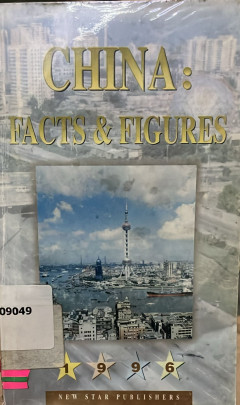
China : Facts and figures 1996
China: Facts and Figures 1996 is a comprehensive reference book that presents the latest data, statistics, and information on the People's Republic of China in the mid-1990s. This book provides a comprehensive overview of the political, economic, social, and cultural conditions, as well as scientific and technological developments in China after two decades of reform and openness. Through table…
- Edisi
- -
- ISBN/ISSN
- 7-80102-497-4
- Deskripsi Fisik
- 87 pages : illustrations ; 18 cm
- Judul Seri
- -
- No. Panggil
- 951.09049 BEI c
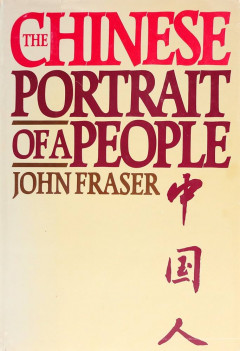
The Chinese portrait of a people
Portrait of a People by John Fraser is an in-depth report on the life of the Chinese people at the end of the 20th century, written based on the author's direct experience as a foreign correspondent living and working in China. Fraser describes the social, cultural, and political realities of China through keen observation and interviews with various segments of society, from government officia…
- Edisi
- -
- ISBN/ISSN
- 0-671-44873-0
- Deskripsi Fisik
- 463 pages : illustrations ; 24 cm
- Judul Seri
- -
- No. Panggil
- 951.057 FRA c

The political economy of China's provinces
Traditionally, political scientists and economists have seen China as a single entity and business people have seen China as a single market. This book challenges the notion of a centralised and unified China, and outlines how provinces are taking on new economic and political roles, forced upon them by decentralisation.It is the most thorough data on contemporary Chinese provinces available an…
- Edisi
- -
- ISBN/ISSN
- 9780415207768
- Deskripsi Fisik
- x, 287 pages ; 23,5 cm.
- Judul Seri
- -
- No. Panggil
- 338.951 Hen p

Stumbling giant: The threats to China's future
While dozens of recent books and articles have predicted the near-certainty of China's rise to global supremacy, this book boldly counters such widely-held assumptions. Timothy Beardson brings to light the daunting array of challenges that today confront China, as well as the inadequacy of leadership's responses. Threats to China come from many fronts, Beardson shows, and by their number and sh…
- Edisi
- -
- ISBN/ISSN
- 978-0-300-16542-5
- Deskripsi Fisik
- x, 517 pages : bibl: hlm 477-493 : index ; 24 cm
- Judul Seri
- -
- No. Panggil
- 330.951 Bea s
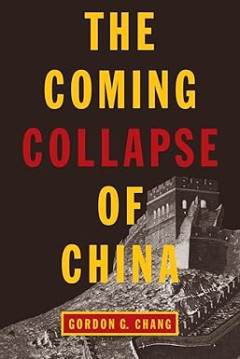
The coming collapse of China
China is hot. The world sees a glorious future for this sleeping giant, three times larger than the United States, predicting it will blossom into the world's biggest economy by 2010. According to Chang, however, a Chinese-American lawyer and China specialist, the People's Republic is a paper dragon. Peer beneath the veneer of modernization since Mao's death, and the symptoms of decay are every…
- Edisi
- -
- ISBN/ISSN
- 0-375-50477-X
- Deskripsi Fisik
- xxii, 344 pages : index ; 24 cm
- Judul Seri
- -
- No. Panggil
- 330.951 Cha c

The 36 Strategies of the Chinese: Adapting ancient Chinese wisdom to the busi…
The "Thirty-six Strategies" are well-known to the Chinese and are frequently applied in business practices. No one can pinpoint the exact period in which the thirty-six strategies were written, nor the exact combinations of strategies that constitute the thirty-six. However, through the years, scholars have expediently adopted the thirty-six strategies as a set of common tactics used by the Chi…
- Edisi
- -
- ISBN/ISSN
- 981-235-832-3
- Deskripsi Fisik
- xx, 298 pages : illustrations : index ; 23 cm.
- Judul Seri
- -
- No. Panggil
- 330.951 Hou s
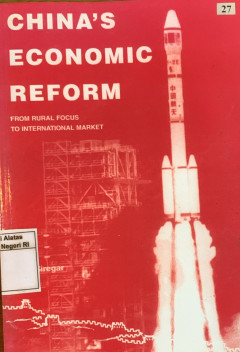
China's economic reform
This book contains: 1. A brief historical background on the period before the liberation 2. Natural and social economic conditions 3. Transformation and readjustment in the agricultural sector 4. China's rural economic development 5. Rural development and modernization 6. China's bilateral relations 7. People's living standard, social security and culture in rural areas 8. General dis…
- Edisi
- -
- ISBN/ISSN
- 90-5808-209-1
- Deskripsi Fisik
- 325 pages : bibl: hlm 303-317 ; 24 cm.
- Judul Seri
- -
- No. Panggil
- 330.951 Sir c
 Karya Umum
  Filsafat
  Agama
Agama  Ilmu-ilmu Sosial
  Bahasa
  Ilmu-ilmu Murni
  Ilmu-ilmu Terapan
  Kesenian, Hiburan, dan Olahraga
  Kesusastraan
  Geografi dan Sejarah