Ditapis dengan
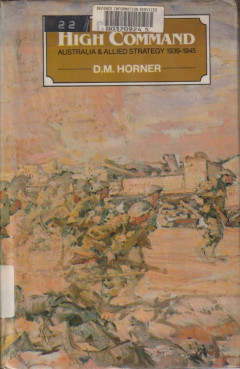
High command: Australia and allied strategy 1939–1945
This book provides an in-depth analysis of Australia's strategic decision-making and military leadership during the Second World War. D.M. Horner explores how Australia coordinated its defence strategy with Allied powers, examining the challenges, political pressures, and high-level command structures that shaped the nation's wartime policies from 1939 to 1945. Through detailed research and arc…
- Edisi
- -
- ISBN/ISSN
- 0-86861-084-4
- Deskripsi Fisik
- xxiii, 556 pages : illustration ; 22,5 cm
- Judul Seri
- -
- No. Panggil
- 940.54012 HOR h

The Commanders: Australian Military Leadership in the Twentieth Century
This book presents a comprehensive examination of Australian military leadership throughout the twentieth century. Edited by D. M. Horner, it offers detailed biographical studies of key Australian commanders and explores how their decisions, leadership styles, and operational experiences shaped the development of the nation’s military history. Through an analytical and historical approach, th…
- Edisi
- -
- ISBN/ISSN
- 0-86861-496-3
- Deskripsi Fisik
- xix, 355 halaman : illustration ; 25 cm
- Judul Seri
- -
- No. Panggil
- 355.00922 HOR c

Australian, New Zealand, and United States security relations, 1951-1986
The postwar alliance that evolved among Australia, New Zealand and the United States is rarely recognized as having had three distinct although closely related parts: legal basis (the ANZUS treaty); the diplomatic alliance, which is most commonly studied; and the defence relationship. This study provides a description and functional analysis of the long-ignored, but important security relations…
- Edisi
- -
- ISBN/ISSN
- 0-8133-8056-1
- Deskripsi Fisik
- xxii, 284 pages : illustrations (black and white) ; 22 cm
- Judul Seri
- -
- No. Panggil
- 355.0310959 You a

The new Australian militarism: Undermining our future security
This book examines the nature of Australia's emerging militarism and its implications for the future of this country and our neighbours. It argues that Australia's forces should confine themselves to the defence of this continent and its maritime resource zone. It urges a cooperative approach to regional security which would use dialogue, negotiation and conflict resolution as tools for resolvi…
- Edisi
- -
- ISBN/ISSN
- 0-949138-40-1
- Deskripsi Fisik
- 231 pages : index ; 21 cm
- Judul Seri
- -
- No. Panggil
- 355.02130994 Che n
 Karya Umum
  Filsafat
  Agama
Agama  Ilmu-ilmu Sosial
  Bahasa
  Ilmu-ilmu Murni
  Ilmu-ilmu Terapan
  Kesenian, Hiburan, dan Olahraga
  Kesusastraan
  Geografi dan Sejarah