Ditapis dengan
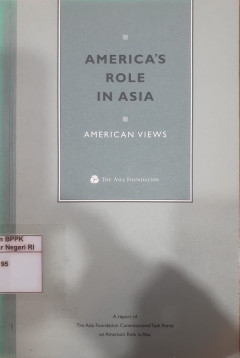
America's role in Asia: American views
In the post-Cold War world, U.S.-Asian relations remain central to U.S. policy. Fault lines in the Taiwan Straits and on the Korean peninsula require the daily vigilance of U.S. and Asian policymakers. Asia's continued recovery from the 1997 financial crisis depends in part upon the health of the American economy. And as domestic political change accelerates across Asia, relations must be recal…
- Edisi
- ed. 1
- ISBN/ISSN
- 1-892325-02-0
- Deskripsi Fisik
- xi, 62 pages : iIlustrations ; 23 cm
- Judul Seri
- -
- No. Panggil
- 330.97395 Fou a

Toward disengagement in Asia: A strategy for American foreign policy
This book gets to the marrow of the matter in East Asia. It is free of the distortions, misrepresentations, and irrelevancies which have so marred the debate on Vietnam and so filled most of the current literature on crises in Asia. In the author seeks to find out how the Asians can take over the primary responsibility for security while the United States decreases its involvement. Thus, he add…
- Edisi
- -
- ISBN/ISSN
- -
- Deskripsi Fisik
- vi, 186 pages : illustrations : index ; 20 cm
- Judul Seri
- -
- No. Panggil
- 327.59073 Gor t

Behind the myth : Business, money and power in Southeast Asia
This book describes the links between business and politics in Southeast Asia, an unseen system of business favouritism that lies behind the myth of free market enterprise. At a broader level, my central point is this: despite the glitter, Southeast Asia's prosperity rests on shaky foundations and depends on external forces well beyond its control. The region's growth, in its essence, results p…
- Edisi
- First Edition
- ISBN/ISSN
- 0-04-302011-9
- Deskripsi Fisik
- xiii, 275 pages ; 24 cm
- Judul Seri
- -
- No. Panggil
- 330.959 Cla b
 Karya Umum
  Filsafat
  Agama
Agama  Ilmu-ilmu Sosial
  Bahasa
  Ilmu-ilmu Murni
  Ilmu-ilmu Terapan
  Kesenian, Hiburan, dan Olahraga
  Kesusastraan
  Geografi dan Sejarah