Ditapis dengan

Asia and Africa in the global economy
The performance of Asian and African economies over recent decades has clearly shown that engagement with the global economy can play a key role in advancing development. Researchers and policymakers have paid particular attention to the marked divergence in growth in Southeast Asia and sub-Saharan Africa. One of the most obvious differences in their performance and economic structure has been …
- Edisi
- ed. 1
- ISBN/ISSN
- 92-808-1089-8
- Deskripsi Fisik
- ix, 418 pages ; 24 cm
- Judul Seri
- -
- No. Panggil
- 337.59 Ary a
Regional outlook: Southeast Asia 1994-95
The vibrance and optimism in Southeast Asia during 1993 was palpable. In the wake of the end of the Cold War, the region built upon the development that was already on track. Even so, the pace has been surprising. Not only did the ASEAN economies perform well generally, Vietnam surged ahead in economic development, and Myanmar registered strong sings of economic growth. Politically, the regi…
- Edisi
- -
- ISBN/ISSN
- 981-3016-73-6
- Deskripsi Fisik
- 85 pages : illustrations ; 28 cm
- Judul Seri
- -
- No. Panggil
- 330.959 Che r
Regional outlook: Southeast Asia 1994-93
The contents of this book: 1. Political Outlook - Southeast Asia 1992-93 2. Economic Outlook - ASEAN 1992-93 3. Economic Outlook - Indochinese States and Myanmar 1992-93
- Edisi
- -
- ISBN/ISSN
- 981-3016-18-3
- Deskripsi Fisik
- 81 pages : illustrations ; 28 cm
- Judul Seri
- -
- No. Panggil
- 330.959 Sin r
Regional Outlook: Southeast Asia 1993-94
The world is undergoing dramatic transformations in the wake of the crumbling of the Cold War order, and the ebbs and flows of these changes are not passing unnoticed in Southeast Asia. Indeed, the region is witnessing its own mini-versions of glasnot and perestroika, as countries like Vietnam, Cambodia, Laos, and Myanmar, for instance, seek their niches in the emerging opportunities and constr…
- Edisi
- -
- ISBN/ISSN
- 981-3016-47-7
- Deskripsi Fisik
- 93 pages : illustrations ; 28 cm
- Judul Seri
- -
- No. Panggil
- 330.959 San r
Regional outlook: Southeast Asia 1995-96
The contents of this book; 1. Political Outlook 1995-96 2. Economic Outlook 1995-96
- Edisi
- -
- ISBN/ISSN
- 981-3016-94-9
- Deskripsi Fisik
- 82 pages : illustrations ; 28 cm
- Judul Seri
- -
- No. Panggil
- 330.959 Sin r
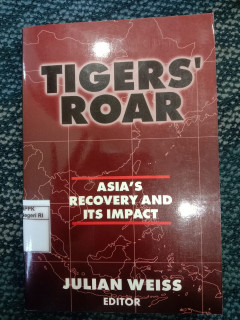
Tiger's roar: Asia's recovery and its impact
Tiger's roar identifies the major challenges facing Asia's four tigers (Singapore, Taiwan, South Korea, and Hong Kong), Japan, China, and their Shoutheast Asian neighboars (notably Thailand, Indonesia, Malaysia, and the philippines) as the region increases its role and stature on the world stage.
- Edisi
- -
- ISBN/ISSN
- 0-7656-0784-0
- Deskripsi Fisik
- xx, 354 pages : index ; 23 cm
- Judul Seri
- -
- No. Panggil
- 950 Wei t
 Karya Umum
  Filsafat
  Agama
Agama  Ilmu-ilmu Sosial
  Bahasa
  Ilmu-ilmu Murni
  Ilmu-ilmu Terapan
  Kesenian, Hiburan, dan Olahraga
  Kesusastraan
  Geografi dan Sejarah