Ditapis dengan

The routledge dictionary of twentieth-century political thinkers
The Routledge Dictionary of Twentieth-Century Political Thinkers introduces the reader to important thinkers from the early years of the century to the contemporary period. Through them an informed, reliable and accessible guide to the ideas that have influenced political activity and thought in the twentieth century is provided.
- Edisi
- Second edition
- ISBN/ISSN
- 0-415-09623-5
- Deskripsi Fisik
- xv, 277 pages : index ; 25 cm
- Judul Seri
- -
- No. Panggil
- 320.0922 Ben r

Knowledge and power: The life of the mind and the conduct of government
We as a nation, have often tended to see problems as opportunities. In the face of conflicting demands, proliferating information, and rapid technological change, many of us would agree that imagination and integrity in the use of knowledge are essential if we are to make hard choices and move ahead.
- Edisi
- -
- ISBN/ISSN
- -
- Deskripsi Fisik
- 43 pages; 22 cm
- Judul Seri
- Occasional papers of the Council of Scholars ; no. 6
- No. Panggil
- 303.3 Bil k

The rulling class
This book discusses political science from various theories. Also explained are various ruling classes, systems, social types and legal defenses. Several government sciences are also explained.
- Edisi
- -
- ISBN/ISSN
- -
- Deskripsi Fisik
- ix, 514 pages ; 22 cm
- Judul Seri
- -
- No. Panggil
- 320 Liv r

Soft power : The means to success in world politics
Joseph Nye coined the term "soft power" to describe a nation's ability to attract and persuade. Whereas hard power-the ability to coerce- grows out of a country's military or economic might, soft power arises from the attractiveness of its culture, political ideals, and policies. Hard power remains crucial in a world of states trying to guard their independence and of non-state groups willin…
- Edisi
- -
- ISBN/ISSN
- 1586483064
- Deskripsi Fisik
- 191 pages : 23 cm.
- Judul Seri
- -
- No. Panggil
- 327. 73 Nye s

The paradox of American power: Why the worlds only superpower can't go it alone
Not since Rome has any nation had so much economic, cultural, and military power, but that power does not allow us to solve global problems like terrorism, environmental degradation, and the proliferation of weapons of mass destruction without involving other nations. The author focuses on the rise of these and other new challenges and explains clearly why America must adopt a more cooperative …
- Edisi
- -
- ISBN/ISSN
- 0195150880
- Deskripsi Fisik
- 222 pages : 25 cm.
- Judul Seri
- -
- No. Panggil
- 327. 73 Nye p

Ideals and realities: Selected essays of Abdul Salam
The first two editions of ideals and realities got a response from the readers that showed the book to be a tour de force. In the meantime, Professor Abdul Salam had made some more valuable presentations like "Notes on science, technology and science educations in the development of the South"--a document he had prepared for the 4th and 5th meetings of the South commission.
- Edisi
- Third Edition
- ISBN/ISSN
- 981-02-0081-1
- Deskripsi Fisik
- xiv, 509 pages : illustrations ; 21 cm
- Judul Seri
- -
- No. Panggil
- 345 Lai i

Globalization and its discontents: Essays on the new mobility of people and m…
Nations fret about their shrinking sovereignty as large numbers of immigrants cross borders at will. Multinational corporations quietly draw up contracts that sidestep the legal institutions of their "home" territories. Complex financial ties tightly bind competing national centers such as New York and Tokyo, putting these cities in a nomad's land beyond the reach of any one state.
- Edisi
- Cetakan Pertama
- ISBN/ISSN
- 1565843959
- Deskripsi Fisik
- xix, 253 pages : bibliography : index ; 25 cm
- Judul Seri
- -
- No. Panggil
- 303.482 Sas g
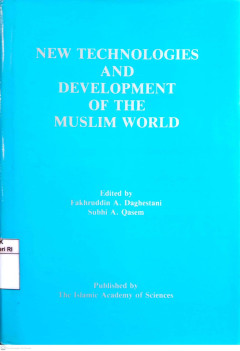
New technologies and development of the Muslim world
Economic development depends largely on the ability of a nation to fully utilize its natural resources, which depends on detailed knowledge of these resorces; what were, and how much. This information is scarce or lacking in most developing countries, particularly in the Islamic World.
- Edisi
- First Edition
- ISBN/ISSN
- -
- Deskripsi Fisik
- 426 pages : illustration ; 24 cm
- Judul Seri
- -
- No. Panggil
- 291.195 Dag n

Science and technology manpower for development in the Islamic world
This paper presents a historical perspective of the early Islamic science including its rise and decline. In addition, brief discussion covers the scientific and technological manpower potential in the OIC member states.
- Edisi
- First Edition
- ISBN/ISSN
- -
- Deskripsi Fisik
- 496 pages ; 24 cm
- Judul Seri
- -
- No. Panggil
- 291.175 Dag s

The ruler's imperative: Strategies for political survival in Asia and Africa
This book on political leadership in underdeveloped Africa and Asia as- sumes that a ruler's first desire is to retain his position at the apex of government while others press to displace him. THE RULER'S IMPERATIVE asks: Once positioned at the apex, what must a ruler do to remain in power and pursue more effectively the nation- building goals he sets for himself and his polity? How can he act…
- Edisi
- -
- ISBN/ISSN
- -
- Deskripsi Fisik
- ix, 275 pages : index ; 24 cm
- Judul Seri
- -
- No. Panggil
- 320.59960 Wri r
 Karya Umum
  Filsafat
  Agama
Agama  Ilmu-ilmu Sosial
  Bahasa
  Ilmu-ilmu Murni
  Ilmu-ilmu Terapan
  Kesenian, Hiburan, dan Olahraga
  Kesusastraan
  Geografi dan Sejarah