Ditapis dengan

Japan: An Anthropological introduction
A comprehensive ethnographic and anthropological overview of Japanese society, tracing its cultural origins, social structure, and value systems. Befu explores Japan’s historical development — from prehistoric periods through the formation of kinship systems, family structures, and rural community life. He examines how ritual kinship, paternalism, and the stem family concept shape familial …
- Edisi
- -
- ISBN/ISSN
- 4-8053-0461-8
- Deskripsi Fisik
- xii, 210 pages : illustrations ; 18 cm
- Judul Seri
- -
- No. Panggil
- 915.2 BEF j
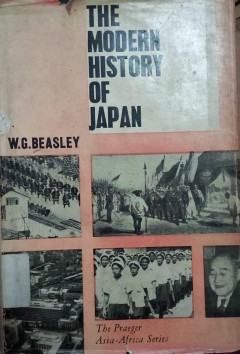
The Modern history of Japan
The Modern History of Japan by W. G. Beasley provides a comprehensive overview of Japan’s political, social, and economic transformation from the late Tokugawa era to the modern period. The book examines the fall of the shogunate, the Meiji Restoration, Japan’s rapid modernization, and the emergence of the nation as a major world power. Beasley analyzes key historical developments, includin…
- Edisi
- -
- ISBN/ISSN
- -
- Deskripsi Fisik
- xi, 352 pages : illustrations ; 21,5 cm
- Judul Seri
- -
- No. Panggil
- 952 BEA m
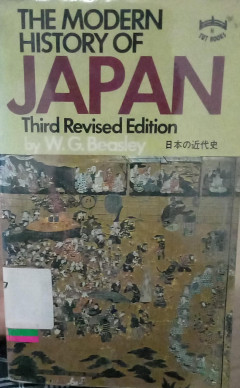
The Modern history of Japan
The Modern History of Japan by W. G. Beasley provides a comprehensive overview of Japan’s political, social, and economic transformation from the late Tokugawa era to the modern period. The book examines the fall of the shogunate, the Meiji Restoration, Japan’s rapid modernization, and the emergence of the nation as a major world power. Beasley analyzes key historical developments, includin…
- Edisi
- 3
- ISBN/ISSN
- 4-8053-0480-4
- Deskripsi Fisik
- ix, 358 pages : illustrations ; 18 cm
- Judul Seri
- -
- No. Panggil
- 952.047 BEA m

The Horizon concise history of Japan
A clear, readable, and compact overview of Japan’s history. The book spans from ancient times through the feudal era, the modernization during the Meiji Restoration, and into the twentieth century, covering Japan’s rise as a world power. Busch highlights political, economic, and social transformations, such as the shift from isolation to international engagement, industrial growth, and the …
- Edisi
- -
- ISBN/ISSN
- 07-009299-0
- Deskripsi Fisik
- 217 pages : illustrations ; 24 cm
- Judul Seri
- -
- No. Panggil
- 952 BUS h

Faces of Japan
Faces of Japan by Bob Davis is a photographic book capturing everyday life in Japan during the 1970s. Through 88 black-and-white photographs, Davis portrays both traditional and modern aspects of Japanese society, from urban centers to rural areas, highlighting daily routines, local markets, sumo wrestling, and street scenes in cities like Shibuya. The book aims to reveal the “real faces of J…
- Edisi
- 1
- ISBN/ISSN
- 0-87011-338-0
- Deskripsi Fisik
- xiv, 108 pages : illustrations ; 25 cm
- Judul Seri
- -
- No. Panggil
- 952 DAV f
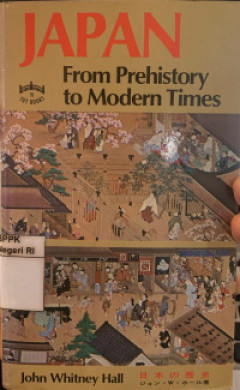
Japan from prehistory to modern times
the political, social, and cultural evolution of Japan from its earliest eras through the mid‑20th century. Hall places special emphasis on Japan’s premodern period, analyzing how its feudal institutions, social hierarchies, and political structures changed over more than two millennia. He explores the influence of both the Chinese civilization (especially from the 6th century) and the West…
- Edisi
- 13
- ISBN/ISSN
- 4-8053-0276-3
- Deskripsi Fisik
- xii, 397 pages : illustrations ; 18 cm
- Judul Seri
- -
- No. Panggil
- 952 HAL j

The Meiji restoration
A comprehensive and scholarly examination of the pivotal events of 1868 in Japan, when Imperial power was restored. He argues that the Restoration was not primarily driven by economic distress or class conflict, but by a rising sense of national danger and pride as Japan encountered Western powers. Nationalism motivated the overthrow of the Tokugawa shogunate and the re-unification of Japan und…
- Edisi
- -
- ISBN/ISSN
- 0-8047-0815-0
- Deskripsi Fisik
- 513 pages ; 24 cm
- Judul Seri
- -
- No. Panggil
- 952.031 BEA m

The Japanaese mind : The Goliath explained
The Japanese Mind: The Goliath Explained by Robert C. Christopher offers a concise analysis of the cultural values and social behaviors that shape Japanese thinking. The book explains how tradition, group orientation, discipline, and implicit communication influence Japan’s society, education, and work culture. Christopher highlights the contrast between modern industrial success and enduring…
- Edisi
- -
- ISBN/ISSN
- 0-671-44947-8
- Deskripsi Fisik
- 352 pages ; 24 cm
- Judul Seri
- -
- No. Panggil
- 952.04 CHR j

A History of political institutions in Japan
A historical examination of the major political institutions in Japan, from the early modern period through the Meiji Restoration and into more recent eras. Ishii analyzes the development of governance structures, the relationship between the imperial system, the bureaucracy, and emerging representative bodies, as well as how these institutions evolved in response to internal and external press…
- Edisi
- -
- ISBN/ISSN
- 0-86008-261-X
- Deskripsi Fisik
- x, 172 pages : illustrations ; 23 cm
- Judul Seri
- -
- No. Panggil
- 952.04 ISH a

Japan's postwar peace settlements
Examines the diplomatic, legal, and geopolitical dimensions of Japan’s postwar peace settlements from 1945 onwards. Jain explores how Japan negotiated with various countries to reestablish its international relations, focusing on treaties, reparations, and reconciliation. He analyzes key agreements such as the San Francisco Peace Treaty as well as bilateral pacts with nations including Korea …
- Edisi
- -
- ISBN/ISSN
- -
- Deskripsi Fisik
- xvi, 399 pages ; 22 cm
- Judul Seri
- -
- No. Panggil
- 952.04 JAI j
 Karya Umum
  Filsafat
  Agama
Agama  Ilmu-ilmu Sosial
  Bahasa
  Ilmu-ilmu Murni
  Ilmu-ilmu Terapan
  Kesenian, Hiburan, dan Olahraga
  Kesusastraan
  Geografi dan Sejarah