Ditapis dengan

Diplomatic bag : an anthology of diplomatic incidents and anecdotes from the …
This collection provides an account of diplomatic life as seen by the diplomats themselves. Included are coups and disasters, gaffes of protocol and great moments of history - as seen through the eyes of those who have been in the right place at the right time.
- Edisi
- First Published
- ISBN/ISSN
- 0-7195-5740-2
- Deskripsi Fisik
- viii,248 pages : index ; 24 cm
- Judul Seri
- -
- No. Panggil
- 327.2 Ure d

Shattered peace: The origins of the cold war and the national security state
In 1945, as the horrors of the Second World War finally came to a close, few would have guessed that less than five years later the United States would be locked into something called a Cold War with its former ally, the Soviet Union. But by 1947, that's exactly what happened. Somehow the American viewpoint had changed: now Russia was the enemy.
- Edisi
- -
- ISBN/ISSN
- 0-14-012177-3
- Deskripsi Fisik
- xiii, 544 pages : bibl: hlm 509-530 : index ; 24 cm
- Judul Seri
- -
- No. Panggil
- 327.09044 Yer s

Playing God: Seven fateful moments when great men met to change the world
Throughout time, leaders at the pinnacle of power - popes and kings, presidents and prime ministers, even czars and generals - have subscribed to the belief that they can change the course of history, not by the force of arms, but through charm, skillful negotiation, honesty, deceit, and all the other arts of peaceful human exchange. Now, in Playing God, Charles L. Mee, Jr. - author of the crit…
- Edisi
- -
- ISBN/ISSN
- 0-671-67888-4
- Deskripsi Fisik
- 269 pages : index ; 24 cm
- Judul Seri
- -
- No. Panggil
- 327.09 Mee p
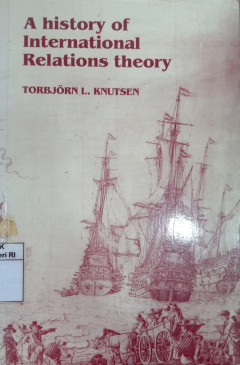
A history of international relations theory: An introduction
This work disputes the idea that speculation about the relations between states only goes back to World War I, but argues that scholars, soldiers and statesmen have speculated about the relations between states since the modern state emerged four or five centuries ago.
- Edisi
- -
- ISBN/ISSN
- 0-7190-3660-7
- Deskripsi Fisik
- ix, 298 pages : illustrations : bibl: hlm 273-289 : index ; 25 cm
- Judul Seri
- -
- No. Panggil
- 327.09 Knu h
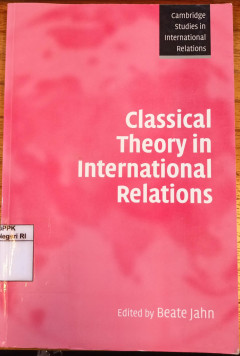
Classical theory in international relations
A group of international contributors critically assess how traditional interpretations of classical political theorists frequently ignore the intellectual and historical context in which they wrote. The essays provide alternative interpretations sensitive to these contexts and the trajectory of their appropriation in the international relations discipline
- Edisi
- First Published
- ISBN/ISSN
- 0-521-68602-4
- Deskripsi Fisik
- xv, 309 pages : index ; 22 cm
- Judul Seri
- -
- No. Panggil
- 327 Jah c

Latin America and the Caribbean in the global context: Why care about the Ame…
Current perspectives on Latin America’s role in the world tend to focus on one question: Why is Latin America always falling behind? Analysts and scholars offer answers grounded in history, economic underdevelopment, or democratic consolidation. Bagley and Horwitz, however, shift the central question to ask why and to what extent does Latin America matter in world politics, both now and in th…
- Edisi
- First Published
- ISBN/ISSN
- 978-0-415-87745-9
- Deskripsi Fisik
- xiv, 273 pages : index, bibliography ; 23 cm
- Judul Seri
- -
- No. Panggil
- 327.8 Hor l

The transformation of Southeast Asia: International perspectives on decoloniz…
This volume moves beyond the traditional view of decolonization as simply a transfer of power. Instead the chapters emphasize the process rather than events to provide a framework for discussion. The editors have brought together Asian, American and European scholars to share different perspectives & insights in the post-colonial era.
- Edisi
- -
- ISBN/ISSN
- 9971-69-293-7
- Deskripsi Fisik
- xiv, 358 pages : illustrations : index ; 23 cm
- Judul Seri
- -
- No. Panggil
- 325.5909045 Fre t

The transformation of Southeast Asia: International perspectives on decoloniz…
This work provides the basis for a reconceptualization of key features in Southeast Asia's history. It examines evolutionary patterns of Europe's and Japan's Southeast Asian empires from the late 19th century through World War II, and offer insights into the events of the 1940s, 1950s, and 1960s.
- Edisi
- -
- ISBN/ISSN
- 0-7656-1140-6
- Deskripsi Fisik
- xiv, 358 pages : index ; 24 cm.
- Judul Seri
- -
- No. Panggil
- 325.5909045 Fre t

The power of the vote : Electing presidents, overthrowing dictators, and prom…
From the legendary New York City mayoral race of 1977 to his twenty-year efforts to modernize Israeli politics to Bill Clinton's 1996 reelection campaign, Schoen takes you on a fascinating, eye-opening ride across the international political landscape of the past three decades. Demonstrating how politics has evolved and how he has utilized the latest technology to help candidates win the hearts…
- Edisi
- -
- ISBN/ISSN
- 978-0-06-144080-9
- Deskripsi Fisik
- xx, 396 pages : index ; 24 cm
- Judul Seri
- -
- No. Panggil
- 342.7307 Sch p

Men in white: The untold story of Singapore's ruling political party
Men in White is the inside story of one of the world's most successful political parties the ruling People's Action Party of Singapore. With its victory in the 2006 polls, PAP has won 12 successive general elections since it assumed power in 1959. Narrated in three parts, Men in White chronicles the rise, fall, capture, split, and rise of a political party which has become synonymous with th…
- Edisi
- Ed. 2
- ISBN/ISSN
- 978-981-4266-51-2
- Deskripsi Fisik
- xvi, 692 pages : illustrations : index ; 23 cm
- Judul Seri
- -
- No. Panggil
- 324.25957 Yap m
 Karya Umum
  Filsafat
  Agama
Agama  Ilmu-ilmu Sosial
  Bahasa
  Ilmu-ilmu Murni
  Ilmu-ilmu Terapan
  Kesenian, Hiburan, dan Olahraga
  Kesusastraan
  Geografi dan Sejarah