Ditapis dengan

The Origins of the cold war in the near east: Great power conflict and diplom…
This book is a comprehensive study of the origins of the Cold War in the Near East, focusing on the great power rivalry in Iran, Turkey, and Greece after World War II. Bruce R. Kuniholm analyzes the dynamics of international politics between the United States, the Soviet Union, and regional states, and how conflict and diplomacy shaped the postwar geopolitical architecture. Drawing on archival …
- Edisi
- -
- ISBN/ISSN
- 0-691-04665-4
- Deskripsi Fisik
- xxiii, 485 pages ; 24 cm
- Judul Seri
- -
- No. Panggil
- 327.09045 KUN o
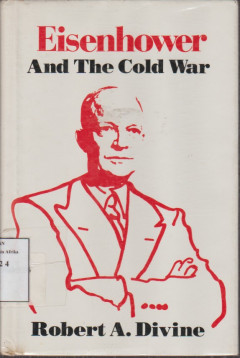
Eisenhower and the cold war
Robert A. Divine's Eisenhower and the Cold War explores President Dwight D. Eisenhower's foreign policy during the Cold War (1953–1961). Divine demonstrates that Eisenhower, despite his cautious approach, played a crucial role in shaping the United States' global strategy through his policies of containing communism, strengthening international alliances, and using nuclear power as a deterren…
- Edisi
- -
- ISBN/ISSN
- 0-19-502823-6
- Deskripsi Fisik
- ix, 181 pages ; 22 cm
- Judul Seri
- -
- No. Panggil
- 327.73 DIV e
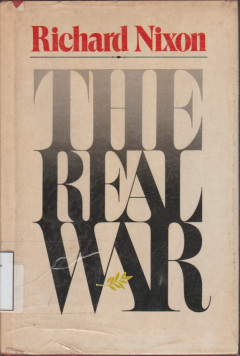
The Real war
The Real War is a global political and strategic analysis written by former US President Richard Nixon. In it, Nixon outlines his views on the geopolitical threats facing the United States during the Cold War, particularly the ideological and military rivalry with the Soviet Union. He emphasizes the need for a firm foreign policy, strengthened national defense, and realistic diplomacy to mainta…
- Edisi
- -
- ISBN/ISSN
- 0-446-51201-X
- Deskripsi Fisik
- 341 pages : illustration ; 23,5 cm
- Judul Seri
- -
- No. Panggil
- 327.73 NIX r
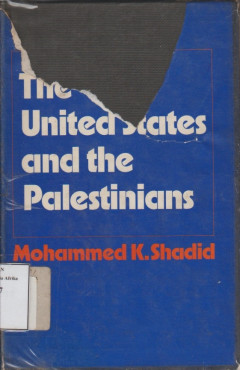
The United States and the Palestinians
This book analyzes the relationship between the United States and the Palestinian people in the context of Middle Eastern politics. Mohammed K. Shadid examines changes in American foreign policy over time, the influence of political lobbies, and the dynamics of US relations with Arab states and Israel. Using historical data, diplomatic policy, and political analysis, the book reveals how the Pa…
- Edisi
- -
- ISBN/ISSN
- 0-312-83315-6
- Deskripsi Fisik
- 252 pages : illustration ; 22 cm
- Judul Seri
- -
- No. Panggil
- 327.730 SHA u
South Africa: Time running out
South Africa. Many Americans regard it as remote and of little concern United States. Yet within the past few yegrs it has become increasingly important to our country. How dependent is America on South Africa's strategic minerals? Can the United States do anything to help end apartheid? How dangerous is South Africa as a potential point of entry for Soviet influence? Is the Cape sea route u…
- Edisi
- -
- ISBN/ISSN
- 0-520-04594-1
- Deskripsi Fisik
- xxvii, 517 pages : illustrations ; 23 cm
- Judul Seri
- -
- No. Panggil
- 327.73068 STU s

China's strategic competition with the United States
This book examines the transformation and the multifaceted nature of the relationship between US and China in the twenty-first century and argues that it is more competitive than co-operative, even in areas that are amenable to co-operation such as trade and nuclear non-proliferation
- Edisi
- -
- ISBN/ISSN
- 9780415725941
- Deskripsi Fisik
- x, 170 pages ; 24 cm
- Judul Seri
- -
- No. Panggil
- 327.73051 Ong c

The United States and Asia: Regional dynamics and twenty-first-century relations
Offers a cogent overview of the historical context and enduring patterns of U.S. relations with Asia ... Robert G. Sutter provides a balanced analysis of post-Cold War dynamics in Asia, which involve interrelated questions of security, economics, national identity, and regional institution building. He demonstrates how these critical concerns manifest a complex mix of realist, liberal, and cons…
- Edisi
- -
- ISBN/ISSN
- 9781442226333
- Deskripsi Fisik
- x, 327 pages ; 23 cm
- Judul Seri
- -
- No. Panggil
- 327.7305 Sut u

The imperial mantle: The United States, decolonization, and the Third World
The Imperial Mantle traces the upheavals in the post-war era as the peoples of British, Dutch, Belgian, and Portuguese empires demanded and gained independence. As the most powerful leader of the free world, despite its anti-colonial heritage, the United States tended to inherit the imperial mantle in this period, becoming the focus of both expectations and demands from the new nations. How the…
- Edisi
- -
- ISBN/ISSN
- 0-253-33834-4
- Deskripsi Fisik
- x, 241 pages : bibl: hlm 225-231 : index ; 25 cm
- Judul Seri
- -
- No. Panggil
- 327.7301724 New i
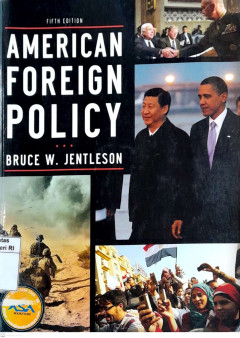
American foreign policy
When we went to bed on the night of September 10, 2001, the world was already going through a historic transition. The Cold War had ended, raising hopes for the future. War, though, had not ended, as the 1990s bore tragic witness in Bosnia, Rwanda, and all too many other places. New forces of globalization were sweeping the world, bringing their own combination of progress and problems. Democra…
- Edisi
- Ed.5
- ISBN/ISSN
- 978-0-393-91943-1
- Deskripsi Fisik
- xxiv,672 pages : index ; 25 cm
- Judul Seri
- -
- No. Panggil
- 327.73 Jen a

Does America need a foreign policy? Toward a diplomacy for the 21st century
An assessment of how the United States dominant position may be effectively reconciled with the urgent need, in the 21st century, to achieve a new world order. Kissinger examines America's present and future relations with Russia, China, Europe, the Middle East, and other areas in the world. He covers areas such as globilization, military intervention, free trade and the eroding of the planet's…
- Edisi
- Edition 1 Touchstone
- ISBN/ISSN
- 0-684-85567-4
- Deskripsi Fisik
- 350 pages : illustrations : index ; 24 cm
- Judul Seri
- -
- No. Panggil
- 327.73 Kis d
 Karya Umum
  Filsafat
  Agama
Agama  Ilmu-ilmu Sosial
  Bahasa
  Ilmu-ilmu Murni
  Ilmu-ilmu Terapan
  Kesenian, Hiburan, dan Olahraga
  Kesusastraan
  Geografi dan Sejarah