Ditapis dengan
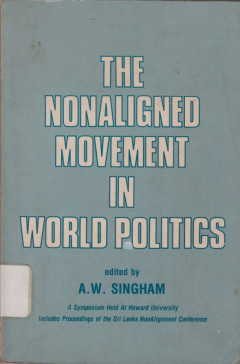
The Nonaligned movement in world politics
This volume examines the emergence, evolution, and political significance of the Non-Aligned Movement within the context of global politics during the Cold War. It analyzes the movement’s ideological foundations, its responses to major world conflicts, and its role in representing the interests of developing nations. Through contributions from various scholars, the book explores how nonalignm…
- Edisi
- -
- ISBN/ISSN
- 0-88208-069-9
- Deskripsi Fisik
- 273 pages ; 23 cm
- Judul Seri
- -
- No. Panggil
- 327.17 TIM n
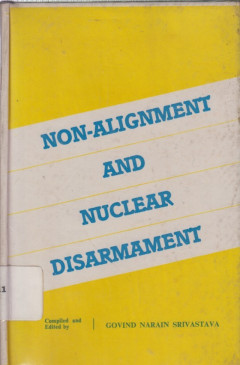
Non-alignment and nuclear disarmament
This volume examines the relationship between the Non-Aligned Movement (NAM) and global efforts toward nuclear disarmament. Compiled and edited by Govind Narain Srivastava, it analyzes NAM’s political stance on nuclear weapons, the advocacy for disarmament, and the movement’s influence on international peace negotiations. The book provides insights into the strategic, moral, and diplomatic …
- Edisi
- -
- ISBN/ISSN
- -
- Deskripsi Fisik
- 97 pages ; 22 cm
- Judul Seri
- -
- No. Panggil
- 327.174 SRI n

Twenty Years of Bandung and Problems of Peace and Security in Asia: A Collect…
This volume presents a collection of scholarly articles reflecting on the twenty years following the historic 1955 Bandung Conference. Edited by Shashi Bhushan, the book discusses the challenges of peace and security in Asia, the evolution of Asian-African political solidarity, and the broader implications for international relations during the Cold War era. It examines regional conflicts, dipl…
- Edisi
- -
- ISBN/ISSN
- -
- Deskripsi Fisik
- xiv, 151 pages ; 22 cm
- Judul Seri
- -
- No. Panggil
- 327.095 BHU t
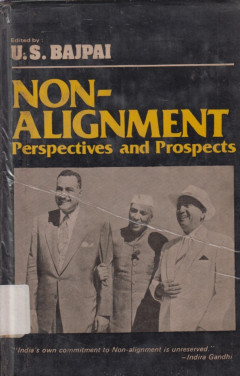
Non-alignment: perspectives and prospects
This volume presents a comprehensive collection of perspectives on the Non-Aligned Movement, examining its historical evolution, political foundations, and emerging challenges in the international system. Edited by U. S. Bajpai, the book gathers contributions from scholars and diplomats who analyze the principles, relevance, and strategic role of non-alignment in global affairs. It explores how…
- Edisi
- -
- ISBN/ISSN
- -
- Deskripsi Fisik
- xxii, 309 pages ; 25 cm
- Judul Seri
- -
- No. Panggil
- 327.17 BAJ n
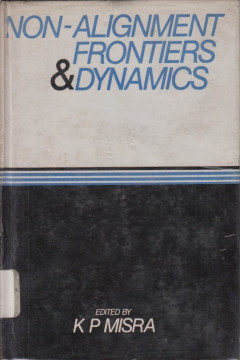
Non-alignment: Frontiers & dynamics
This book provides a comprehensive examination of the frontiers and evolving dynamics of the Non-Aligned Movement (NAM). Edited by K. P. Misra, it explores the historical background, ideological foundations, political strategies, and global roles of non-aligned countries during the Cold War era. The volume analyzes the shifting international environment and the challenges faced by NAM in mainta…
- Edisi
- -
- ISBN/ISSN
- -
- Deskripsi Fisik
- xi, 512 pages ; 24,5 cm
- Judul Seri
- -
- No. Panggil
- 327.17 MIS n
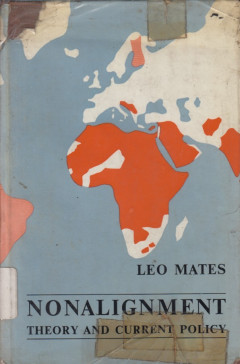
Nonalignment: Theory and current policy
This book provides a foundational theoretical and historical study of the Non-Aligned Movement, written by Leo Mates, one of Yugoslavia’s leading scholars on international politics. It examines the conceptual origins of nonalignment, its evolution in global politics, and its role as a strategic alternative during the Cold War. The author discusses the principles, objectives, and diplomatic pr…
- Edisi
- -
- ISBN/ISSN
- 0-379-00170-5
- Deskripsi Fisik
- 543 pages ; 23,5 cm
- Judul Seri
- -
- No. Panggil
- 327.17 MAT n

Non-alignment: Origins, growth and potential for world peace
This work provides a comprehensive study of the origins, evolution, and ideological foundations of the Non-Aligned Movement (NAM). Rikhi Jaipal examines the political environment that led developing nations to adopt non-alignment during the Cold War, highlighting the movement’s principles, leadership, and contributions to international peace efforts. The book discusses the growing influence o…
- Edisi
- -
- ISBN/ISSN
- -
- Deskripsi Fisik
- xii, 214 pages ; 22,5 cm
- Judul Seri
- -
- No. Panggil
- 327.17 JAI n

The People’s Republic of China Foreign Affairs archives compilation (Volume…
This volume presents a curated selection of diplomatic archives from the Ministry of Foreign Affairs of the People’s Republic of China, focusing on the Chinese delegation’s participation in the 1955 Asian-African Conference in Bandung. The documents provide insights into China’s foreign policy strategies, diplomatic interactions, preparatory communications, and the geopolitical context su…
- Edisi
- -
- ISBN/ISSN
- -
- Deskripsi Fisik
- 260 pages : illustrations ; 24,5 cm
- Judul Seri
- -
- No. Panggil
- 327.51 MIN p

The Elephants and the grass: A Study of nonalignment
This book provides an in-depth analysis of the Nonaligned Movement during the Cold War, exploring how emerging nations sought to maintain independence from the influence of major global powers. Cecil V. Crabb, Jr. examines the political dynamics between the superpowers (“the elephants”) and the smaller, developing nations (“the grass”), highlighting the movement’s origins, strategies,…
- Edisi
- -
- ISBN/ISSN
- -
- Deskripsi Fisik
- xiii pages ; 20,5 cm
- Judul Seri
- -
- No. Panggil
- 327.17 CRA e
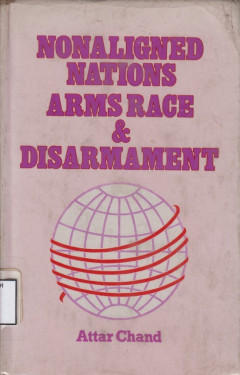
Nonaligned nations: Arms race and disarmament
This book presents a comprehensive study of the arms race, nuclear weapons, and global disarmament from the perspective of the Non-Aligned Nations. It analyzes the strategic importance of the Indian Ocean, the dynamics of détente, and the political role played by nonaligned countries within the United Nations. Through discussions on peace initiatives and global security issues, the author high…
- Edisi
- -
- ISBN/ISSN
- -
- Deskripsi Fisik
- xliv, 373 pages ; 22 cm
- Judul Seri
- -
- No. Panggil
- 327.17 CHA n
 Karya Umum
  Filsafat
  Agama
Agama  Ilmu-ilmu Sosial
  Bahasa
  Ilmu-ilmu Murni
  Ilmu-ilmu Terapan
  Kesenian, Hiburan, dan Olahraga
  Kesusastraan
  Geografi dan Sejarah