Ditapis dengan
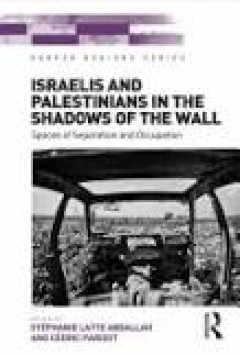
Israelis and Palestinians in the shadows of the wall: Spaces of separation an…
Shedding light on the recent mutations of the Israeli separation policy, whose institutional and spatial configurations are increasingly complex, this book argues that this policy has actually reinforced the interconnectedness of Israelis and Palestinian lives and their spaces. Instead of focusing on the over-mediatized separation wall, this book deals with what it hides: its shadows. Based on …
- Edisi
- -
- ISBN/ISSN
- 9781472448880
- Deskripsi Fisik
- xviii, 276 pages : illustrations (black and white) ; 24 cm
- Judul Seri
- -
- No. Panggil
- 956.94054 Abd i

Arabs and Israelis: Conflict and peacemaking in the Middle East
This textbook is devoted to the Arab-Israeli conflict one of the most protracted of modern times. It has already lasted more than 110 years a bitter struggle, involving states, peoples, movements and individuals. It has manifested itself in wars, revolts, uprisings, massacres and various types of violence and terror. It has involved the historical ingathering of a people to a land they regard a…
- Edisi
- -
- ISBN/ISSN
- 978-1-137-29082-3
- Deskripsi Fisik
- xviii, 477 pages : illustrations, maps ; 24 cm
- Judul Seri
- -
- No. Panggil
- 956 Aly a

Conflict and reconciliation in the contemporary world
Conflict and Reconciliation in the Contemporary World gives a concise, original and multi-faceted introduction to the study of modern conflict situations. Using eight case- studies, from four continents: Yugoslavia, Israel, Northern Ireland, South Africa, El Salvador, Cambodia, Cyprus and Afghanistan, it includes discussion on: - threatened regional peace and security - cycles of internal dis…
- Edisi
- -
- ISBN/ISSN
- 0-415-18327-8
- Deskripsi Fisik
- 124 pages ; 21 cm
- Judul Seri
- -
- No. Panggil
- 909.82 Whi c

Managing on the edge
The contents of this book: 1. Unlocking the mystery of Self-Renewal 2. The Fit/Split Paradox 3. Vectors of Contention 4. Disturbing Equilibrum, etc.
- Edisi
- -
- ISBN/ISSN
- 0-671-73285-4
- Deskripsi Fisik
- 350 pages 23 cm
- Judul Seri
- -
- No. Panggil
- 658.4 Pas m

The case for peace: How the Arab-Israeli conflict can be resolved
In The Case for Peace, Dershowitz identifies twelve geopolitical barriers to peace between Israel and Palestine–and explains how to move around them and push the process forward. From the division of Jerusalem and Israeli counterterrorism measures to the security fence and the Iranian nuclear threat, his analyses are clear-headed, well-argued, and sure to be controversial. According to Dersho…
- Edisi
- -
- ISBN/ISSN
- 978-0-471-74317-0
- Deskripsi Fisik
- ix, 246 pages ; 24 cm
- Judul Seri
- -
- No. Panggil
- 956.9405 Der c
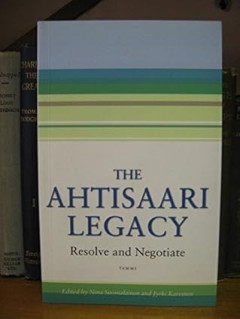
The Ahtisaari legacy: Resolve and negotiate
President MARTTI AHTISAARI was awarded the Nobel Peace Prize for 2008 for his important efforts, on several continents, to resolve international conflicts. Recently he has been actively involved in coordinating the peace process in Kosovo, which resulted in the Kosovo declaration of independence in Febryary 2008. In this book, Ahtisaari describes his work and methods, and depicts the course of …
- Edisi
- -
- ISBN/ISSN
- 978-951-31-4832-4
- Deskripsi Fisik
- 219 pages ; 20 cm
- Judul Seri
- -
- No. Panggil
- 303.6 Suo a
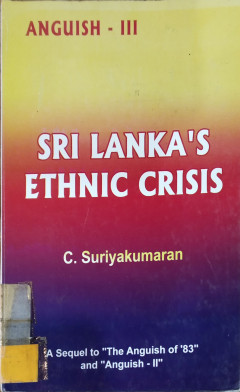
Sri Lanka's ethnic crisis
Contents: 1. Development under devolution 2. JR'S reply box 3. Let us refurbish the executive committe system 4. Drawbacks in the proportional system of voting 5. New proposal for voting system etc.
- Edisi
- -
- ISBN/ISSN
- -
- Deskripsi Fisik
- xiii, 389 pages ; 21 cm
- Judul Seri
- -
- No. Panggil
- 305.8914 Sur s

Sri Lanka LTTE and the British parliament
In his first publication on a national issue, Professor Ravindra Fernando, a senior professor at the University of Colombo, explores the emotional British Parliament debate on Sri Lanka and the LTTE in 2007. This book compiles the entire parliamentary debate, documents the intense reactions from Sri Lankans worldwide, and includes references and explanatory notes to provide a comprehensive unde…
- Edisi
- Ed. 1
- ISBN/ISSN
- 978-955-1266-86-8
- Deskripsi Fisik
- 192 pages : illustrations (black and white) ; 21 cm
- Judul Seri
- -
- No. Panggil
- 303.6 Fer s
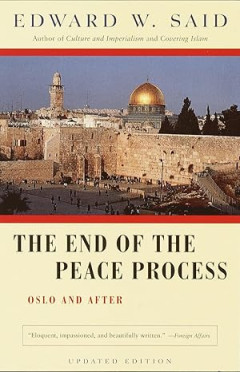
The end of the peace process: Oslo and after
Soon after the Oslo accords were signed in September 1993 by Israel and Palestinian Liberation Organization, Edward Said predicted that they could not lead to real peace. In these essays, most written for Arab and European newspapers, Said uncovers the political mechanism that advertises reconciliation in the Middle East while keeping peace out of the picture. Said argues that the imbalance …
- Edisi
- -
- ISBN/ISSN
- 0-375-72574-1
- Deskripsi Fisik
- xvii, 411 pages ; 20 cm
- Judul Seri
- -
- No. Panggil
- 956.053 Sai e

Dereliction of duty: Lyndon Johnson, Robert McNamara, the Joint Chiefs of Sta…
An insightful analysis of how and why the U.S. became involved in the war in Southeast Asia outlines the policies and decisions that embroiled America in the conflict and examines the roles of Lyndon Johnson, Robert McNamara, and others in deceiving the American public.
- Edisi
- -
- ISBN/ISSN
- 0-06-018795-6
- Deskripsi Fisik
- xxii, 446 pages ; 24 cm
- Judul Seri
- -
- No. Panggil
- 959.704 Mcm d
 Karya Umum
  Filsafat
  Agama
Agama  Ilmu-ilmu Sosial
  Bahasa
  Ilmu-ilmu Murni
  Ilmu-ilmu Terapan
  Kesenian, Hiburan, dan Olahraga
  Kesusastraan
  Geografi dan Sejarah