Ditapis dengan
China perspectives
This book presents a comprehensive and accessible analysis of China's socio-political economy. The authors provide insightful explanations of China's economic reforms which started in 1978, have triggered China's integration with the world economy, privatized farming, liberalized markets, intensified healthy competition in industry, and introduced modern macro-economic management. The book comb…
- Edisi
- -
- ISBN/ISSN
- 81-207-2359-7
- Deskripsi Fisik
- vi, 249 pages ; 22 cm
- Judul Seri
- -
- No. Panggil
- 951 Put c

The new Chinese Empire: And what It means for the United States
This past spring, the outbreak of SARS grabbed the attention of the world. The schizophrenic, paranoid way the Chinese government handled the outbreak perfectly illustrated the danger of a political system unaccountable to its citizens. In The New Chinese Empire, Ross Terrill assesses this government, and the central question it raises: Is the People's Republic of China, whose polity is a hybri…
- Edisi
- -
- ISBN/ISSN
- 0-465-08413-3
- Deskripsi Fisik
- xv, 384 pages : illustrations ; 20 cm
- Judul Seri
- -
- No. Panggil
- 951 Ter n

The China factor in modern Japanese thought: The case of Tachibana Shiraki, 1…
The China Factor in Modern Japanese Thought examines the ideas of Tachibana Shiraki, 1881–1945, a revisionist within the Japanese Kangaku tradition, which focused on incorporating Chinese elements into Japanese culture. Tachibana advocated the study of popular culture as the key to understanding contemporary society. When militarism was on the ascendant, Tachibana was a vocal critic of mil…
- Edisi
- -
- ISBN/ISSN
- 0-7914-3039-1
- Deskripsi Fisik
- x, 171 pages ; 22 cm
- Judul Seri
- -
- No. Panggil
- 951 Lin c
What does China think ?
Although dozens of books have been published about China's rise, most authors treat it as an economic, political or military bloc rather than seeing it as a powerhouse of ideas that could influence our world. They have little to say about China's intellectual debates, or the ideological competition they might pose to the European and American world-views.
- Edisi
- -
- ISBN/ISSN
- 978-0-00-723068-6
- Deskripsi Fisik
- 164 pages : illustration (black and white) ; 20 cm
- Judul Seri
- -
- No. Panggil
- 951 Leo w

Uyghur nation: Reform and revolution on the Russia-China frontier
The meeting of the Russian and Qing empires in the nineteenth century had dramatic consequences for Central Asia’s Muslim communities. Along this frontier, a new political space emerged, shaped by competing imperial and spiritual loyalties, cross-border economic and social ties, and the revolutions that engulfed Russia and China in the early twentieth century. David Brophy explores how a comm…
- Edisi
- -
- ISBN/ISSN
- 978-0-674-66037-3
- Deskripsi Fisik
- 347 pages : illustrations (black and white) ; 24 cm
- Judul Seri
- -
- No. Panggil
- 951 Bro u
China facts & figures 2000
Contents: 1. National conditions 2. Politics 3. Economy 4. Science and technology, education, culture and art, public health and sports etc.
- Edisi
- Ed. 1
- ISBN/ISSN
- 7-80148-309-X
- Deskripsi Fisik
- 222 pages : illustration ; 18 cm
- Judul Seri
- -
- No. Panggil
- 951 Pub c
An outline history of China 1919-1949
This book is actually a sequel to, and the eleventh chapter of, An Outline History of China edited by Prof. Bai Shouyi and published by the Foreign Languages Press in English in 1982. The May 4th Movement of 1919 is regarded as the beginning of the new-democratic revolution in China. From that time until the founding of the People's Republic of China on October 1, 1949, the four decades saw …
- Edisi
- Ed. 1
- ISBN/ISSN
- 7-119-01498-6
- Deskripsi Fisik
- 319 pages : illustrations (black and white) ; 21 cm
- Judul Seri
- -
- No. Panggil
- 951 Sho o
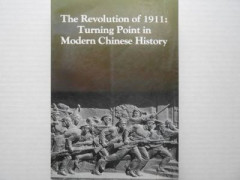
The revolution of 1911: Turning point in modern Chinese history
The Revolution of 1911 is the most important event in early 20th century China. At that time the Qing Dynasty, which had ruled over China for 260 years, was overthrown, ending two thousand years of feudal monarchic dictatorship. With the subsequent establishment of the Republic of China, democracy and the republican form of government was able to strike a deep root in the hearts of the Chinese …
- Edisi
- -
- ISBN/ISSN
- 0-8351-2889-X
- Deskripsi Fisik
- ii, 544 pages ; 21 cm
- Judul Seri
- -
- No. Panggil
- 951 Cai r
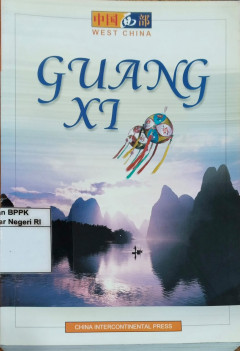
Guang Xi
Contents: 1. The only coastal province in the western region 2. The region with the biggest population of minority nationalities 3. Beautiful and abundant southern border etc.
- Edisi
- Ed. 1 ; Cet. 1
- ISBN/ISSN
- 7-80113-812-0
- Deskripsi Fisik
- 134 pages : illustrations ; 20 cm
- Judul Seri
- -
- No. Panggil
- 951 Pre g
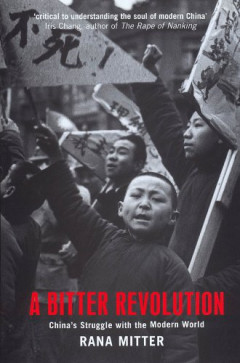
A bitter revolution: China's struggle with the modern world
The defining moment in the development of a modern China is shown to be 4 May 1919 at the Tian'anmen gate in Beijing, where a new generation rejected Confucianism and traditional Chinese culture, and protested violently against the Paris Peace Conference. Chinese cities at that time still bore the imprints of their ancient past, with narrow lanes and sacred temples, but they were starting to ch…
- Edisi
- -
- ISBN/ISSN
- 0-19-280341-7
- Deskripsi Fisik
- xix, 357 pages : illustrations (black and white) ; 25 cm
- Judul Seri
- -
- No. Panggil
- 951 Mit b
 Karya Umum
  Filsafat
  Agama
Agama  Ilmu-ilmu Sosial
  Bahasa
  Ilmu-ilmu Murni
  Ilmu-ilmu Terapan
  Kesenian, Hiburan, dan Olahraga
  Kesusastraan
  Geografi dan Sejarah