Ditapis dengan

Collective indentities nationalisms and protest in modern Sri Langka
This book explores the formation and transformation of collective identities in modern Sri Lanka, focusing on the interplay between ethnicity, nationalism, and political mobilization. Roberts analyzes historical and contemporary movements to show how cultural narratives and social structures shape public protest. Through detailed case studies, he illustrates the tensions and interactions among …
- Edisi
- -
- ISBN/ISSN
- -
- Deskripsi Fisik
- ix, 537 pages ; 21,5 cm
- Judul Seri
- -
- No. Panggil
- 954.93 ROB c

The Revolt in the temple
This book commemorates 2,500 years of the land, race, and faith of the Sinhalese Buddhist people, weaving together their history, philosophy, and nationhood. The author explores the deep ethical and spiritual teachings of Buddhism as a foundation for both individual and societal integrity. He argues that Buddhist ideals can inform practical political and social reforms in the modern world. Ulti…
- Edisi
- -
- ISBN/ISSN
- -
- Deskripsi Fisik
- 700 pages : 21 cm
- Judul Seri
- -
- No. Panggil
- 954.93 TIM r
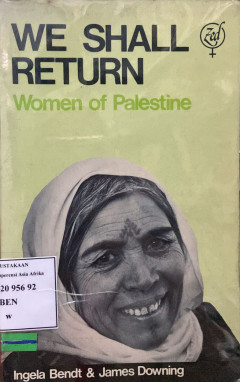
We shall return: Women of Palestine
The authors, swedish journalists spent five months in lebanon interviewing palestinian women in refugee camps during 1978-1979. besidestheir own personal impressions, they include description, quotes from their interviews which is full political passion. going through the accounta we get a feel of the oppression and resistence of stateless palestinians and the exploding civil war in lebanon. we…
- Edisi
- -
- ISBN/ISSN
- 0-8820-154-3
- Deskripsi Fisik
- iii, 129 pages: illustration; 22 cm
- Judul Seri
- -
- No. Panggil
- 305.420 BEN w

J. R. Jayewardene of Sri Lanka a political biography volume 1: 1960-1956
J. R. Jayewardene of Sri Lanka: A Political Biography, Volume 1 (1906–1956) by K. M. de Silva explores the early life and political formation of one of Sri Lanka’s most influential leaders. The book traces Jayewardene’s rise from his education and legal background to his emergence as a prominent figure in the independence movement. It examines his evolving political ideology, key policy p…
- Edisi
- -
- ISBN/ISSN
- 0-7043-2658-2
- Deskripsi Fisik
- 336 pages : 23 cm
- Judul Seri
- -
- No. Panggil
- 954.93 SIL j

Le Dernier de l'empire
A political fiction novel written between 1976 and 1980, which tells the story of a constitutional coup in Senegal where French-speaking Africans clash with staunch nationalists.
- Edisi
- -
- ISBN/ISSN
- 2-85802-169-4
- Deskripsi Fisik
- 226 pages, 19 cm
- Judul Seri
- -
- No. Panggil
- 966.3 OUS l
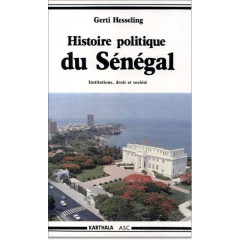
Histoire politique du Senegal
Senegal occupies a special place in African history. Longstanding relations with Europe, an early modern political life, independence marked by the stability of the regime and the personality of Léopold Sédar Senghor, a multiparty system that is quite rare on the continent... all these factors explain the appeal, even fascination, that Senegal exerts. Gerti Hesseling's book describes the co…
- Edisi
- -
- ISBN/ISSN
- 2-86537-118-2
- Deskripsi Fisik
- 437 pages; 24 cm
- Judul Seri
- -
- No. Panggil
- 966.3 HES h

La Sénégambie du XVe au XIXe siècle : Traite négrière, islam et conquêt…
This is a regional history conceived within a global vision of Senegambia, without taking into account either the borders of pre-colonial kingdoms or those of the current states inherited from colonial division. It is only within this framework that we can understand the dynamics of regional and interregional trade, the impact of Atlantic trade, the contradiction between Ceddo and Muslim power,…
- Edisi
- -
- ISBN/ISSN
- 2-85802-670-X
- Deskripsi Fisik
- 431 pages : ilustrations ; 22 cm
- Judul Seri
- -
- No. Panggil
- 966.305 BAR l
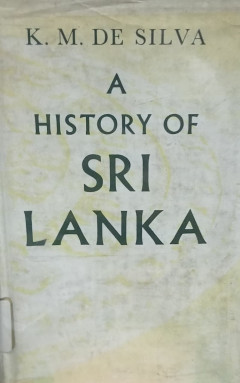
A History of Sri Lanka
A History of Sri Lanka by K. M. de Silva provides a comprehensive overview of Sri Lanka’s political, social, and cultural development from ancient times to the modern era. The book explores the island’s early civilizations, the influence of Buddhism, and the impact of successive foreign powers, including the Portuguese, Dutch, and British. De Silva offers detailed analysis of colonial polic…
- Edisi
- -
- ISBN/ISSN
- -
- Deskripsi Fisik
- vii, 603 pages : illustrations ; 21,5 cm
- Judul Seri
- -
- No. Panggil
- 954.93 SIL h

Japan: The Intellectual foundations of modern Japanese politics
Explores the major ideas and intellectual traditions that shaped Japan’s political development from the late Tokugawa era to modern times. The book highlights how thinkers and reformers debated issues such as modernization, authority, democracy, and national identity. Najita shows how these evolving ideas influenced the formation of Japan’s political institutions and guided the country’s …
- Edisi
- -
- ISBN/ISSN
- 0-226-56803-2
- Deskripsi Fisik
- viii, 152 pages ; 20 cm
- Judul Seri
- -
- No. Panggil
- 320.52 NAJ j

The Japan of today
An overview of Japan’s contemporary political, economic, and social landscape, highlighting the forces that have shaped the nation’s modern identity. The book examines postwar developments, governmental structure, industrial growth, technological innovation, demographic change, and cultural trends. It explores the balance between tradition and modernization, the role of education and work c…
- Edisi
- -
- ISBN/ISSN
- -
- Deskripsi Fisik
- 157 pages : illustrations ; 22,5 cm
- Judul Seri
- -
- No. Panggil
- 306.52 INT j
 Karya Umum
  Filsafat
  Agama
Agama  Ilmu-ilmu Sosial
  Bahasa
  Ilmu-ilmu Murni
  Ilmu-ilmu Terapan
  Kesenian, Hiburan, dan Olahraga
  Kesusastraan
  Geografi dan Sejarah