Ditapis dengan

India unbound
India Unbound is the riveting story of a nation’s rise from poverty to prosperity and the clash of ideas that occurred along the way. Gurcharan Das examines the highs and lows of independent India through the prism of history, his own experiences and those of numerous others he has met-from young people in sleepy UP villages to chiefs of software companies in Bangalore. Defining and exploring…
- Edisi
- -
- ISBN/ISSN
- 978-0-143-06301-8
- Deskripsi Fisik
- xix, 419 pages : index ; 22 cm
- Judul Seri
- -
- No. Panggil
- 330.954 Das i

Japan's failed revolution: Koizumi and the politics of economic reform
Japan's failed revolution: Koizumi and the politics of economic reform asks why, despite all the high expectation's, the Japanese public's desire for economic reform, and leadership of a majority coalition in a parliamentary democracy, the reformer prime minister Koizumi has not achieved the economic reforms expected of him since he surprisingly attained power over a year ago. this book expl…
- Edisi
- -
- ISBN/ISSN
- 0-7315-3693-2
- Deskripsi Fisik
- ix, 260 pages : index ; 23 cm
- Judul Seri
- -
- No. Panggil
- 330.95 Mul j

Regional dynamics : Security, political and economic issues in the Asia-Pasif…
This collection of papers is only a subset of a much larger body of papers, the result of a collaboration among about 50 scholars from the Asia Pacific region, which have been commissioned under the so-called "Quadrilateral Project." That project was jointly sponsored by the Institute of East Asian Studies, University of California, Berkeley; the University of Tokyo, the Centre for Strategic an…
- Edisi
- -
- ISBN/ISSN
- 979-8026-10-1
- Deskripsi Fisik
- vi, 418 pages ; 21 cm
- Judul Seri
- -
- No. Panggil
- 330.95 Sca r

Stumbling giant: The threats to China's future
While dozens of recent books and articles have predicted the near-certainty of China's rise to global supremacy, this book boldly counters such widely-held assumptions. Timothy Beardson brings to light the daunting array of challenges that today confront China, as well as the inadequacy of leadership's responses. Threats to China come from many fronts, Beardson shows, and by their number and sh…
- Edisi
- -
- ISBN/ISSN
- 978-0-300-16542-5
- Deskripsi Fisik
- x, 517 pages : bibl: hlm 477-493 : index ; 24 cm
- Judul Seri
- -
- No. Panggil
- 330.951 Bea s

The coming collapse of China
China is hot. The world sees a glorious future for this sleeping giant, three times larger than the United States, predicting it will blossom into the world's biggest economy by 2010. According to Chang, however, a Chinese-American lawyer and China specialist, the People's Republic is a paper dragon. Peer beneath the veneer of modernization since Mao's death, and the symptoms of decay are every…
- Edisi
- -
- ISBN/ISSN
- 0-375-50477-X
- Deskripsi Fisik
- xxii, 344 pages : index ; 24 cm
- Judul Seri
- -
- No. Panggil
- 330.951 Cha c

Secrets, lies and democracy
Another illusion-shattering piece from the man "The New York Times" called "arguably the most important intellectual alive". In 1970, about 90 per cent of international capital was used for trade and long-term investment - more or less productive things - and 10 per cent for speculation. By 1990, these figures had reversed. Haiti, a starving island, is exporting food to the US - about 35 times …
- Edisi
- First Published
- ISBN/ISSN
- 978-1-878-82504-9
- Deskripsi Fisik
- 128 pages ; 21 cm.
- Judul Seri
- -
- No. Panggil
- 330.9048 Cho s

Manufacturing consent: The political economy of the mass media
In this pathbreaking work, Edward S. Herman and Noam Chomsky show that, contrary to the usual image of the news media as cantankerous, obstinate, and ubiquitous in their search for truth and defense of justice, in their actual practice they defend the economic, social, and political agendas of the privileged groups that dominate domestic society, the state, and the global order. Based on a s…
- Edisi
- -
- ISBN/ISSN
- 0-375-71449-9
- Deskripsi Fisik
- lxiv, 412 pages : index ; 23,5 cm
- Judul Seri
- -
- No. Panggil
- 330.9 Her m

Every nation for itself: What happens when no one leads the world
For the first time in seven decades, there is no single power or alliance of powers ready to take on the challenges of global leadership. A generation ago, the United States, Europe, and Japan were the world’s powerhouses, the free-market democracies that propelled the global economy forward. Today, they struggle just to find their footing. Acclaimed geopolitical analyst Ian Bremmer argues…
- Edisi
- -
- ISBN/ISSN
- 978-1-59184-468-6
- Deskripsi Fisik
- x, 229 pages : index ; 21 cm.
- Judul Seri
- -
- No. Panggil
- 330.9 Bre e
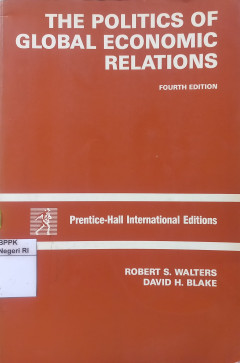
The politics of global economic relations 4th edition
The analytical and topical foci used to organize this survey of the politics of international economic relations continue to serve us well.
- Edisi
- -
- ISBN/ISSN
- 0-13-681222-8
- Deskripsi Fisik
- vi, 281 pages : illustration (black and white) : index ; 23 cm.
- Judul Seri
- -
- No. Panggil
- 330 Wal p

The political economy of growth and impoverishment in the Marcos Era
Contents: 1. The Setting 2. The Growth and Distribution : An Overview 3. The Green Revolution 4. What Price Rice? 5. The New Rice Technology and Rural Inequality 6. Farming for the World Market, etc.
- Edisi
- -
- ISBN/ISSN
- 971-550-096-x
- Deskripsi Fisik
- xv, 405 pages : illustrations (black and white) : bibl; hlm.353-390 : index ; 22 cm
- Judul Seri
- -
- No. Panggil
- 330.9599 Boy p
 Karya Umum
  Filsafat
  Agama
Agama  Ilmu-ilmu Sosial
  Bahasa
  Ilmu-ilmu Murni
  Ilmu-ilmu Terapan
  Kesenian, Hiburan, dan Olahraga
  Kesusastraan
  Geografi dan Sejarah