Ditapis dengan
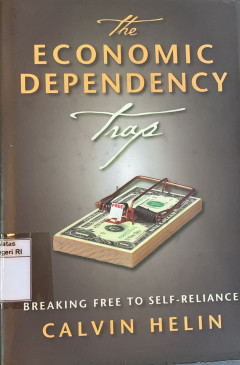
The economic dependency trap: Breaking free to self-reliance
This book offers effective strategies to help erase poverty. It advocates self-reliance, policy reform and cultural awareness. Accountability is required from all; the middle class, the trust fund babies and the underprivileged who see themselves as perpetual victims and have fallen into the entitlement trap. True Blue-prints are offered to rescue people from an economical slump and help them i…
- Edisi
- -
- ISBN/ISSN
- 978-1-932824-08-7
- Deskripsi Fisik
- 351 pages : illustrations : bibl: hlm 334-342 : index ; 23 cm.
- Judul Seri
- -
- No. Panggil
- 330.1556 Hel e
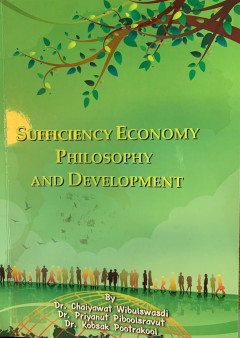
Sufficiency economy philosophy and development
This book contains: 1. What is sufficiency economy? 2. Applications of SEP as a guiding principle 3. SEP and sustainable development
- Edisi
- -
- ISBN/ISSN
- 978-974-8259-21-5
- Deskripsi Fisik
- 54 pages ; 21 cm
- Judul Seri
- -
- No. Panggil
- 330.01 Wib s
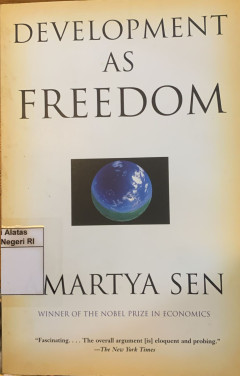
Development as freedom
Freedom, Sen argues, is both the end and most efficient means of sustaining economic life and the key to securing the general welfare of the world's entire population. Releasing the idea of individual freedom from association with any particular historical, intellectual, political, or religious tradition, Sen clearly demonstrates its current applicability and possibilities. In the new global ec…
- Edisi
- Ed.1
- ISBN/ISSN
- 0-385-72027-0
- Deskripsi Fisik
- xvi, 366 pages : index ; 20 cm
- Judul Seri
- -
- No. Panggil
- 330.01 Sen d

Why nations fail: The origins of power, prosperity, and poverty
Daron Acemoglu and James Robinson conclusively show that it is man-made political and economic institutions that underlie economic success (or lack of it). Korea, to take just one of their fascinating examples, is a remarkably homogeneous nation, yet the people of North Korea are among the poorest on earth while their brothers and sisters in South Korea are among the richest. The south forged a…
- Edisi
- First Edition
- ISBN/ISSN
- 978-0-307-71922-5
- Deskripsi Fisik
- 529 pages : illustration : bibl: hlm 465-482 : index ; 25 cm
- Judul Seri
- -
- No. Panggil
- 330 Ace w

Why states recover : Changing walking societies into winning nations-from Afg…
State failure takes many forms, from the collapse of central authority à la Somalia to the subversion of democracy in Venezuela and Zimbabwe. Assessing why and how states fail is only half of the story, however. More important is pinpointing why they recover. Based on fieldwork in over 40 countries, Why States Recover incorporates first-hand interviews with leadership to disaggregate various s…
- Edisi
- -
- ISBN/ISSN
- 978-1-77010-325-2
- Deskripsi Fisik
- xiv, 689 pages : illustrations : index ; 23 cm
- Judul Seri
- -
- No. Panggil
- 330.96891 Mil w

The prosperity agenda : What the world wants from America--and what we need i…
In this provocative, ingenious book, Soderberg and Katulis make one of the most controversial arguments that foreign policy circles have seen in years: no more putting all our eggs in the basket of promoting democracy or market reforms, or even diplomacy, sanctions, or cash handouts to faltering governments. Instead, they argue, we should go right to the citizens of troubled nations and give th…
- Edisi
- -
- ISBN/ISSN
- 978-0-470-10529-0
- Deskripsi Fisik
- xi, 260 pages : index ; 25 cm
- Judul Seri
- -
- No. Panggil
- 327.7300905 Sod p

Rivals: How the power struggle between China, India and Japan will shape our …
It is not just, as many argue, a question of the rise of China. For the first time in history Asia will not be dominated by just one country or by outside powers. It will contain three large, economically powerful countries, all with interests and ambitions that range across the whole region and the world. The future of the world economy will be determined by the competition between these three…
- Edisi
- 1st published
- ISBN/ISSN
- 978-1-846-14009-9
- Deskripsi Fisik
- xiv, 313 pages : illustrations : maps : index ; 25 cm
- Judul Seri
- -
- No. Panggil
- 327.5 Emm r

Common responsibility in the 1990's: The stockholm initiative on global secur…
The Stockholm Initiative on Global Security and Governance brings out the most urgent themes from the international indepen- dent commissions of the 1980's, chaired by Willy Brandt and Olof Palme, by Gro Harlem Brundtland and Julius Nyerere. The memorandum on COMMON RESPONSIBILITY IN THE 1990's focuses on major areas for multilateral cooperation and on ways and means to strengthen international…
- Edisi
- -
- ISBN/ISSN
- 91-38-10806-2
- Deskripsi Fisik
- 48 pages ; 21 cm
- Judul Seri
- -
- No. Panggil
- 327.17 Nil c

The right to development: A primer
This primer introduces the concept of RTD as well as discusses its practical application in the Indian setting. It is divided accordingly into two sections, the first of which traces the origins and the evolution of the idea of RTD. This section identifies the defining parameters and content of RTD and focuses especially on the three rights―the rights to food, education and health―that have…
- Edisi
- First Published
- ISBN/ISSN
- 0-7619-3211-9
- Deskripsi Fisik
- 293 pages : illustrations (black and white) : bibl: hlm 270-283 : index ; 25 cm
- Judul Seri
- -
- No. Panggil
- 323.0954 Rig r

The democracy advantage: How democracies promote prosperity and peace
Reviewing 40 years of hard, empirical data, from China and India to Chile and Iraq, the authors show that poor democracies beat poor autocracies in every economic measure. In addition, the authors offer dramatic evidence that democracies are less likely to fight each other and that terrorists more often find safe haven in authoritarian countries such as Egypt, Saudi Arabia, and Pakistan.
- Edisi
- -
- ISBN/ISSN
- 0-415-95052-X
- Deskripsi Fisik
- xv, 290 pages : illustrations (black and white) : bibl: hlm 271-282 : index ; 23 cm
- Judul Seri
- -
- No. Panggil
- 321.8 Hal d
 Karya Umum
  Filsafat
  Agama
Agama  Ilmu-ilmu Sosial
  Bahasa
  Ilmu-ilmu Murni
  Ilmu-ilmu Terapan
  Kesenian, Hiburan, dan Olahraga
  Kesusastraan
  Geografi dan Sejarah