Ditapis dengan
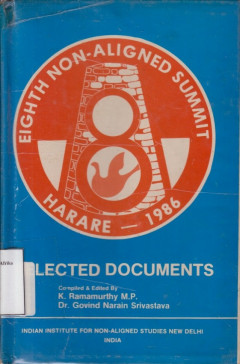
Eighth NAM summit: Selected documents
This volume compiles key official documents from the Eighth Summit of the Non-Aligned Movement (NAM), presenting resolutions, declarations, and policy statements adopted by member states. Edited by K. Ramamurthy and Dr. Srivastava, the book provides an essential reference on the political, economic, and international security concerns discussed during the summit. It highlights the collective po…
- Edisi
- -
- ISBN/ISSN
- -
- Deskripsi Fisik
- 267 pages : illustrations ; 21,5 cm
- Judul Seri
- -
- No. Panggil
- 327.172 RAM e

Peranan Indonesia sebagai pendiri Gerakan Non Blok dalam usaha memurnikan tuj…
The book "Indonesia's Role as the Founder of the Non-Aligned Movement in Efforts to Purify Its Goals and Principles" was published by the Research and Development Agency of the Ministry of Foreign Affairs of the Republic of Indonesia in 1986. This book discusses Indonesia's contribution to the birth of the Non-Aligned Movement (NAM) from the 1955 Asian-African Conference to the 1961 Belgrade Su…
- Edisi
- -
- ISBN/ISSN
- -
- Deskripsi Fisik
- iv, 145 pages : illustrations ; 23,5 cm
- Judul Seri
- -
- No. Panggil
- 327.172 BAD p

Contemporary art of the non-aligned countries: Unity in diversity in internat…
This post-event catalogue documents the exhibition “Contemporary Art of the Non-Aligned Countries: Unity in Diversity in International Art”, held from April 28 to June 30, 1995, at the Visual Arts Exhibition Hall of the Department of Education and Culture in Jakarta, Indonesia. The catalogue presents contemporary artworks from participating Non-Aligned Movement countries, highlighting cultu…
- Edisi
- -
- ISBN/ISSN
- 979-95284-0-2
- Deskripsi Fisik
- 332 pages : illustrations ; 29 cm
- Judul Seri
- -
- No. Panggil
- 709.05 SED c

India and the Nonaligned Summits : Belgrade to Jakarta
Renu Srivastava's book India and the Nonaligned Summits: Belgrade to Jakarta comprehensively examines India's role in various Non-Aligned Movement (NAM) summits, from the first summit in Belgrade to the Jakarta summit. As one of the founders of NAM, India played a key role in formulating the principles of non-alignment, political independence, and cooperation among developing countries. The boo…
- Edisi
- -
- ISBN/ISSN
- 81-7211-063-4
- Deskripsi Fisik
- ix, 195 pages ; 22 cm
- Judul Seri
- -
- No. Panggil
- 327.172 SRI i

The Crucial years of non-alignment: USA Korean war India
This book provides an analytical study of the formative period of the Non-Aligned Movement, focusing particularly on India’s diplomatic stance during the Korean War and its interactions with the United States. R. P. Kaushik examines major political developments, decision-making processes, and the broader implications of non-alignment in the early Cold War era. The work highlights how India na…
- Edisi
- -
- ISBN/ISSN
- -
- Deskripsi Fisik
- 264 pages ; 22 cm
- Judul Seri
- -
- No. Panggil
- 327.17 KAU c

Non-Aligned movement in the era of globalization: With Reference to informati…
This book discusses the role and relevance of the Non-Aligned Movement (NAM) in the era of globalization, with particular emphasis on issues of information and communication. Harmoko explores how developing countries can strengthen cooperation, maintain independence, and ensure fair access to global information flows. The work highlights the challenges faced by NAM member states in responding t…
- Edisi
- -
- ISBN/ISSN
- -
- Deskripsi Fisik
- 110 pages : illustrations ; 23 cm
- Judul Seri
- -
- No. Panggil
- 327.17 HAR n

KTT X Gerakan Non Blok : Tenth conference of heads of state or government of …
The book "X Non-Aligned Movement Summit: Tenth Conference of Heads of State or Government of Non-Aligned Countries" is the official documentation of the 10th Non-Aligned Movement Summit held in Jakarta in 1992 and published in 1993. This book contains a series of activities, decisions, and political declarations produced by the heads of state and government of Non-Aligned Movement members in re…
- Edisi
- -
- ISBN/ISSN
- -
- Deskripsi Fisik
- 618 pages : illustrations ; 28 cm
- Judul Seri
- -
- No. Panggil
- 327.172 TIM k

XII Summit conference of heads of state or government of the non-aligned move…
This volume contains the basic documents of the Twelfth Summit Conference of Heads of State or Government of the Non-Aligned Movement, held in Durban, South Africa, from 29 August to 3 September 1998. It includes declarations, resolutions, statements, and administrative documents adopted during the summit. The publication reflects the Movement's collective positions on global political, economi…
- Edisi
- -
- ISBN/ISSN
- 0-7970-3752-7
- Deskripsi Fisik
- vi, 266 pages ; 21 cm
- Judul Seri
- -
- No. Panggil
- 327.17 DEP t t

Nonaligned states: A Great leap forward — A Study in new international econ…
“This book analyzes the role of nonaligned states in shaping the New International Economic Order during the early 1980s. Attar Chand examines the political and economic aspirations of the Non-Aligned Movement, emphasizing its collective efforts to restructure global economic relations in favor of developing countries. Through detailed assessments of policy positions, international negotiatio…
- Edisi
- -
- ISBN/ISSN
- -
- Deskripsi Fisik
- xxxi, 308 pages ; 22 cm
- Judul Seri
- -
- No. Panggil
- 327.17 CHA n

Indonesian notebook: A Sourcebook on Richard Wright and the Bandung Conference
Indonesian Notebook presents a rare compilation of writings, reflections, and contextual documents surrounding the participation of African American author Richard Wright in the 1955 Bandung Conference. Edited by Brian Russell Roberts and Keith Foulcher, the book offers insights into Wright’s encounters in Indonesia, his observations on Afro-Asian political solidarity, and the global signific…
- Edisi
- -
- ISBN/ISSN
- 978-0-8223-6067-4
- Deskripsi Fisik
- xxiv, 262 pages : illustrations ; 23 cm
- Judul Seri
- -
- No. Panggil
- 327.0958 ROB i
 Karya Umum
  Filsafat
  Agama
Agama  Ilmu-ilmu Sosial
  Bahasa
  Ilmu-ilmu Murni
  Ilmu-ilmu Terapan
  Kesenian, Hiburan, dan Olahraga
  Kesusastraan
  Geografi dan Sejarah