Ditapis dengan
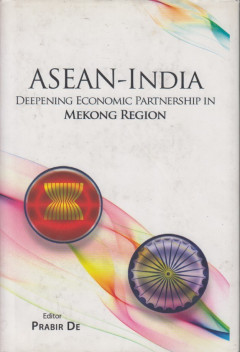
ASEAN–India: Deepening economic partnership in Mekong region
This book examines the evolving economic partnership between ASEAN and India, with a special focus on the Mekong region. It analyzes trade relations, regional connectivity, investment flows, and policy frameworks that shape cooperation between India and Southeast Asian countries. Through research-based chapters, the volume explores opportunities and challenges in deepening regional integration,…
- Edisi
- -
- ISBN/ISSN
- 81-7122-102-5
- Deskripsi Fisik
- xxxv, 314 pages : illustrations ; 23,5 cm
- Judul Seri
- -
- No. Panggil
- 337.159 RDE a

The Troubled region: Issues of peace and development in Southeast Asia
This volume examines key political, economic, and social issues affecting Southeast Asia in the post-1945 period. Edited by Parimal Kumar Das, the book compiles scholarly contributions that analyze peace efforts, development challenges, regional security concerns, and socioeconomic transitions across various Southeast Asian nations. By presenting diverse perspectives from researchers and practi…
- Edisi
- -
- ISBN/ISSN
- 81-7036-074-9
- Deskripsi Fisik
- 330 pages : illustrations ; 22,5 cm
- Judul Seri
- -
- No. Panggil
- 959.053 DAS t

Asian Dilemma: The Essence of social progress in the transitional period
This book examines the fundamental dilemmas faced by Asian countries during the transitional period of social and economic development. Ulyanovsky and Pavlov analyze the social progress of Asian nations as they move from traditional structures toward modern economic systems. The authors discuss key issues such as economic transformation, social change, political development, and the challenges …
- Edisi
- -
- ISBN/ISSN
- -
- Deskripsi Fisik
- 256 pages ; 20,5 cm
- Judul Seri
- -
- No. Panggil
- 330.95 ULY a
ASEAN in a changing pacific and world economy
This edited volume analyzes the role of ASEAN within a rapidly changing Pacific and global economic environment. The contributors examine the external economic relations of Southeast Asian nations, the development of regional industries, and the broader impact of international economic trends on ASEAN member states. The book discusses shifts in global trade patterns, resource-based industries, …
- Edisi
- -
- ISBN/ISSN
- 0-7081-1304-4
- Deskripsi Fisik
- xxiii, 557 pages ; 24,5 cm
- Judul Seri
- -
- No. Panggil
- 337.59 GAR a
Southeast Asian perceptions of foreign assistance
This volume presents the papers and proceedings of a workshop held at Chulalongkorn University in June 1976, jointly organized by the Institute of Southeast Asian Studies (Singapore) and the Institute of Asian Studies of Chulalongkorn University. The book explores how Southeast Asian countries perceive foreign assistance, examining political, economic, and social dimensions of aid in the region…
- Edisi
- -
- ISBN/ISSN
- -
- Deskripsi Fisik
- x, 185 pages ; 21 cm
- Judul Seri
- -
- No. Panggil
- 337.159 LIM s
Underdevelopment and economic nationalism in Southeast Asia
This book provides an in-depth analysis of the economic underdevelopment of Southeast Asia and the rise of economic nationalism in the region. The authors examine the historical foundations of Southeast Asia’s economic structures, the legacy of colonialism, and the challenges faced by developing states in pursuing autonomous economic policies. The work evaluates nationalist responses to exter…
- Edisi
- First Published
- ISBN/ISSN
- 8014-0493-2
- Deskripsi Fisik
- xv, 494 pages : index ; 24 cm
- Judul Seri
- -
- No. Panggil
- 330.959 GOL u
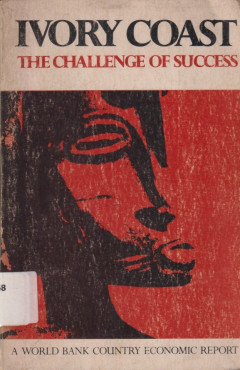
Ivory Coast: The Challenge of success
Ivory Coast: The Challenge of Success is an in-depth economic analysis authored by B. A. den Tuinder for the World Bank. The book examines the rapid economic growth of Côte d'Ivoire during the post-independence period and explores the structural factors that contributed to its development performance. It discusses the country's agricultural expansion, industrialization strategies, macroeconomi…
- Edisi
- -
- ISBN/ISSN
- -
- Deskripsi Fisik
- xxi, 445 pages ; 23 cm
- Judul Seri
- -
- No. Panggil
- 338.96668 TUI i
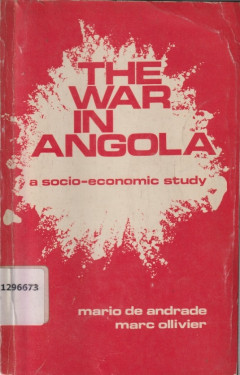
The War in Angola: A Socio-economic study
The War in Angola: A Socio-Economic Study provides an analytical overview of the armed struggle in Angola against Portuguese colonial rule, focusing on the period leading up to independence. Written by Mario de Andrade and Marc Ollivier, the book examines the root causes of the conflict, the development of liberation movements, and the socio-economic structure shaped by colonial exploitation. I…
- Edisi
- -
- ISBN/ISSN
- -
- Deskripsi Fisik
- x, 128 pages : illustration ; 21,5 cm
- Judul Seri
- -
- No. Panggil
- 968.8702 AND w

The Great crash ahead: Strategies for a world turned upside down
This book presents Harry S. Dent Jr.’s predictions of a looming major economic downturn based on demographic, financial, and market-cycle analysis. Dent argues that structural shifts in consumer spending, aging populations, and excessive debt will trigger a global economic crash and reshape financial markets. The book provides strategic guidance for investors and individuals seeking to naviga…
- Edisi
- -
- ISBN/ISSN
- -
- Deskripsi Fisik
- xvi, 341 pages : illustration ; 23,5 cm
- Judul Seri
- -
- No. Panggil
- 330.973 DEN g

The Vast majority: A Journey to the world’s poor
This book offers Michael Harrington’s firsthand account of global poverty, based on his travels through some of the world’s poorest regions. Harrington examines the economic, political, and social forces that shape underdevelopment, highlighting the impact of global inequality and the failures of international aid. Through vivid descriptions and critical analysis, he challenges readers to c…
- Edisi
- -
- ISBN/ISSN
- 0-671-22529-4
- Deskripsi Fisik
- 281 pages ; 21 cm
- Judul Seri
- -
- No. Panggil
- 330.917 HAR v
 Karya Umum
  Filsafat
  Agama
Agama  Ilmu-ilmu Sosial
  Bahasa
  Ilmu-ilmu Murni
  Ilmu-ilmu Terapan
  Kesenian, Hiburan, dan Olahraga
  Kesusastraan
  Geografi dan Sejarah