Ditapis dengan

Collected documents of the Asian-African conference April 18-24, 1955
The Asian - African conference succeeded in formulating the principles of international relations for developing countries in general and the non-aligned in particular. This collection will become the record of history of politics and international relations of the Republic of Indonesia and will be re-read by anyone interested in the problems.
- Edisi
- -
- ISBN/ISSN
- -
- Deskripsi Fisik
- vi, 207 pages : 25 cm
- Judul Seri
- -
- No. Panggil
- 327.959 AGE c

Congratulatory messages on the occasion of the commemoration of the fortieth …
This volume compiles congratulatory messages delivered on the occasion of the fortieth anniversary of the 1955 Asian-African Conference. Published by the Department of Foreign Affairs of the Republic of Indonesia in cooperation with Gramedia Widiasarana Indonesia, the book highlights reflections, tributes, and diplomatic statements from leaders and representatives of various nations. The collec…
- Edisi
- -
- ISBN/ISSN
- 979-553-853-5
- Deskripsi Fisik
- v, 195 pages ; 29 cm
- Judul Seri
- -
- No. Panggil
- 327.170.6 DEP c
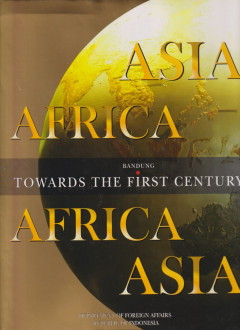
Asia Africa: Bandung towards the first century
This commemorative volume presents a collection of essays, reflections, and policy perspectives on the enduring legacy of the 1955 Bandung Asian-African Conference. Edited under the coordination of Joop Avé and published by the Department of Foreign Affairs of the Republic of Indonesia, the book explores the historical significance of Asia–Africa cooperation and its relevance in the twenty-f…
- Edisi
- -
- ISBN/ISSN
- -
- Deskripsi Fisik
- 225 pages : illustrations ; 31 cm
- Judul Seri
- -
- No. Panggil
- 327.172 AVE a

Asian-African identity in world affairs: Its Impact and prospects for the fut…
This book explores the evolving political, legal, and cultural identity of Asian and African nations in global affairs, with particular emphasis on international and environmental law. Written by Prof. Munadjat Danusaputro, the work was prepared for the 21st Regular Session of the Asian-African Legal Consultative Committee (AALCC) held in conjunction with the 25th anniversary of the 1955 Bandun…
- Edisi
- -
- ISBN/ISSN
- -
- Deskripsi Fisik
- xiv, 240 pages : illustrations ; 21 cm
- Judul Seri
- -
- No. Panggil
- 327.172 DAN a
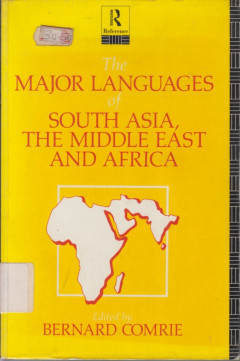
The Major Languages of South Asia, the Middle East and Africa
This volume provides an authoritative survey of the major languages spoken across South Asia, the Middle East, and Africa. Edited by Bernard Comrie, the book contains contributions from leading linguists and offers detailed descriptions of the phonological, grammatical, and lexical features of each language or language group. The work also discusses historical developments, linguistic typology,…
- Edisi
- -
- ISBN/ISSN
- 0–415–05772–8
- Deskripsi Fisik
- xi, 315 pages : illustrations ; 23,5 cm
- Judul Seri
- -
- No. Panggil
- 409 COM m

The Maghreb in the modern world: Algeria, Tunisia, Morocco
This book is an in-depth study of the political, economic, and social dynamics of the Maghreb region, encompassing Algeria, Tunisia, and Morocco, in the modern era. Samir Amin, a leading economist and thinker, analyzes the legacies of colonialism, the process of state-building, economic challenges, and the social and political movements that shaped the Maghreb's regional identity. Using a polit…
- Edisi
- First published
- ISBN/ISSN
- 0140211182
- Deskripsi Fisik
- 256 pages ; 18 cm
- Judul Seri
- -
- No. Panggil
- 960.4 AMI m

South African predicament: The Economics of apartheid
Written by F. P. Spooner, South African Predicament: The Economics of Apartheid examines how the apartheid system shaped South Africa's economic structure. Through in-depth analysis, the book explains the impact of racial segregation on the country's labor force, production, income distribution, and socioeconomic development. Spooner highlights the economic imbalances created by apartheid polic…
- Edisi
- -
- ISBN/ISSN
- -
- Deskripsi Fisik
- 288 pages ; 21 cm
- Judul Seri
- -
- No. Panggil
- 330.968 SPO s

Dictionary of African Biography. Volume 6: Tertu–Zwang
Dictionary of African Biography, Volume 6, provides a comprehensive collection of biographical entries on influential figures across the African continent whose names fall within the range Tertu to Zwang. Edited by Emmanuel K. Akyeampong and Henry Louis Gates, Jr., this volume compiles authoritative profiles written by leading scholars in African studies. The entries cover a wide spectrum of i…
- Edisi
- -
- ISBN/ISSN
- -
- Deskripsi Fisik
- 592 pages : illustration ; 26 cm
- Judul Seri
- -
- No. Panggil
- 920.06 AKY d

Dictionary of African biography. Volume 1: Abach–Brand
Dictionary of African Biography, Volume 1: Abach–Brand provides an authoritative collection of biographical entries on significant figures from across the African continent. Edited by Emmanuel K. Akyeampong and Henry Louis Gates, Jr., this volume is part of a six-volume reference work produced by Oxford University Press in 2012. The entries cover individuals from ancient to contemporary time…
- Edisi
- -
- ISBN/ISSN
- 978-0-19-538207-5
- Deskripsi Fisik
- xili, 522 pages : illustration ; 26 cm
- Judul Seri
- -
- No. Panggil
- 920.06 AKY d
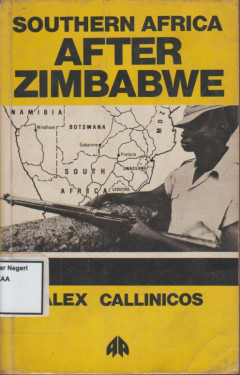
Southern Africa after Zimbabwe
Southern Africa after Zimbabwe examines the shifting political landscape in the region in the early 1980s following Zimbabwe’s independence in 1980. Alex Callinicos analyzes the effects of Zimbabwe’s liberation on neighboring countries and evaluates the broader regional struggle against colonialism, apartheid, and imperialism. The book provides insights into the dynamics of revolutionary mo…
- Edisi
- -
- ISBN/ISSN
- 0-86104-336-7
- Deskripsi Fisik
- 186 pages ; 20 cm
- Judul Seri
- -
- No. Panggil
- 968.910 CAL s
 Karya Umum
  Filsafat
  Agama
Agama  Ilmu-ilmu Sosial
  Bahasa
  Ilmu-ilmu Murni
  Ilmu-ilmu Terapan
  Kesenian, Hiburan, dan Olahraga
  Kesusastraan
  Geografi dan Sejarah